


War risk insurance in Ukraine
By Dominic Culverwell, Liliane Bivings
Editor’s note: The views and opinions expressed herein are those of the interviewee and do not necessarily represent the views and opinions of The Kyiv Independent, KPMG International Limited, or any KPMG member firm.
In the days leading up to Russia’s full-scale invasion of Ukraine, war risk insurance quotes began changing by the hour. Premiums surged. Coverage limits shrank. Some reinsurers quietly stopped taking exposure altogether.
When the invasion itself started, global insurance companies left the market. “In 2022, there was nothing,” says Olga Slyvynska, director of international relations at the Kyiv School of Economics.
What’s more, many global reinsurers — companies that insure insurers —grouped Ukraine, Russia, and Belarus together under war-peril exclusions, broadly limiting reinsurance capacity and capital available to Ukraine.
But as the war dragged on, it became clear that some form of coverage would have to return. By late 2023, limited and expensive local insurance began to reappear, covering selected war-related risks.
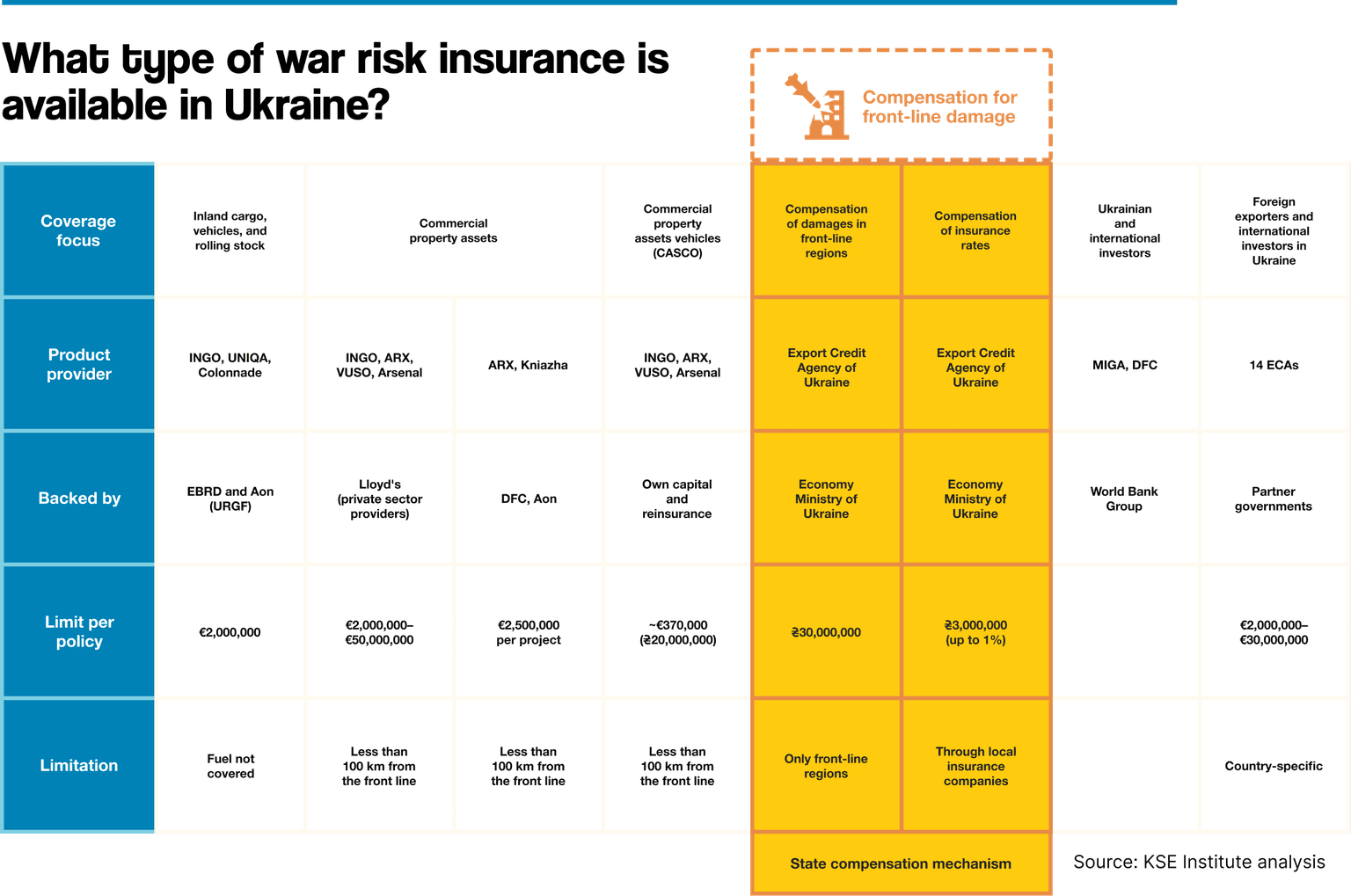
The U.S. Development Finance Corporation and the World Bank-backed Multilateral Investment Guarantee Agency followed — though access remains so difficult that only one Ukrainian company, Dragon Capital, has secured MIGA coverage so far.
Ukraine’s government and the local insurance market have since worked with global brokers and insurers to build reinsurance-style facilities. Over the following two years, several products emerged, including a facility launched by the European Bank for Reconstruction and Development together with Aon to cover inland cargo.
For foreign investors, political and financial risks are increasingly covered through export credit agencies. But operational risks on the ground are still covered by local Ukrainian insurers.
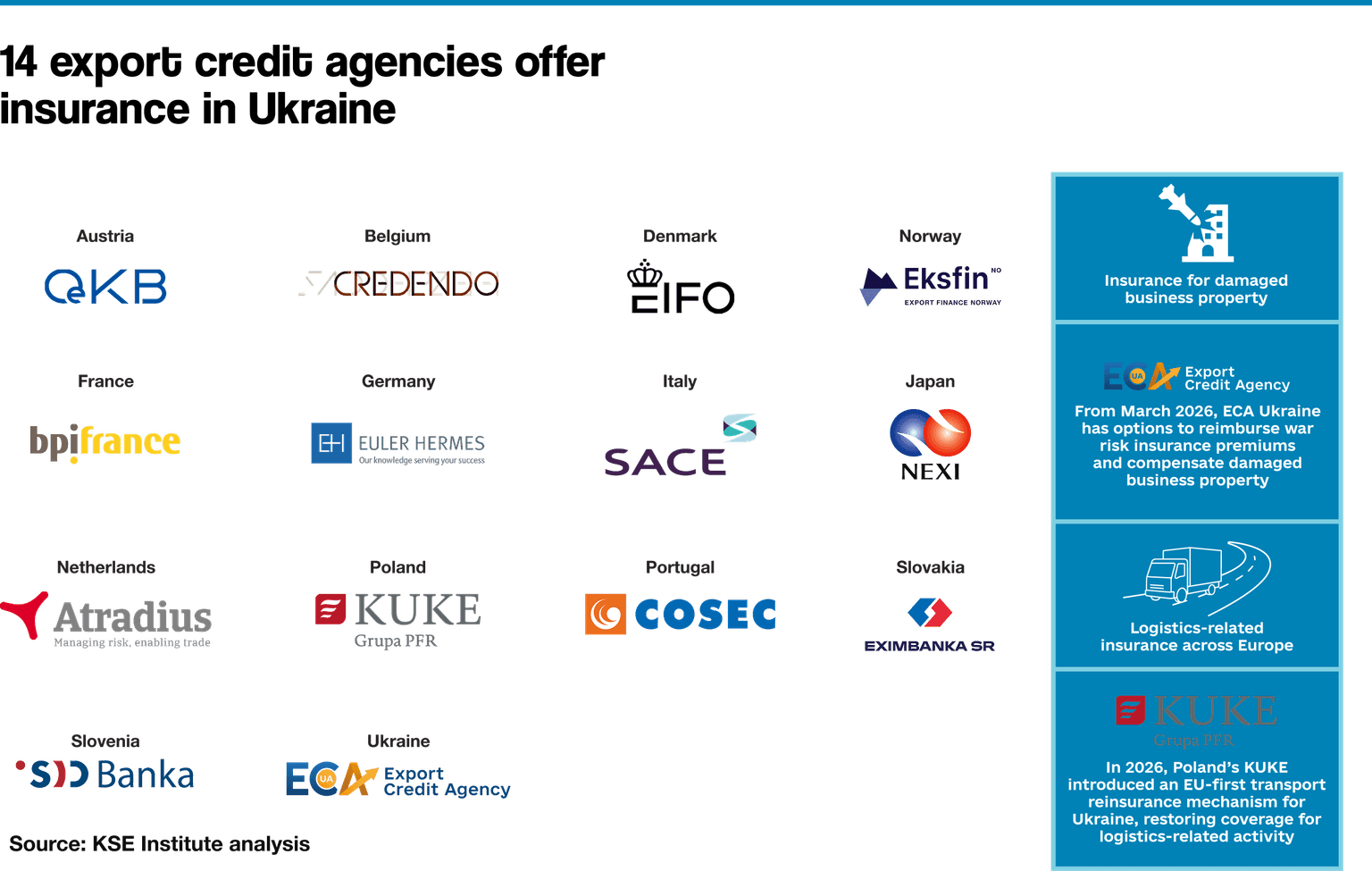
“Several national Export Credit Agencies are active in Ukraine, including the British UKEF, Euler Hermes on behalf of Germany, and the Polish KUKE, providing guarantees for trade and investment tied to companies from each nation and their partners,” says Oleg Goshchansky, head of the KPMG Ukraine Gateway initiative.
Fourteen countries’ export credit agencies now offer political and violence risk insurance — generally more available than war risk insurance — for doing business in Ukraine.
As of 2026, however, war-risk insurance in Ukraine still remains scarce, expensive, and patchy. For example, existing policies cover only real estate, vehicles, cargo, and life and health insurance. Critical infrastructure — like energy and defense facilities, frequent targets of Russian attacks — is effectively excluded from coverage altogether.
And even for assets that can be covered, geography matters. Companies can insure themselves against missile and drone strikes hundreds of kilometers from the front lines. But the farther east one goes, closer to the fighting, the higher the premiums, with some reaching as much as 12%, according to the Kyiv School of Economics. Get within 50–100 kilometers of the front line and insurance disappears.
But the outlook is clearer than at any point since the invasion began, according to Slyvynska, who works closely with Ukraine’s government on this topic. What was barely discussed in 2022 is now a fixture at international conferences, as insurers and governments develop new facilities. Senior insurance executives have also begun visiting Ukraine to assess expansion opportunities, Slyvynska says.
The task ahead is no longer inventing solutions but expanding them to unlock investment at scale. Extending coverage is now a question less of if than when, she says.
“This is where donor or public funds could play a role in reducing premiums or absorbing first-loss risks,” says Mark Fitzgerald, global head of KPMG’s international development assistance services practice. He cites Ukraine’s Unity shipping program backed by the Ukrainian government, which reduced wartime rates for vessels by sharing risk. However, Fitzgerald also says that absent such support, “war insurance isn’t just expensive, it can be economically untenable for investors.”
When scaling coverage, special attention should be paid to medium-sized projects that may “presently not be adequately covered,” says Yuriy Katser, partner and head of legal services at KPMG Law Ukraine. “It would therefore be advisable, with the involvement of international donors, to develop insurance specifically tailored to medium-sized projects.”
Whether the lack of war-risk insurance is a major barrier to investment remains an open question, as other concerns — namely the war itself and issues surrounding the rule of law — tend to top the list.
It’s an issue that can’t be brushed aside, however, intertwining with those other concerns. “Given so many unknowns, the question becomes one of political risk,” says Fitzgerald. “Unless we set the groundwork now and get a sense of what that medium- to longer-term outlook looks like, it’s very hard for insurers to adjust their models for either a full cessation and peace, or even some degree of stabilization and how durable any settlement might be.”
Local insurance can enable smoother business operations and the wider the coverage across Ukraine, the more investors can trust that solutions exist, and the more will come.
This fifth guide on investing in Ukraine was produced in collaboration with KPMG Ukraine Gateway and the Kyiv Independent.
Please note that, given high price volatility and an unstable security environment, exact pricing of different types of insurance cannot be reliably detailed.