Zelensky-Nawrocki feud fails to overshadow Ukraine’s biggest recovery conference yet
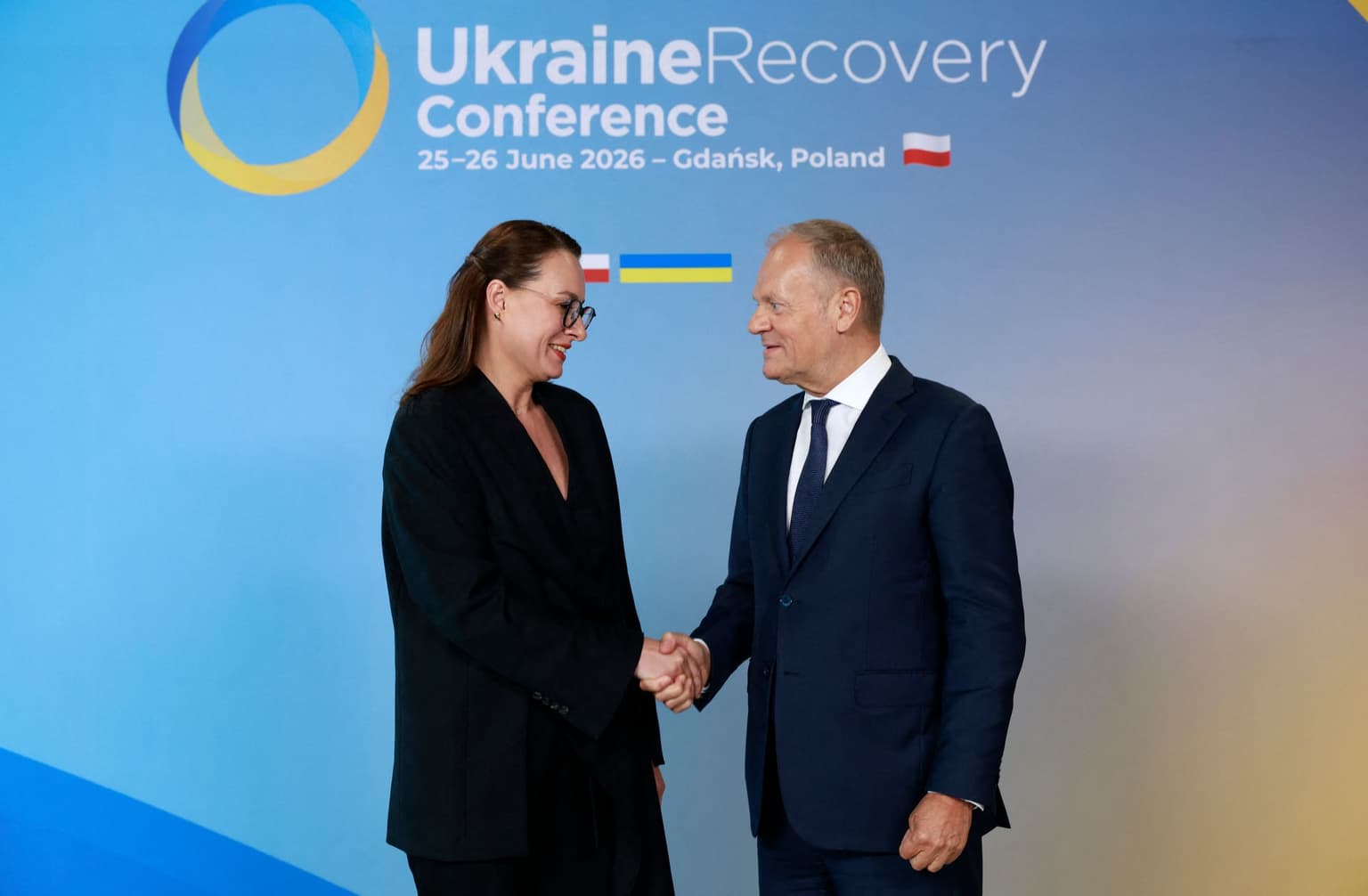
Polish Prime Minister Donald Tusk (R) shakes hands with Prime Minister Yulia Svyrydenko (R) at the Ukraine Recovery Conference (URC 2026) in Gdansk, Poland, on June 25, 2026. (Wojtek Radwanski / AFP / Getty Images)
 on Google
"See you at the Ukraine Recovery Conference (URC)" was the departing note after many meetings in Kyiv during the weeks leading up to Ukraine’s largest annual business and economics event.
From June 25–26, it felt like half of Ukraine had descended upon Gdansk on Poland’s Baltic coast as a record 7,500 officials, business leaders, entrepreneurs, economists, activists, and journalists envisioned the war-torn country’s economic revival. Last year's conference attracted between 5,000–6,000 people.
The notable absentee this year was President Volodymyr Zelensky, who declined the invitation amid a row with Polish President Karol Nawrocki, who wasn't invited to the conference.
But politics didn’t overshadow the event, with hundreds of Polish businesses attending the business fair and more than 15 agreements signed between Poland and Ukraine.
"This political tension created by the two presidents was not visible in Gdansk," Wojciech Kostrzewa, president of the Polish Business Roundtable, told the Kyiv Independent after the conference.
"The focus of all parties involved was really toward what should be done in order to do good business together and mobilize private capital and combine it with the public sector."
One of the standout Polish-Ukrainian agreements was in the defense tech sector, with Ukrainian startup Skyfall signing a memorandum of understanding with Polish state development bank Bank Gospodarstwa Krajowego to help access EU financing.
Meanwhile, in the energy sector, Ukraine’s Kovel Porto Industrial Park signed an agreement with Polish energy company Hanplast to build a solar power plant and energy storage system.
In total, there were around 160 agreements at the conference valued at more than $10 billion, including a $3.4 billion conditional agreement with the World Bank, Prime Minister Yuliia Svyrydenko said after the first day of the conference. That figure also includes a 3.2 billion euro ($3.6 billion) tranche from a previously agreed 90 billion euro ($103 billion) loan.
Three sectors dominated the conference, both in deals and discussions: energy, infrastructure, and Ukraine’s fastest-growing industry, defense tech.
At the same time, Ukraine’s government unveiled its 18 "Economy of the Future" flagship investment projects, which include a wind farm from energy firm DTEK and a graphite mine belonging to BGV.

"You can see this huge evolution of the URC from the first one to now. It’s become more and more pragmatic," Gennadiy Chyzhykov, president of the Ukrainian Chamber of Commerce and Industry, told the Kyiv Independent.
"It's the one place you can meet with businesses, European institutions, and banking and business organizations. More Ukrainian companies now understand how to use this opportunity."
The URC is always a slightly strange event, where smartly dressed attendees mingle over free drinks and endless food while Russia continues to bombard Ukraine. The panel discussions and evening parties feel a world away from the burned-out warehouses, factories, and power plants torn apart by Russian missiles and drones.
But this year showed that Europe and international institutions had a clearer understanding of where to direct their money in Ukraine, with more concrete pledges and proposals.
Ukraine, in turn, had something to offer Europe in the form of defense tech and knowledge of operating under wartime conditions as the world grows increasingly unstable.
Top deals
Ukraine’s embattled energy sector saw nearly $2 billion worth of agreements through 28 international agreements and 550 million euros ($628 million) in much-needed winter support, Energy Minister Denys Shmyhal wrote on Telegram.
Notably, state-run oil and gas giant Naftogaz secured $300 million from the U.S. Export-Import Bank for American-made equipment after Russian strikes obliterated its gas infrastructure last fall.
read also
The hottest new addition to the URC was Ukraine’s dual-use sector — products for both military and civilian use — which attracted agreements worth 343 million euros ($392 million) from EU partners.

The booming industry has seen a wave of foreign investment in recent months, and the new financing will help companies scale production as Ukraine turns the tables on the battlefield.
Meanwhile, Ukraine’s infrastructure projects attracted a 470-million-euro ($536 million) package to build health care facilities, affordable housing, support for small and medium-sized businesses, and develop public services via the European Investment Bank.
New investment frameworks were also brought to life. There was a big push from Kyiv for public-private partnerships (PPP) with a $5 billion portfolio featuring 30 projects covering transport, port, road, rail, water, and municipal infrastructure.
Private equity was another popular topic, building on last year’s U.S.-Ukraine Reconstruction Investment Fund — the product of the infamous minerals deal negotiations — which was the talk of the town at the previous URC.
This year, the EU launched a long-awaited reconstruction flagship fund with an initial capital injection of 220 million euros ($252 million) and a long-term goal of leveraging 7 billion euros ($8 billion) for critical areas of Ukraine’s recovery. The fund's managers, the Kyiv-based Dragon Capital and London-headquartered Amber Infrastructure Group, contributed $40 million in seed capital to the fund.
"Everyone's talking about private equity. Private equity used to be this bad word. But now we're all looking at it to bring in big capital into the country," Lena Koszarny, CEO of Ukrainian investment firm Horizon Capital, said during the conference.
The shift to public-private partnerships and private equity has helped mitigate the biggest concern at last year’s URC — war-risk insurance, which investors have repeatedly complained is either too limited or too expensive.
In a change from last year, international financial institutions announced multiple de-risking packages.
The largest was a record-breaking risk-sharing agreement valued at 825 million euros ($942 million) between the European Bank for Reconstruction and Development (EBRD) and Ukrainian state-owned bank Privatbank.

"I think we have almost figured out this war-risk insurance issue,” Oleksii Sobolev, Ukraine’s economy minister, told the Kyiv Independent during the closing press briefing.
He pointed to the U.S. International Development Finance Corporation (DFC), which inked a new de-risking framework with MIGA, the insurance arm of the World Bank, as a major step.
While details of the agreement are still being worked out, the partnership should, in theory, help lower the cost of insuring projects in Ukraine against attacks and political risks.
What’s next?
With more than 160 deals signed, Ukraine needs to make sure they are all followed through on and not just hot air, Chyzhykov believes.
Before the next URC in Tallinn next year, the government should assess what works, what doesn’t, and avoid attracting failing businesses, he added.
But for all the optimism this URC offered, it still didn’t fully answer how Ukraine can truly kick-start reconstruction while Russia continues the war.
Even with the current war-risk instruments, many investors continue to watch from the sidelines or cherry-pick safer projects while avoiding riskier ones that are more likely to be damaged or occupied by Russia.
Consequently, many Ukrainian companies are still cash-strapped and unable to take advantage of their full potential.
Even Naftogaz, which has secured multiple rounds of financing from large financial institutions, lacks the capital to drill new gas wells while simultaneously rebuilding damaged infrastructure, the chairman of the company’s supervisory board, Duncan Nightingale, said during the conference.
"There is some movement from people who believe that this is the right time. But the big wave of investment will come basically once the hot phase of the war is over, or at least once serious negotiations begin," Kostrzewa said.
"It’s still a little bit like a dry run or rehearsal because there is at the moment a limited number of projects that can be implemented in Ukraine."