‘Everything except nukes’: As the world watches Wildberries, Russia unleashes war on Ukraine’s economy
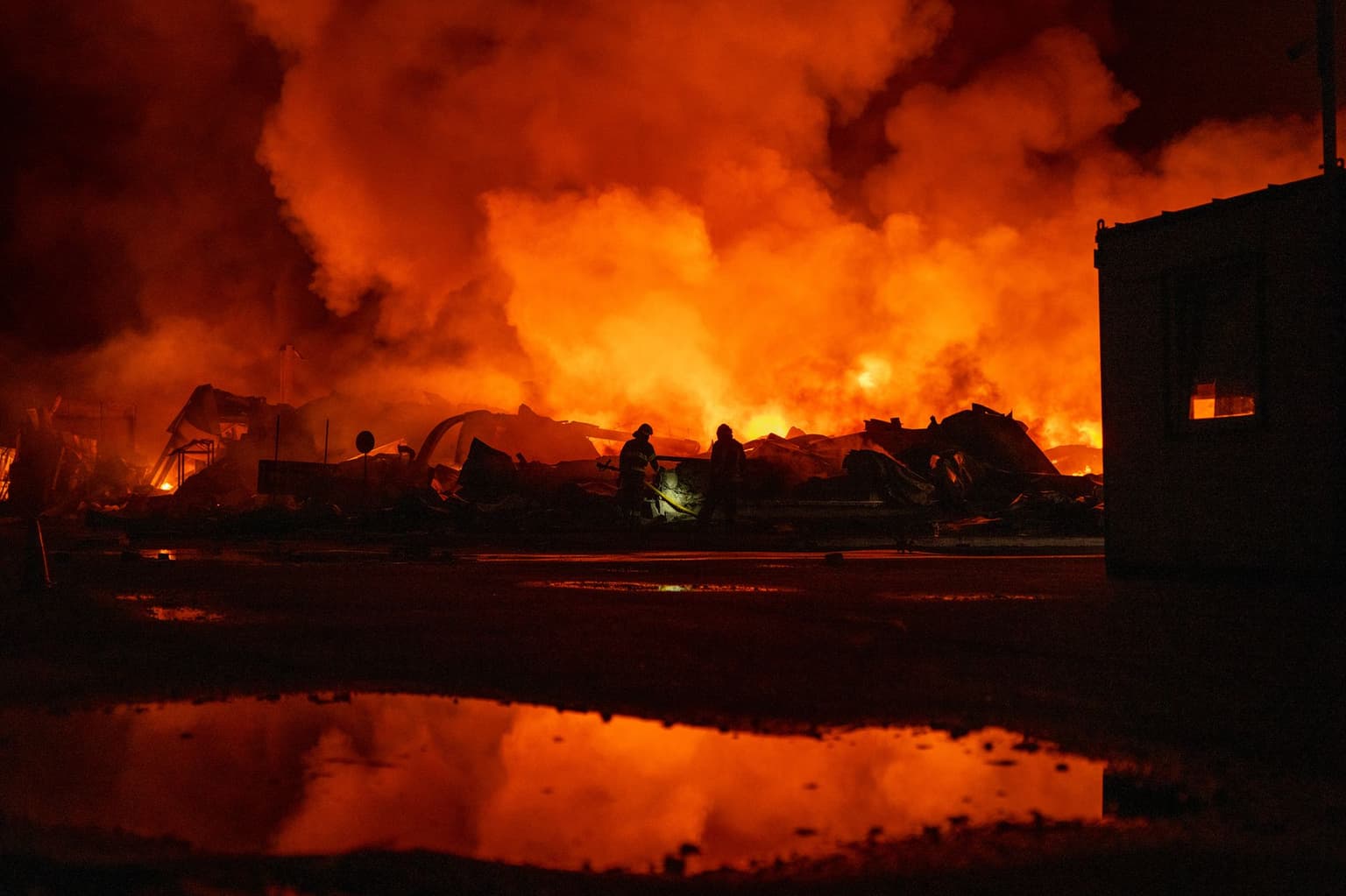
Firefighters put out a fire after Russian missiles hit a warehouse in Kyiv, Ukraine, on Aug. 5, 2026. (Dan Bashakov / AP)
 on Google
Walk through a supermarket in Kyiv, and you will find rows of empty shelves. Drive your car to a gas station in Kharkiv, and a Russian drone may have gotten there first. Across Ukraine, packages are at risk of being turned to ash as Russian missiles pummel post offices. Once bustling ports sit empty, as ships stay clear of Ukraine.
As Ukraine captures global attention with dramatic strikes on Russia’s oil infrastructure and e-commerce giants Wildberries and Ozon, Russia has unleashed its most devastating campaign yet against Ukraine’s economic infrastructure.
Over the last few months, Moscow’s relentless bombardment has torn apart postal services, supermarkets, factories, warehouses, gas stations, ports, civilian vessels, and railway infrastructure.
As a result, ships are no longer docking in Black Sea ports, slashing Ukraine’s exports. Retailers are laying off staff, mining companies have shut operations, and there are growing fuel shortages in southern and eastern regions.
The short- and long-term consequences look bleak, with the National Bank estimating it could cost Ukraine 0.9% of gross domestic product (GDP) this year.

"Russia is using more and more drones and missiles to hurt Ukraine’s economy, to make it weaker, and psychologically push the population towards peace talks," Oleksandra Betliy, leading research fellow at the Institute for Economic Research and Policy Consulting, told the Kyiv Independent.
And Russia currently has more drones and missiles than in previous years, meaning attacks are likely to continue, Betliy said.
"The Russians have no other answer but to escalate even further. They are utilizing everything they have except nukes," Bogdan Kostetskyi, an operating partner at consulting service Barva Invest that provides insights into how the war is impacting Ukraine’s agricultural trade, told the Kyiv Independent.
"It’s like a fight without rules. Unfortunately, this is the new normal," he added.
As blows intensify, Ukraine is desperately seeking ways to keep its economy afloat. While Kyiv’s strikes are alarming the Kremlin and inhibiting its war machine, Russia’s multi-trillion-dollar economy is unlikely to collapse any time soon, Konstantin Sonin, an exiled Russian economist and professor at the University of Chicago Harris School of Public Policy, told the Kyiv Independent.
Ukraine, with a much smaller and weaker economy, is reaching out to international partners for support, while expanding financial programs to support affected businesses. But many companies are still having to adapt to Russia’s attacks at their own expense.
Agents of chaos
Russia launched a record 389 missiles at Ukraine last month, taking advantage of Ukraine’s Patriot air defense shortage. For comparison, Russia fired 244 missiles in July 2025. In May this year, Moscow launched 8,150 drones, more than double the 4,003 drones launched in May last year.
The attacks are costing war-damaged cities. In Kyiv alone, which has suffered several major strikes and numerous smaller attacks over the summer, each ballistic missile strike costs the city Hr 300-500 million ($7-12 million) to repair shelters and homes, the head of the Kyiv City State Administration, Petro Panteleev, told Ukrainian media, Liga.
"They want to intimidate and wear down the population."
Roughly 20 gas stations were hit every week in July, NaftoRynok, a consulting firm, told the Kyiv Independent. Stations in front-line regions have reduced fuel in storage tanks, imposed refueling limits, and closed during air alerts, which can last hours at a time.
Moscow is also honing in on the nerve centers of critical businesses for maximum effect, like the warehouses and distribution centers of supermarkets rather than individual stores.
"We believe that, in the enemy’s view, this tactic is intended to destabilize the situation among the population and create a shortage of goods," the press service for Ukraine’s largest supermarket chain, ATB, told the Kyiv Independent in a written statement.

"They want to intimidate and wear down the population," it said
One of the most aggressive attacks on Ukrainian businesses took place overnight on Aug. 4-5 in Kyiv Oblast. Russia targeted the logistics center of supermarket firm Novus, two distribution centers belonging to Fozzy Group, another supermarket chain, a sorting center owned by leading private postal service Nova Post, and a distribution warehouse complex owned by Rozetka, Ukraine’s biggest online retailer.
For weeks after the attack, supermarkets across Kyiv were left with empty shelves and signs warning of delays — a rare sight in Ukraine where stores are usually packed with food. To avoid a future crisis, Novus stopped storing goods in one large unit, instead diversifying storage and sending two-thirds of "essential" products directly from factory to store, Krystyna Ivchenko, head of Novus’ external communications, told the Kyiv Independent in a written statement.
The chain is also campaigning for the government to introduce financial programs to help companies repair damages and better war risk insurance instruments.

Rozetka publicly said that the damages to its complex were irreparable — costing them 70 million euros ($81 million), destroying billions of hryvnias of goods, and forcing the company to lay off staff. Co-founder Iryna Chechotkina pleaded with the government to defer taxes, stressing that Rozetka won’t be able to recover without help.
Nova Post, the country’s largest private courier firm, has remained tight-lipped, not revealing the extent of the damage nor how much it has paid to compensate customers — unusual for a company that is normally communicative.
However, from open-source information, Russia has recently moved from targeting the company’s individual branches to much bigger logistics centers, hitting at least four sorting centers in June and at least seven in July.
"If you're hitting big distribution centers, you're destroying huge investments, and you destroy a big number of parcels, some of which might be dual-use. It makes logistics much slower and causes delays," Betliy said.
Ukraine’s steelmakers have also come under fire, with precise strikes on their production sites. On Aug. 11, Russian ballistic missiles destroyed blast furnace equipment at Metinvest’s steel plant in Zaporizhzhia, shutting the factory down. A few days later, another ballistic missile tore apart energy and blast furnace equipment at ArcelorMittal Kryvyi Rih’s factory on Aug. 16.
The attacks were a shock for many in the industry, which hasn’t suffered direct missile strikes since 2024. Some in the embattled sector are bracing for factories to be targeted more intensely the longer Ukraine doesn’t have adequate air defense.
Sinking trade
The attacks on gas stations, supermarkets, and postal services disrupt the general population, but are unlikely to have a significant knock-on effect for the economy at large as businesses are quickly adapting. Instead, the most devastating attacks are on Ukraine’s ports in the Black Sea, causing Ukraine’s biggest industries to hemorrhage cash.
In a bid to choke trade in the Black Sea, Russia struck ports 67 times and vessels 57 times last month. Despite Kyiv publicly backing a maritime truce, Moscow’s officials have shown no interest in de-escalation.
Unsurprisingly, vessels are avoiding the ports. When Russia began systematically targeting civilian vessels, the families of sailors begged shipping companies to stop sending vessels to Ukraine, Gennadiy Ivanov, director of shipping firm BPG, told the Kyiv Independent.

Grain exports collapsed in the first two weeks of August — the start of export season — with Ukraine only exporting 30% of its normal grain volumes, Agriculture Minister Taras Vysotsky told reporters on Aug. 14.
As a result, Ukraine could lose 10.8 billion euros ($12.6 billion) from blocked agri-exports, while food prices will jump globally — Vysotsky estimates by 30% — impacting countries in West Asia and Africa that rely on Ukrainian grain.
But richer EU nations will feel the cost too, particularly as European livestock farmers depend on millions of tons of Ukrainian corn annually for feed, Oleh Khomenko, CEO of the Ukrainian Agribusiness Club (UCAB), told the Kyiv Independent.
The situation is especially worse this year because of a corn deficit in Europe, with European farmers planning to increase corn imports by nearly 6 million tons, he said. Without Ukrainian corn, prices will increase across the board, leaving European livestock farmers to foot the bill, he said.
Ukrainian agribusinesses are looking at alternative routes, such as the Danube River ports, road, and railway to export goods. But these options can only handle half the volume of the Black Sea ports, and some products, like corn, require deep-water ports, which the Danube doesn’t have — particularly as water levels are at a record low due to summer heatwaves.
Even if Ukraine does manage to open up the Black Sea, cargo prices will be sky-high, Serhii Vovk, director of the Center for Transportation Strategies, a consulting firm in Kyiv, told the Kyiv Independent. Ukrainian goods risk losing their competitiveness on the global market as a result, he added.
Insurance prices for Ukraine’s Black Sea ports are around 10 times greater than before the summer, reaching levels last seen in 2023 after Moscow pulled out of the short-lived grain corridor that helped food exports bypass Russia’s naval blockade, said Ivanov.
For metallurgy companies, which rely on the Black Sea for exports to countries like China and Turkey, the blockade has forced factories to suspend work. Disruptions to coking coal imports, used to fuel blast furnaces, have slowed steel production, while iron ore exports are effectively at zero.
In total, metal exports dropped by 15% month over month in July. It’s another heavy blow for metallurgy companies after the EU imposed trade restrictions on steel products earlier this year, slashing revenues for Ukraine’s metallurgy sector — a major economic driver that accounted for over 5% of GDP last year.

Now, with railway tariffs increasing by 30% as a result of the blockade, exports have become economically unviable, the press service for Metinvest, Ukraine’s largest steel company, told the Kyiv Independent. The more the blockade drags on, the greater the risk of industrial shutdowns, tax losses, and economic instability, they added.
With the decline of its two main economic drivers — agriculture and metallurgy — Ukraine’s economy could slide next year if the blockade continues, said Betliy.
"If everything is just as bad as it looks now, then Ukraine’s GDP will probably not grow next year," she said.