The Kyiv Independent Live in London:

'Any format of Donbas under Russian control is unacceptable' — Ukraine hails 'real progress' but holds firm on territory after Berlin talks
 on Google


Editor's note: The story has been updated with the latest details.
Kyiv and Washington made "real progress" toward peace in Ukraine during two-day talks in Berlin, top security official and negotiator Rustem Umerov said on Dec. 15, even as other officials signal that a final agreement on territorial issues remains elusive.
The statement comes after a delegation led by President Volodymyr Zelensky held two rounds of discussions with U.S. envoys Steve Witkoff and Jared Kushner on a plan for ending the Russia-Ukraine war.
Zelensky later commented on the talks, providing his assessment of the negotiations and outlining Kyiv’s priorities.
He acknowledged that while the Washington is pushing for a rapid end to the war, Kyiv is more focused on ensuring the quality of any agreement.
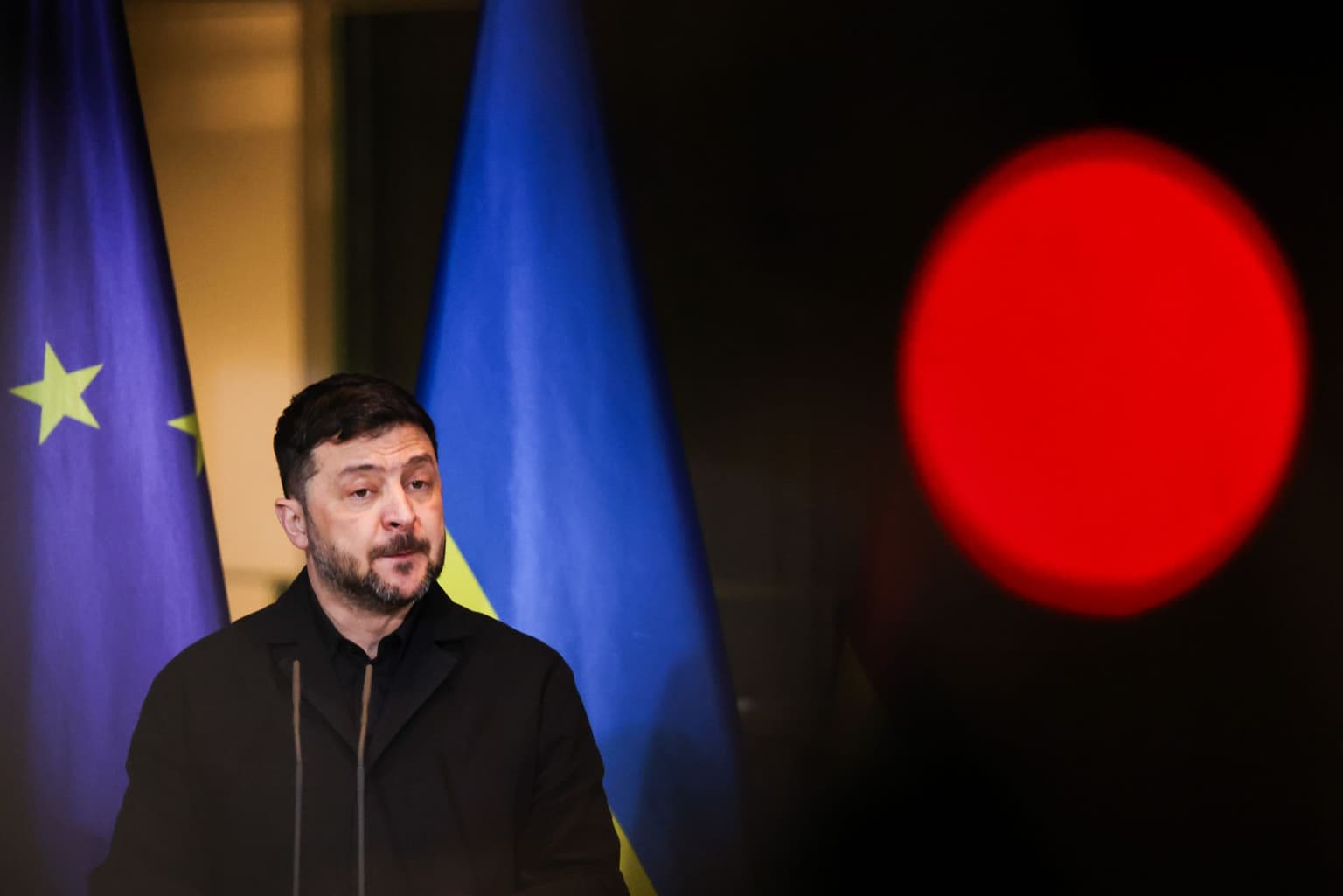
"The path is definitely not easy, because the war is complicated," Zelensky told reporters on. "The Americans want a quick end. For us, quality is important in this speed. If speed and quality coincide, we support that fully."
The president also reiterated that Kyiv will not accept any arrangement that places Donbas under Russian control.
"Any format of Donbas under Russian control is unacceptable to me," Zelensky said. "Neither de jure nor de facto will we recognize Donbas as Russian."
Speaking beside German Chancellor Friedrich Merz at the German-Ukrainian Economic Forum, Zelensky said the talks were "not easy" but "productive."
U.S. officials were optimistic, saying that "90%" of the issues have been resolved, while U.S. President Donald Trump is said to be "pleased" with the progress achieved in Berlin, the Guardian reported.
Talks focused on discussions about NATO-like security guarantees for Ukraine, while some topics regarding territory and sovereignty still need refinement, according to the outlet.
According to an undisclosed source quoted by AFP, the two parties did not reach an agreement on territorial issues, as the U.S. continues to push Kyiv to cede the entire Donetsk and Luhansk oblasts to Russia.
Ukraine's First Deputy Foreign Minister Sergiy Kyslytsya warned against "mischaracterizing" Washington's approach and said the U.S. "remains fully engaged in the peace process."
"Every team listens carefully to each other. The Ukrainian position is very clear. The anonymous sources aren't correct," he said.
Nevertheless, Zelensky signaled during a press briefing later in the day that territorial questions remain unresolved, stressing the need for clear security guarantees.
"It seems to me that we still have different positions" on territorial issues, Zelensky said after the talks with the U.S. side. "But everyone is ready to work productively to find solutions... which will bring the real end of the war closer."
Zelensky confirmed that Kyiv seeks "Article 5-like" security guarantees and said there has been "progress" in this area. He said the guarantees under discussion would not rely on a single actor but on a broad alliance of partners.
"If earlier in our dialogues there were doubts from some partners about the effectiveness of a 'coalition of the willing,' today we are discussing that security guarantees must come from Europe — the coalition of willing European countries — and Canada and other partners — plus American security guarantees," he said.
The president also dismissed claims that Ukraine is being pressured by the U.S., explaining that the pressure comes from Moscow, and Washington acts as a mediator.
Merz, in turn, said there appears to be a real chance for peace thanks to an unprecedented diplomatic effort, and lauded U.S. proposals for "legal and material" security guarantees.
Citing undisclosed U.S. officials, Politico reported that Washington is ready to offer "Article 5-like" guarantees to Kyiv as part of a peace deal, with the warning that such "guarantees will not be on the table forever."
Umerov, the secretary of Ukraine's National Security and Defense Council, expressed hope for "an agreement that will bring us closer to peace by the end of the day."
However, Umerov's press secretary later clarified that no specific agreement is expected today, saying the two sides simply hope to align their positions by the end of the day.
The first round of talks on Dec. 14 lasted about five hours, while the subsequent one took under two hours.
Russia is reportedly expected to be briefed on the outcomes by the U.S. later today.
The negotiations are part of renewed diplomatic efforts that followed Washington's backing of a 28-point peace plan, which would impose punishing conditions on Ukraine. The proposal was subsequently reduced to 20 points following consultations with Ukrainian and European representatives.
Zelensky also said discussions covered postwar recovery and the use of frozen Russian assets as part of Ukraine’s security framework, including long-term reconstruction funding.
He said the assets, estimated at $150–200 billion, would function as a financial guarantee regardless of whether the war ends soon or continues. "This is a game changer," Zelensky said, arguing that the funds would provide Ukraine with $40–45 billion annually.
"If there is no war — God willing that it ends — then we will use the appropriate tranches to rebuild Ukraine," he said. "Imagine — no war and $45 billion per year. That would be a serious contribution to Ukraine’s macrofinancial stability and recovery."
He added that the talks also covered the restoration of critical infrastructure, including energy systems, schools, and universities.
Zelensky then said that millions of Ukrainians who lost their homes must be a central focus of recovery planning.
"Today, for the first time, I raised an issue that I consider extremely important: internally displaced persons who lost their homes."
He also addressed compensation for families of fallen soldiers, referring to them as Heroes and acknowledging the strain on the state budget. "Any soldier who died in the war is a Hero for us," he said, adding that while supporting their families is a moral obligation, "it is very difficult for us to bear this financial responsibility."
Speaking ahead of the meeting in Berlin, Zelensky pushed back against a U.S.-backed idea for Ukrainian troops to withdraw from a proposed "demilitarized zone" in the partially Russian-occupied Donbas region.
Facing U.S. pressure to make territorial concessions in eastern regions, Zelensky said that such issues should be decided by the Ukrainian people, possibly through a referendum.
Zelensky also emphasized that any peace deal must be underpinned by ironclad security guarantees, similar to those outlined in NATO's Article 5, even as the U.S. and other allies oppose Ukraine's full membership in the alliance.
Kremlin spokesperson Dmitry Peskov said a ban on Ukraine's entry into NATO remains a "cornerstone" of its demands in a potential peace deal.
A recent poll showed that about 75% of Ukrainians would reject a peace agreement that would be absent of security guarantees and include a Ukrainian withdrawal from Donbas.
As part of his visit to Berlin, Zelensky also met German President Frank-Walter Steinmeier at the presidential residence in Bellevue Palace and held talks with Julia Klockner, the president of Germany's Bundestag.
"I briefed the President (Steinmeier) on our work with the United States aimed at achieving a dignified peace, reliable security guarantees, and economic recovery," Zelensky said on X.
Later in the evening, Zelensky and Merz will discuss the peace efforts with the leaders of France, the U.K., Italy, Poland, and top EU and NATO officials, alongside Kushner and Witkoff.
Trump has previously expressed frustration with Zelensky as Ukraine and its European allies have pushed back against Washington's initial 28-point peace plan, which mirrors some of Moscow's maximalist demands.
Kyiv and its European partners drafted a revised proposal and submitted it to Washington last week, although the U.S. has not yet officially responded to it.
The Kremlin has already said that any revisions by Ukraine and Europe are unlikely to be constructive and will likely be met with "sharp objections" from Russia.
Prior to the second round of talks, Zelensky met his Finnish counterpart, Alexander Stubb, who unexpectedly arrived in Berlin and reportedly also met Witkoff and Kushner.
Stubb has frequently participated in peace talks regarding Ukraine, partly due to his close contacts with Trump.