Territorial concessions by Ukraine won't bring peace, Zelensky says in Munich
 on Google
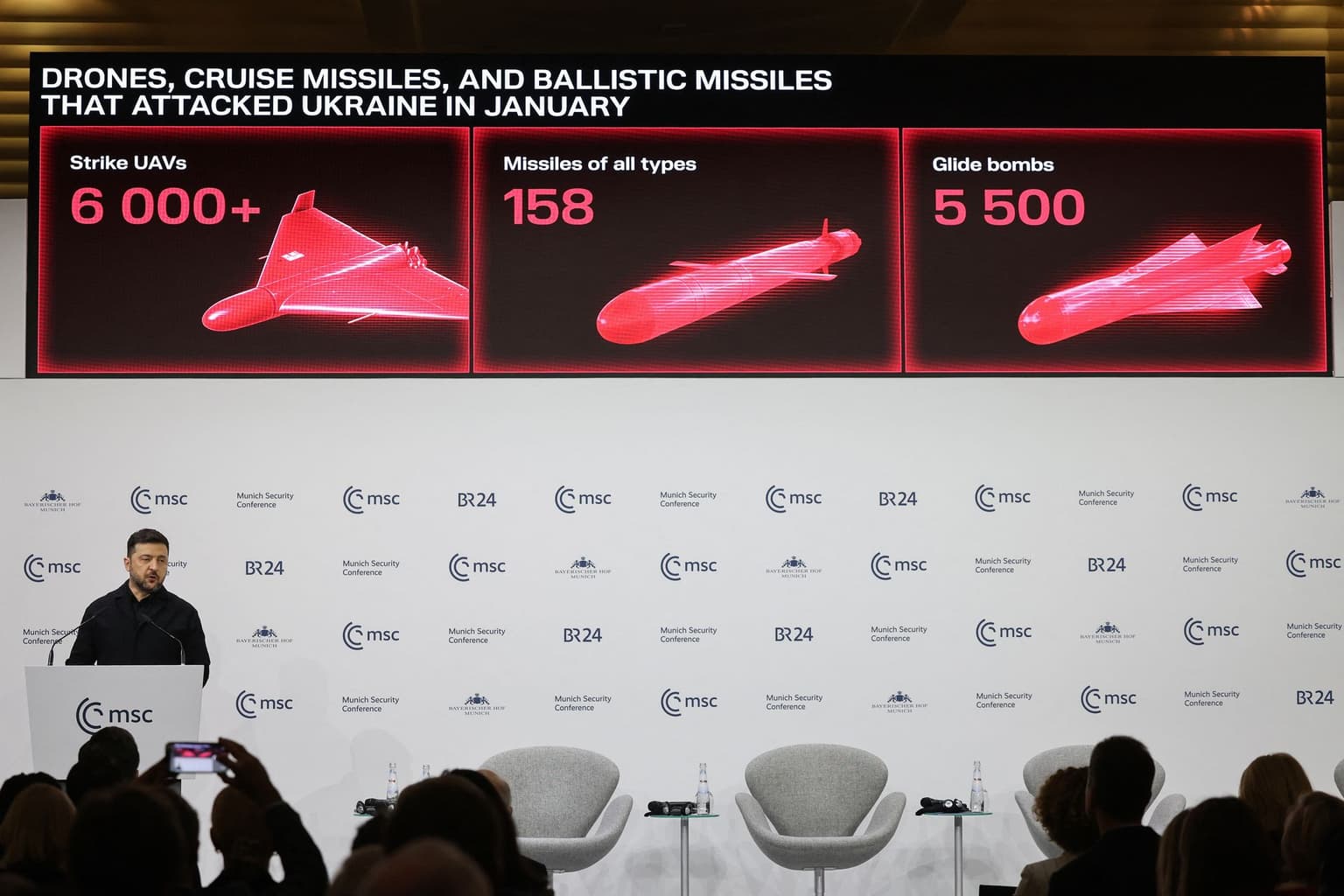
President Volodymyr Zelensky said on Feb. 14 that territorial concessions by Ukraine would not bring peace, just as the 1938 Munich Agreement did not prevent World War II.
"It would be an illusion to believe that this war can now be reliably ended by dividing Ukraine — just as it was an illusion to believe that sacrificing Czechoslovakia would save Europe from a greater war," Zelensky said at the Munich Security Conference.
The Munich Agreement was a compromise reached by Nazi Germany, the U.K., France, and Italy in 1938, allowing German dictator Adolf Hitler to annex Czechoslovakia's Sudetenland region. The agreement was touted as an effort to prevent a war but did not achieve its goal, with Germany invading Poland the following year.
It has since become the primary historical example of the failures of appeasement — the policy of granting concessions to an aggressor in hopes of achieving peace.
In his speech, Zelensky compared Russian President Vladimir Putin to the "previous Putin, who began dividing Europe" — a reference to Hitler.
As part of the ongoing peace talks between Moscow, Kyiv and Washington, Russia is demanding Ukraine's withdrawal from the parts of Donetsk Oblast that it still controls.
Zelensky has repeatedly stated that territorial concessions are unacceptable to Ukraine. He reiterated on Feb. 14 that concessions are often discussed during peace talks only in the context of Ukraine, not Russia.
Regarding elections, Zelensky said that Ukraine can make changes to its constitution and hold elections if there is a ceasefire. He added that Ukraine could also agree to a truce if Russia holds an election.
He also stressed that Ukraine will do "truly everything" to make these negotiations successful.
"Ukraine wants the result of all these efforts to be real security and real peace. Real peace. Not what came out of Geneva in 2021. Not what the Russians hope for, from this so-called spirit of Anchorage."
Zelensky's comments are a reference to Russian-U.S. talks held in Geneva in 2021 and in Anchorage, Alaska, in 2025.
Zelensky also argued that the absence of Europe at the negotiation table is a "big mistake."
"And it is we — Ukrainians — who are trying to bring Europe fully into the process, so that Europe's interests and voice are taken into account," he added.
In later remarks to journalists, Zelensky said that the U.S. had offered Ukraine a 15-year security guarantee as part of a peace deal, but that Kyiv is looking for guarantees that last at least 20 years.
"Today we have a proposal from the American side for 15 years," he said at a briefing.
We want to have 20 years plus. 30, 50 ... We'll see what the administration and Congress will do."
Following the briefing, Zelensky held private talks with U.S. Secretary of State Marco Rubio.

Estonian Foreign Minister Margus Tsahkna told the Kyiv Independent that Zelensky's message was "very clear".
"The first thing is that the Ukrainian people are fighting and not giving in. This is most important. And second, that Putin is not changing the goal," Tsahkna said.
Tsahkna added that the Ukrainian people are willing to stop the war, but not under any conditions, as "Putin is actually not willing to change the goals."
"Putin will continue the aggressive behavior, and Ukraine is protecting Europe," he said. "And the other way around, Ukraine is an opportunity for Europe."
NATO Secretary General Mark Rutte said at the conference that Russia does not seek a peace agreement, as indicated by the appointment of Vladimir Madinsky, a controversial Putin aide and historian, to the Russian negotiating team.
The return of Medinsky signals a potential hardening of Moscow's stance during the negotiations, given his history of uncompromising rhetoric in previous rounds of talks.
During the conference, Zelensky also met Rutte to discuss the funding of the PURL initiative and its further development.
Signed by the U.S. and NATO in July 2025, the Prioritized Ukraine Requirements List (PURL) agreement lays out a mechanism for NATO member states and partners to purchase high-priority equipment for Ukraine.
"We are counting on continued funding for this initiative, which enables us to purchase missiles for air defense systems," Zelenky wrote on X.
Zelensky also thanked for a "highly productive meeting" in the Ramstein format. After the meeting, the allocation of €38 billion in military aid for Ukraine was confirmed, Zelensky said.