Why Putin's Victory Day cult is failing Russia's war veterans
A small and carefully selected group of veterans is promoted into public roles. The others are expendable.
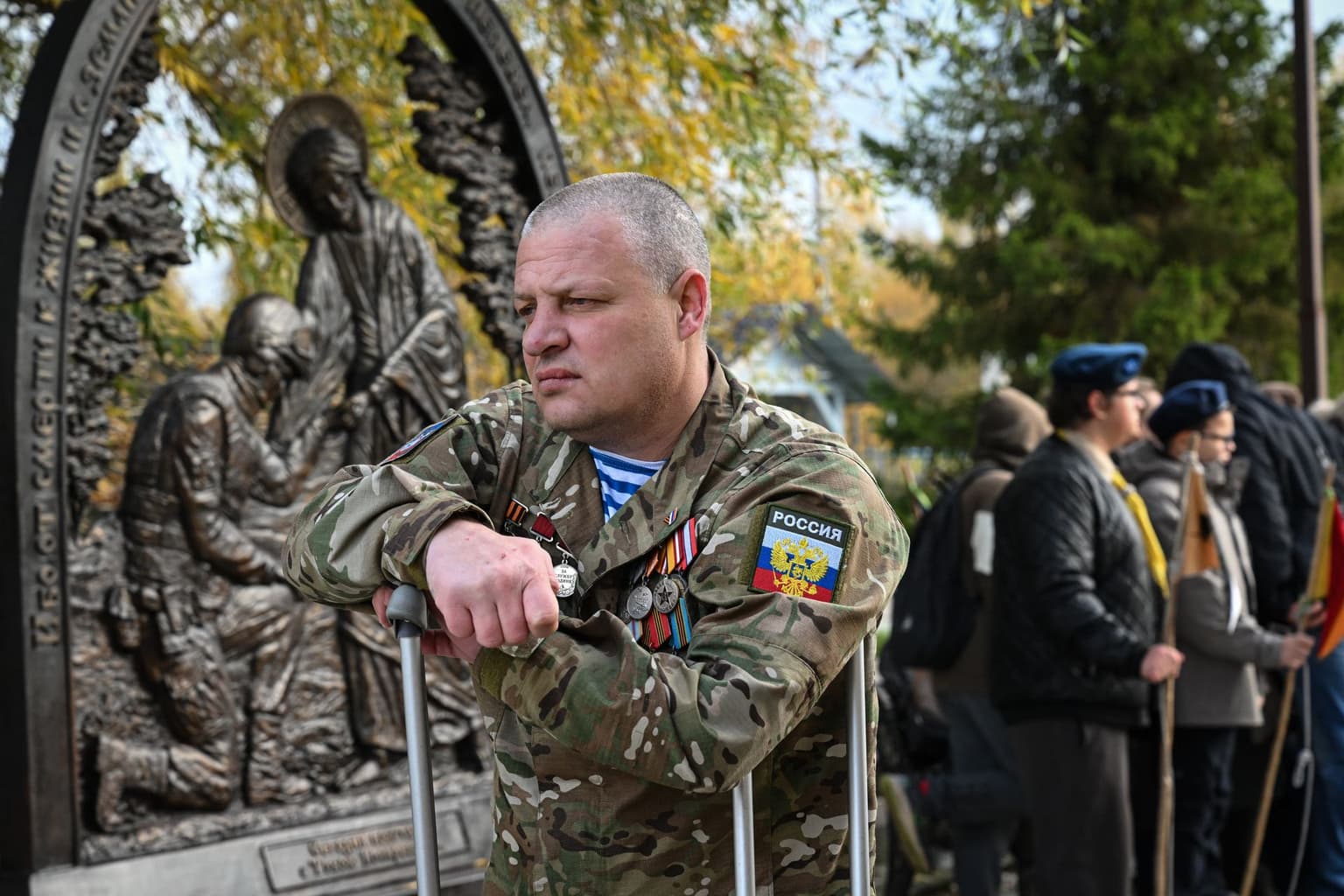
A veteran of the Russian invasion of Ukraine attends the ceremony on the territory of St. George's Church in the Moscow region, Russia, on Oct. 12, 2025. (Olesya Kurpyayeva / AFP / Getty Images)
 on Google
Russia will celebrate Victory Day on May 9 — the most sacred date in its political calendar and the centerpiece of a state-built cult of war.
Over more than two decades of Russian President Vladimir Putin’s rule, the Soviet memory of World War II has moved far beyond commemoration, with its complexities and crimes erased in favor of a simplified, heroic narrative that has also been weaponized — the Kremlin has used the language of World War II to frame its enemies, above all Ukraine, as "Nazis," turning history into a justification for aggression.
Russia, in turn, has used this logic to elevate its WWII veterans into unquestioned symbols of unity, sacrifice, and national greatness. Now, Putin is trying to do the same with veterans of the war against Ukraine — and so far, it is failing.
These new veterans do not fit into a clear or unifying story. Officially, they are presented as a "new elite" from the trenches, as Putin calls them. State media praises them, and the government has launched programs to move them into politics.
But outside this narrative, the picture looks very different.
Many veterans struggle to return to civilian life. Of the roughly 137,000 soldiers who had returned home, only 57% had found employment by mid-2025, according to official data.
In society, they are often seen not as heroes, but as dangerous or unfairly privileged people who profited from the war and, in some cases, act with a sense of impunity.

Indeed, crimes involving veterans are rising. Novaya Gazeta Europe identified around 8,000 convictions since 2022, including 7,000 cases tied to veterans who had returned to civilian life.
At the same time, the state does not give them real influence. Despite official rhetoric, veterans are largely kept out of real politics, seen either as a potential risk or as people who simply do not fit into the system.
Mass elimination
The Russian state's approach to war veterans follows two main directions, according to Russian political analyst in exile Ivan Preobrazhensky: mass elimination of those who are not needed and the "nationalization" of those who remain.
To understand this, it is important to look at who is actually fighting in Russia's war against Ukraine and why.
"Most of the Russian army is, in effect, mercenaries — people fighting for money rather than ideology. In many cases, it turns into a family economic project, where relatives encourage them to go and earn money," Preobrazhensky said.
Recruits often include people with economic struggles, debts, and criminal records. Even death is financially rationalized: Families receive significant compensation, giving rise to the phenomenon of "black widows" — Russian women who enter sham marriages with soldiers in order to claim state compensation if the soldiers die.
The state treats these soldiers as expendable, and it is visible on the battlefield itself.
According to CSIS's recent estimates, Russia has suffered the highest military losses of any major power since World War II, with casualties significantly exceeding those of Ukraine.

Those who survive are encouraged to remain on the periphery or occupied Ukrainian territories, where homes taken from displaced or killed Ukrainians are reassigned to Russians, including soldiers and veterans, as part of a broader settlement policy.
"Given their willingness and ability to use weapons, they can be far more dangerous to the authorities than any conventional anti-war liberal opposition, which is why they are kept in occupied territories, dead or alive," Preobrazhensky said.
"Those who survive are offered housing and incentives to stay in occupied territories long-term. The idea is to keep them out of internationally recognized Russia. In occupied territories, with their blurred legal status, they are easier to control," he added.
In December 2025, about 5,000 apartments had been taken in Mariupol, Donetsk Oblast, with the number growing by 100 to 200 per week, Petro Andriushchenko, head of the Center for the Study of the Occupation, told the Kyiv Independent.
In total, nearly 25,000 properties had been labeled "ownerless" as of October 2025, according to Le Figaro.
Time of heroes
At the same time, there is a second approach — one that shapes the official narrative.
A small and carefully selected group of veterans is promoted into public roles. These individuals are meant to embody the idea of a "new elite" and to show that fighting in the war can lead to recognition and political opportunities.
The centerpiece of this effort is the Kremlin-backed "Time of Heroes" program, led by Sergei Kiriyenko, a senior Kremlin official. It’s presented as a way for veterans to enter politics, offering training and access to state jobs.

Participants typically fall into two broad categories: those with no prior experience in public service, and those who were already part of the system and went to the front to strengthen their credentials.
This creates an image of upward mobility tied to the war, with Putin at the top — and perhaps the only one who truly benefits from it.
"I don't believe in any real promotion of veterans into politics. From what I see, these are personal fantasies of the president, which the system sabotages as much as it can," Russian political scientist Ekaterina Schulmann, a scholar at the Carnegie Russia Eurasia Center in Berlin, told the Kyiv Independent.
Why Putin needs a 'new elite'
The answer lies in how power works in modern Russia.
As Schulmann explains, Russia is a highly personalized autocracy where loyalty is the main currency of power, in the absence of real elections or the rule of law. By promoting the idea that war veterans could replace current officials, Putin signals to the elite that their positions are replaceable. And the threat itself keeps them in line.
"Also, Putin sees himself as a good wartime leader and believes the war is broadly supported by Russian society, as he was told by the people around him," Schulmann added.
"Putin needs loyal people he has lifted from the bottom into positions of power."
Preobrazhensky believes that the deeper goal is to bind the elite to the war.
"The goal is to ensure that the entire ruling elite is implicated in the war to the same extent as Putin, making it impossible to step back or later claim they never supported it," he said.
This logic extends to big businesses, too. In March, Putin urged Russian oligarchs in a closed-door meeting to voluntarily contribute funds to the war. According to a report in the Financial Times, billionaire Suleiman Kerimov pledged around 100 billion rubles (about $1.3 billion).
Bound by blood
Despite the artificial nature of these career pathways, there are real cases of war veterans being integrated into the system through the "Time of Heroes" program, including those linked to war crimes.
Russian outlet Agentstvo identified among them Nursultan Mussagaleev, an officer accused by Ukraine of involvement in the torture and killing of civilians in Bucha in 2022.
He was awarded the title of "Hero of Russia." But, according to Ukraine`s Security Service, his role in the war included ordering the abduction, torture, and killing of a 29-year-old civilian. He was later appointed deputy minister in Orenburg Oblast in 2025.
Ivan Preobrazhensky describes this as what in criminal terms would be called being "bound by blood."
"Putin needs loyal people he has lifted from the bottom into positions of power. He himself is wanted over the mass abduction of Ukrainian children — in that sense, he is no different from them," he said.
The trick is that these veterans are often placed in symbolic roles, such as advisers, regional deputies, or presidential envoys, without real authority.
One of the highest-ranking examples is Artyom Zhoga, appointed as a presidential envoy in the Urals. Similar posts are held by Yury Trutnev and Vladimir Ustinov — but their influence depends on personal power, not the position itself.
"In this role, you have no administrative body, no sizable budget. You can’t fire or hire anyone except your own scanty apparatus. You simply represent the president," Schulmann said.
Imitation
Another, more common approach works in the opposite direction. Members of the existing elite briefly go to the front, spend time in rear units or training camps, and then return with a formal "veteran" status that strengthens their careers.
According to Schulmann, this creates the appearance of a growing class of war participants within the elite, without actually changing who holds power.

In reality, however, the shift is slow. An analysis by Novaya Gazeta Europe found that only about 1.5% of candidates in the 2025 elections had participated in the war.
Schulmann said that Russia's ruling class has little interest in sharing power.
"Its priority is to preserve its positions and resources, and, if possible, pass them on to its children. They do not want any newcomers. Unable to oppose the president directly, they imitate," she said.
Ordinary Russians
For much of Russian society, the war is not a moral or ideological question, but a transactional one — about who pays, who benefits, and whether that balance feels fair.
That logic shapes how veterans themselves are viewed. They are often seen not as defenders, but as people who received what they signed up for.
"Many Russians look at them as people who have taken on dangerous, high-paying work — something that deserves compensation. It’s seen as fair. But benefits or privileges? No, because they got what they went for, and the job is done," Schulmann said.
"This is the newest Russian way of saying 'We did not send them there.'"
In everyday life, this turns into treating them as a source of money to be exploited.
"Reports from regions like Buryatia describe taxi drivers at Ulan-Ude airport deliberately targeting men in military uniform and overcharging them for rides. They are seen as a 'Bag of money,'" research scientist and Buryat activist Maria Vyushkova told the Kyiv Independent.
That sense of unfairness resonates most with the broader Russian society.
"During my time at the Free Buryatia Foundation, we relied on these sentiments because anti-war appeals based on moral arguments had little resonance with the broader public," Vyushkova said.

This perception exists alongside an official narrative of "war heroes" and "new elite," carefully tailored for those connected to the war, that gives a sense of their sacrifices. The Kremlin effectively works with different audiences.
“There is a split between a minority that openly opposes the war and a group of the Kremlin and pro-war supporters. Both compete for the rest of society, which largely remains passive. They do not oppose the war and therefore indirectly support it," Preobrazhensky said.
New economic class
Preobrazhensky believes that the war is reshaping society in more material ways.
It has created a new group — people who earned money through the war and moved up from the poorest layers of society, forming a kind of privileged class with access to payments, benefits, and sometimes status not available to others.
"Still, these programs will not lead to a serious split — there simply isn't enough money," Preobrazhensky said, adding that financial limits will gradually reduce such support.
Indeed, in May, officials in Leningrad Oblast acknowledged a budget shortfall of nearly 8.5 billion rubles (about $113 million), most of which was needed to cover payments to contract soldiers.
"The war will not remain a stable source of income for all the veterans who survive the war, as some may expect," Preobrazhensky said.
Author's note:
Hi, this is Tania, the author of this article, thanks for reading!
At the Kyiv Independent, we keep our reporting free and accessible to everyone. If you value this kind of coverage, please consider supporting our work by becoming a member.