What happens after Russia's abducted children finally return to Ukraine?
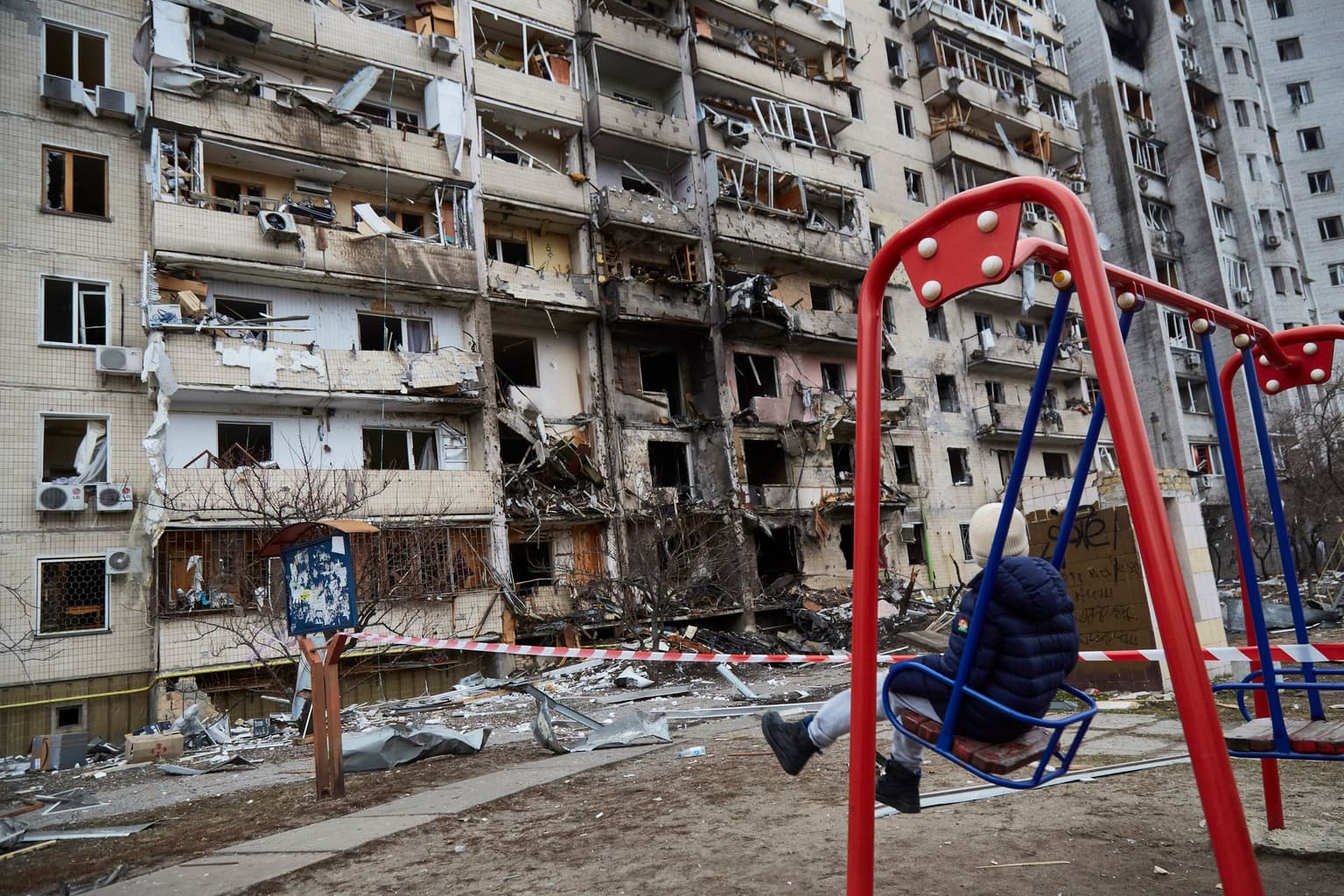
A child sits on a swing in front of a residential building damaged by a missile strike in Kyiv, Ukraine, on Feb. 25, 2022. (Pierre Crom/Getty Images)
 on Google
Iryna Tuliakova
Head of Ukraine's Coordination Center for Family Upbringing and Child Care Development
One of the most grievous crimes Russians have committed during their full-scale war against Ukraine strikes at the most vulnerable part of society — children, who have become Russian assets, stripped of their home, their family, their language, and the life they once knew.
The emotions you feel when you see them — each of the now 2,100 who have returned — are nearly impossible to put into words. You see a child who has lived through a harrowing experience and is now trying to rebuild their life from the ground up. It is an extraordinarily long process, and their return is, unfortunately, only the beginning.
As Ukraine continues its efforts under the Presidential initiative Bring Kids Back UA to return children unlawfully abducted by Russia, there are so many complex questions we have to find an answer to: what happens next? Or what determines whether a child can truly rebuild their life?
Returning alone is not enough. Reintegration is one of the most complex stages of this process. Children return with very different experiences — from prolonged isolation and disrupted education to the absence of access to basic services. Many have lost continuity in learning, have unmet health needs, and require time to readapt to a different social and educational environment.
At the same time, the Ukrainian state receiving these children is still catching up to the scale of what they need. Communities remain under the constant weight of war, their social services are unevenly developed, and, as of now, there is still a need to improve cross-system coordination.
Today, reintegration for these children occurs across several stages.

After returning to Ukraine, a child enters a defined response system, where a multidisciplinary team of social workers, psychologists, and child protection specialists makes initial decisions quickly and carefully, taking the child's condition into account.
When a child returns, the team immediately places them in a safe environment and provides basic support: food, clothing, hygiene items, medical care, and initial contact with mental health professionals. From the first moment, the focus is on physical comfort and restoring a sense of safety.
Simultaneously, a multidisciplinary team — lawyers, social workers, NGO specialists, crisis managers, and case managers — follows the steps critical to reintegration. They document the return, assess the security situation, and begin restoring or issuing any missing documents. These actions form the foundation for everything that follows and unlock access to state support.
Here's a case that illustrates how this works in practice.
Russian authorities forcibly took a group of children from a residential school in Mykolaiv Oblast to temporarily occupied territories, then through Crimea to a sanatorium in Anapa, Russia.
With no documents and no legal guardianship, their caregiver, backed by an NGO, arranged evacuation to Georgia. Ukrainian authorities then secured the children's return home, providing documentation, medical care, education, and family-based placement.
Crucially, no child moves through this process alone. Specialists engage from the moment of return and maintain continuity throughout, so children are never forced to retell their experiences from scratch to a new set of strangers. The Coordination Center for Family Upbringing and Child Care Development oversees the entire process, ensuring alignment among state authorities, local governments, civil society organizations, and international partners.
Once a child stabilizes, an interagency team conducts a comprehensive needs assessment covering every dimension of their life: health, psychological and emotional condition, the experience of deportation or occupation, education level, family situation, and risks to their future.
From this, professionals build an individual support and reintegration plan — specifying where the child will live, which services they will receive, which authorities are responsible, and in what order.
This is the logic behind Ukraine's coordinated, case-based reintegration model.
Uniform approaches cannot meet individual needs; thus, we aim to develop tailored plans. The team revisits and adjusts each plan as circumstances change, and every child has a dedicated case manager who coordinates the whole process, explains decisions to the child and family, connects them to relevant services, and monitors progress.
Wherever possible, children are reunified with biological parents or relatives. When that is not possible, the system arranges alternative family-based care, including foster families.
Because the war has stretched on for so long, support extends to young people up to age 23 — many who were children during the occupation have returned as adults and still need help accessing education, housing, and employment.
Housing comes first: temporary accommodation, a foster family, or supported housing for older youth ready for greater independence.
Education is the next move, where we guarantee fast-tracked admission, state funding, and preparatory courses that help young people recover lost ground. Integration mentors work alongside them in schools, individually or in groups, to help them rebuild relationships and a sense of belonging, while also advising the teachers and parents around them.
The final stage focuses on long-term stability. Children gain access to full education and rehabilitation services, including international programs such as a 22-day structured medical and psychosocial rehabilitation program in Lithuania, supported by that country's Health Ministry.
Long-term housing and social services are carefully planned at this stage, and financial support plays a key role: Ukraine provides a one-time payment of Hr 50,000 (about $1,140) to cover basic needs and create the initial conditions for rebuilding a life.
The children returning today will vote, build, teach, and lead in the Ukraine of twenty years from now. How the country receives them is a foundational bet on the kind of society that will survive this war. This is why Ukraine continues improving its system of reintegration for many young Ukrainians that Russia tries to erase.
Editor's note: The opinions expressed in the op-ed section are those of the authors and do not purport to reflect the views of the Kyiv Independent.