Ukraine's pornography ban fuels corruption. Legalization could boost war funding
A landmark bill could decriminalize adult content, ending a system critics say fuels corruption, extortion, and wasted public resources.
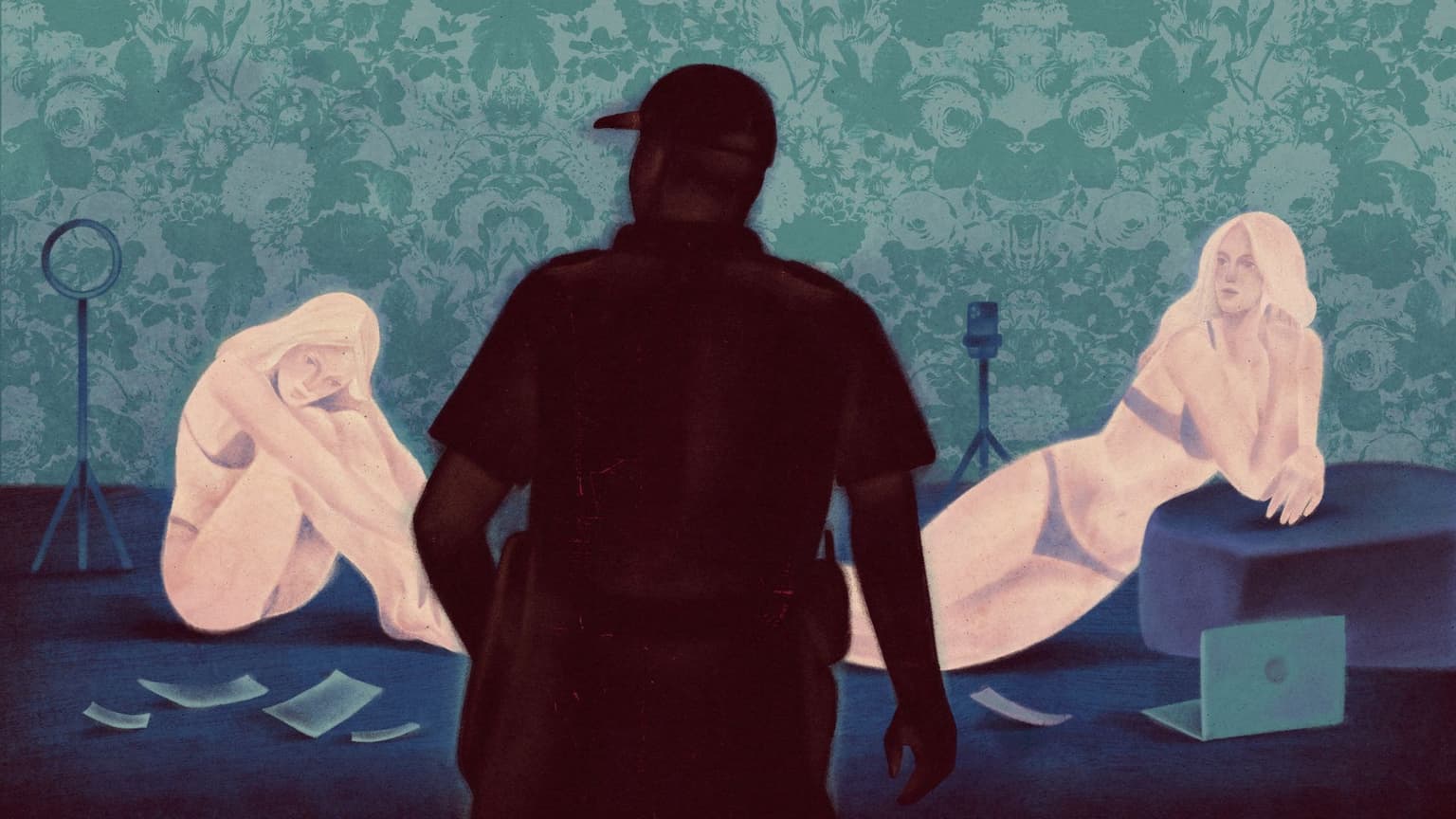
Ukraine's strict anti-pornography laws have left OnlyFans models living in constant fear of severe fines and prison time for content, though a newly supported bill to decriminalize the industry offers a glimmer of hope for reform. (Daria Filippova / The Kyiv Independent)
 on Google
Editor’s note: The two OnlyFans models interviewed for this article are referred to by pseudonyms for security reasons.
Whenever there's a knock at Velma's door, she immediately fears it's the police. The young Ukrainian woman isn't a drug dealer or Russian spy, but instead a former adult OnlyFans model — a profession that is illegal in Ukraine under its strict anti-pornography laws.
Velma initially started as a social media manager for an OnlyFans agency which manages the operations of the models' accounts in return for a fee. Curious to try modeling herself, she soon began creating adult content for the agency, risking breaking the law.
But as more and more girls she knew were raided by law enforcement, the pressure overwhelmed Velma, and she left the industry. Despite deleting her OnlyFans account, she remains scared that law enforcement could dig up her old images and videos.
If she's ever caught, she could face a fine up to Hr 85,000 ($1,800) or even seven years in jail.
"The internet remembers everything," she told the Kyiv Independent under the condition that we don't use her real name.
"I know many models who stopped working, but they still face legal problems because of content they created years ago."
For many of those models, life could become a lot easier after Ukraine's parliament supported in the first reading a pornography decriminalization law on July 14, securing 231 votes.
While the result is still a long way off from legalizing the industry, it's a "major victory" for reformers, Lesia Mykhalenko a lawyer representing OnlyFans models, told the Kyiv Independent.

Advocates for legalizing pornography, like Mykhalenko, say that the current law is outdated, with even consenting adults fined for sharing nude photos of themselves. At the same time, regulating the industry would unlock tens of millions of dollars in tax revenues and plug wasteful state spending during wartime, they say.
The head of parliament's finance, tax, and customs policy committee, Danylo Hetmantsev, was particularly positive after the result, calling it "an undeniable victory of common sense over obvious absurdity."
Regulating the industry will not only assuage legal fears but also make it much easier to pay taxes.
Decriminalization also means that an estimated 15,000 models from Ukraine’s adult content industry will be able to work freely without the fear of being targeted by law enforcement — some of whom threaten and extort models.
But Ukraine, a conservative society by European standards, has been slow to embrace the draft law, which failed to pass two previous hearings. A final second reading is also still needed before it can be signed by the parliament speaker and eventually the president. The margin of support isn’t strong enough for a guaranteed win, Hetmantsev said.
There is strong opposition from top officials, including former Prime Minister Yulia Tymoshenko, who said after the first reading that decriminalizing pornography will "turn Ukraine into Pornhub (a popular adult website) where hundreds of billions of hryvnias will be made by demoralizing our society."
But aside from moral arguments, keeping the industry in the shadows also benefits officials who can use pornography as a tool of extortion or pressure, like in the Soviet era when the law was used to prosecute dissidents, Ihor Samokhodskyi, a Ukrainian policy expert and founder of Policy Genome, a public policy initiative, told the Kyiv Independent.
"It allows you to persecute who you want to persecute," he said.
After the successful first reading, Samokhodskyi told the Kyiv Independent that while he feels positive, he remains cautious.
"The real test will be the final text and second reading. If the president signs, then we'll see how it works," he said.
Bribes and rackets
Around 95% of Ukraine's adult content creators are women, typically young, and vulnerable targets for crooked law enforcement, Mykhalenko said.
It's not uncommon for armed police to treat adult creators like "dangerous criminals" by bursting through the door and pinning them to the floor, before demanding they sign confessions either to extract a bribe or to close the case quickly, she said. Bribes can range from $200 up to $30,000, she added.
Last year alone, prosecutors opened more than 1,400 cases under the Criminal Code's pornography article — the highest number in four years. Arresting people on pornography charges is an easy way for the police to boost their statistics because the cases are simple to investigate and close, Mykhalenko said.
Many girls have horror stories with the police. Velma described how one of her colleagues was dragged from her home into a car by a police officer and two accomplices — likely his friends, she said — who demanded that she pay a bribe in three days or face "problems."

Ukraine has made some effort in recent months to crack down on rogue police. In May, several senior police officers in western and central Ukraine were arrested after they were discovered taking bribes to shield adult content studios.
But the problem is so widespread and systemic that arresting criminal officers is just a palliative measure, said Samokhodskyi. Only lifting the ban will eliminate the root cause of the problem and unwind the criminal structure, he said.
While he says that support for decriminalizing pornography has grown in Ukraine, especially among lawmakers, his efforts were repeatedly hampered by officials who wanted to keep the status quo.
While working at the Better Regulation Delivery Office (BRDO) think tank, he and a coalition of 20 nongovernmental organizations were the first to draft legislation to decriminalize pornography in 2022. But despite meetings with MPs and ministers, Samokhodskyi said he saw that the draft law was being ignored and "going nowhere."
It only made it to parliament in 2023 with the help of opposition lawmaker Yaroslav Zhelezniak, from the Holos Party, after Samokhodskyi told him they were being sabotaged. Since then, Zhelezniak has been the leading political voice of the bill, advocating for bringing the industry into the light at events and on his popular social media channel.
"We must take away this source of corruption from law enforcement agencies, which unfortunately profit from protecting the adult content industry," the MP wrote on his Telegram channel on June 4, a week after parliament failed to pass the draft law for a second time.
Money down the drain
One of the key messages that reformers like Zhelezniak have pushed is that decriminalizing the pornography industry will boost tax revenues. According to him, 5,000 Ukrainians earned $123 million on OnlyFans alone from 2020 to 2022, which could have raised millions in tax revenues if properly regulated.
The problem for many models is that once they declare their earnings from OnlyFans, they expose themselves to law enforcement investigations. But if they don't declare their income, they can be searched by Ukraine's tax-dodging watchdog, the Economic Security Bureau.
The bureau, which has been investigating OnlyFans models since July 2024, told the Kyiv Independent that, as part of their investigation, certain models have already paid approximately 115 million hryvnias ($2.5 million) in back taxes for the years 2020–2023. Although the exact number of models under investigation is confidential.
OnlyFans models started to come under pressure after U.K. authorities — where parent company Fenix International is based — shared data on Ukrainian users' earnings with Kyiv in 2024. This prompted tax authorities to pursue unpaid taxes from creators despite their work being illegal. Even creators living abroad received tax requests.
After thousands of audits from the State Tax Service, models have paid some $2.8 million in backdated taxes for the years 2020-2023. But this figure is likely just 5% of the total income from OnlyFans creators, according to estimates by Ekonomichna Pravda, a Ukrainian media outlet.
Several OnlyFans creators told the Kyiv Independent that regulating the industry will not only assuage legal fears but also make it much easier to pay taxes. Authorities don't understand how the industry operates, leading to cases of overtaxing or double-taxing, they said.
One model, who calls herself Moon, said Ukrainian authorities claimed she owed over $250,000 — money she doesn't have, since it didn't reflect her actual income. She's now locked in a protracted legal battle to prove she's paid the correct amount of taxes, all while accumulating penalties.
She said authorities don't understand that while OnlyFans distributes the total sum to their account, models then have to pay their agency, advertising specialists, managers, and team members. In the end, a model may only take home 20% of the total amount paid to them by OnlyFans.
"Many models have been left with enormous tax liabilities that they simply cannot afford to pay. As a result, people face asset seizures, financial hardship, and lengthy court proceedings," she told the Kyiv Independent.
Moon says that another model she knows took her own life after being unable to afford the hundreds of thousands of dollars the tax service said she owed.
But taxes are only one part of the costs. The state also pays for investigation groups, court reviews, judges, assistants, prosecutors, and experts to hold adult content creators liable for crimes that have no victims, said Mykhalenko. Investigators even get paid to watch the content, up to $10 an hour in some cases.
"We are talking about a legal norm that is outdated. If it is removed, we could save a large amount of money that is currently just going down the drain," she said.