PMCs legally don't exist in Ukraine. They're booming anyway
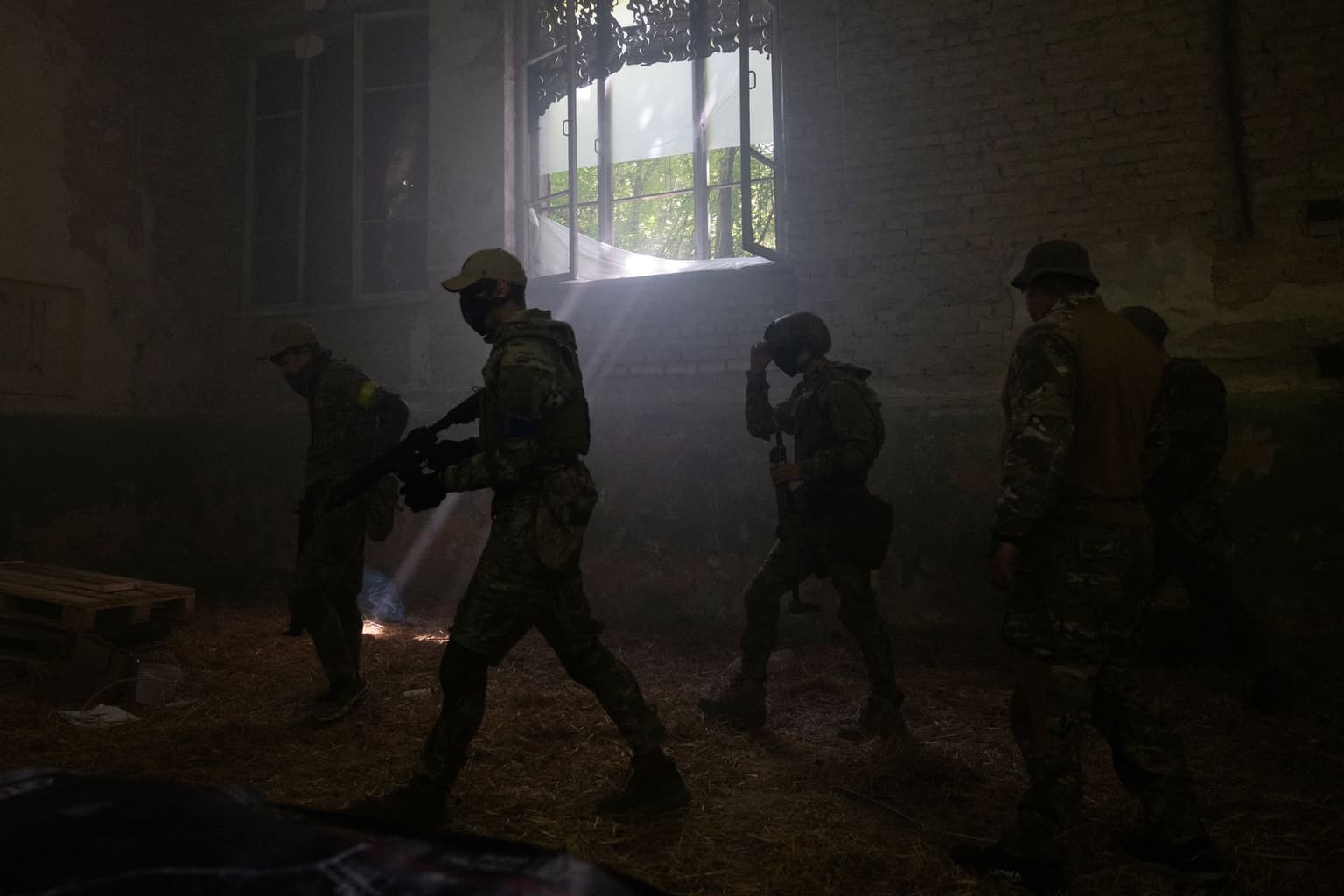
Civilians wearing military uniforms take part in a training organized by soldiers of the Third Separate Assault Brigade in Kyiv Oblast, Ukraine, on July 12, 2025. (Tetiana Dzhafarova / AFP / Getty Images)
 on Google
Editor's note: Tetiana Kebkalo's position was incorrectly listed as deputy director general and has been corrected to managing director.
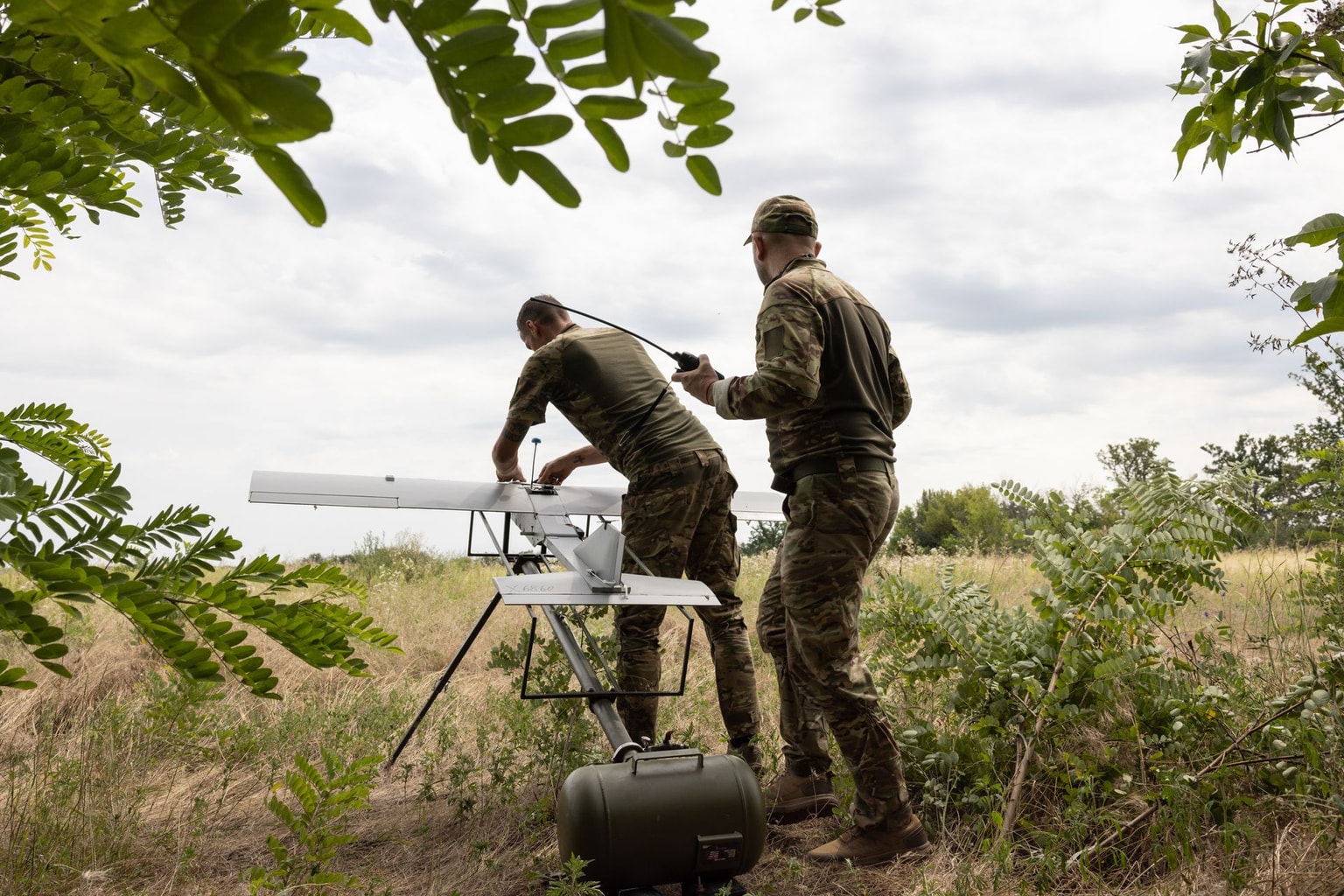
Across Ukraine, dozens of private firms train drone operators, clear minefields, maintain military hardware, and teach foreign clients how to fight a modern war. Some go as far as calling themselves private military companies.
Yet, in the eyes of Ukrainian law, they do not exist.
Ukrainian legislation prohibits armed formations outside state control and has never recognized PMCs, even as most of the activities associated with them carry on under ordinary licenses, permits, and commercial contracts. Four years after the start of Russia's full-scale invasion, the defense sector is one of the fastest-growing industries at the heart of a strained wartime economy.
The gap between PMC activity and the absence of regulation has become impossible to ignore and is now on Ukraine's political agenda.

On May 6, during his evening address, President Volodymyr Zelensky said he had instructed officials to develop "the most optimal format" for regulating private military companies, with legislation to be adopted by the end of the year.
"The key question is not whether a law on private military companies will allow new types of activities, but whether it will create a transparent mechanism for state control and legal regulation of existing practices," says Tetiana Kebkalo, managing director of Omega Consulting Group, a defense-services company that presents itself as "Ukraine's first PMC."
What is a Private Military Company?
Broadly speaking, private military companies are corporate entities that provide military or security-related services for payment. The term evokes images of mercenaries or private armies, though this perception is often misleading.
In practice, these companies encompass a broad spectrum of military, technical, logistical, and security-related activities, ranging from combat, training, intelligence, and operational support to cybersecurity, drone operations, demining, and equipment maintenance.
These companies are a part of a booming global industry but there is no single PMC model, and regulatory frameworks vary from country to country.

However, even formal regulation has not resolved questions of accountability. The U.S. company Blackwater, later renamed Academi, became internationally notorious after its contractors killed 17 Iraqi civilians in Baghdad's Nisour Square in 2007. Although several contractors were later convicted in the United States, they were ultimately pardoned by President Donald Trump in 2020.
When talking about PMCs, another example that often comes to mind is Russia's infamous Wagner Group. However, some experts argue it should not be considered a true PMC, as it was never genuinely private in either its financing or its command structure.
The "PMC" label only helped obscure direct Russian state responsibility for Wagner's operations and crimes abroad, with the group effectively functioning as a shadow extension of the Russian military and the Kremlin's neocolonial ambitions in conflicts ranging from Syria and Libya to Ukraine and several African countries.

PMC activity is also shaped by international frameworks. These include the nonbinding Montreux Document, which outlines legal obligations and good practices for states working with private military and security companies during armed conflict, and the Switzerland-based International Code of Conduct Association (ICoCA), which monitors companies that voluntarily commit to professional and human rights standards.
These frameworks remain quite limited. Enforcement ultimately depends on national legislation and political will, leaving PMC regulation fragmented and inconsistent.
read also
What about PMCs and Ukraine?
Ukraine already has a large and expanding network of private actors in PMC-adjacent spheres: military trainers, logistics and cybersecurity firms, demining teams, risk-management providers, and defense consultancies, many of them working closely with the Ukrainian Armed Forces.
"Every private drone school is, in essence, a defense service provider," says Fedir Serdiuk, founder of the Ukrainian safety and tactical medicine company FAST and an adviser to Ukraine's finance minister. "Everyone who repairs, trains, services, writes software, installs systems, or performs upgrades is providing services in the defense sphere."
Much of that activity, Kebkalo argues, is already regulated. The import and export of military and dual-use goods fall under Ukraine's state export control system and require licenses. Work with explosives is overseen by the National Police and the State Labor Service. Security services have long been licensed by the Interior Ministry.
"At present, I do not see any type of activity that we could not engage in without a PMC law, except for the provision of armed security services," she added.
Her own company is a case in point. Omega Consulting Group, registered in Ukraine in 2012 as a limited liability company, was founded by former French Foreign Legionnaire Andrii Kebkalo and worked primarily abroad before the full-scale invasion, particularly in Africa.
"We could have opened the company somewhere in Cyprus," Kebkalo says. "But we wanted it to be a Ukrainian brand."
The company now focuses primarily on military training and defense consulting inside Ukraine, she added.
"We position ourselves this way because, we are a private entity but at the same time, we provide defense-related services. On some international contracts, our consultants are armed for security reasons," Kebkalo says. "But all of that was before Russia's full-scale invasion of Ukraine."
Despite the sector's steady growth, repeated attempts to formally regulate it have stalled.

At least four draft laws connected to private military or defense-service activities have been introduced over the years, but none have been approved by parliament. The most recent, draft law No. 11214, "On International Defense Companies," was registered in April 2024; the Defense Ministry backed it with reservations, saying the text as written conflicted with Ukraine's Constitution and its laws on defense and intelligence.
Serdiuk attributes this legal stalemate to a combination of institutional inexperience and political stigma. Ukraine, he argues, has little historical experience regulating international defense services or private military activity after decades of rigid Soviet military structures.
"We do not have a long tradition," he says. "Our state has existed for 35 years."
The debate, meanwhile, remains heavily shaped by longstanding concerns in Ukraine about paramilitary groups, including memories of oligarch-linked security structures and armed volunteer formations that emerged during the chaotic post-Soviet period and the early years of Russia's war.
"Everything connected to private initiative and the military scares people," Serdiuk says. "They do not imagine an office with people wearing ties, but PMC Wagner."
Kebkalo expressed similar concerns. In her view, Ukrainian authorities have yet to clearly define the role these companies should play and how the sector should function.
She recalls participating in discussions around earlier draft proposals that appeared detached from both international law and operational reality, including ideas that private military companies could maintain heavy weapon arsenals in Ukraine and deploy abroad independently.
"To be honest, they will never adopt a law that properly regulates these companies until they understand what such companies actually do," she says.
According to Serdiuk, one of the central unresolved questions is where lawmakers draw the line between defense service providers and companies directly participating in combat operations abroad.
"There is a fundamental difference between helping another state acquire a capability and directly participating in combat yourself," he added.
Under that logic, activities such as drone instruction, logistics, software integration, maintenance, and tactical training would fall under defense services, whereas companies with boots on the ground in foreign combat theaters would face significantly stricter regulation.
"In one case, the final shot is fired by the army of a foreign state," Serdiuk says. "In the other, the shot is fired by you."
Ukraine forced to make a choice
The debate is also driven by the question of how Ukraine can sustain its growing defense sector as wartime financing declines.
"There is only one path left: exports," Serdiuk says. "And then this becomes a source of income for the national economy."
Ukraine's wartime experience, including the expertise of its veterans, could also become an exportable asset, Serdiuk argues.
"A launcher, radar, missiles, all the hardware gets sold abroad," Serdiuk explained. "But then comes the service layer: installation, maintenance, integration, operator training. You cannot export these systems if foreign militaries do not know how to use them."
Even while receiving training from abroad, Ukrainian soldiers' invaluable expertise, forged in sweat and blood on the battlefield, benefits their former NATO instructors in areas where Western militaries lack experience.

Kevin Leach, a former Canadian Army soldier and instructor and ex-OSCE ceasefire observer, now heads the Ukrainian nonprofit Sabre Training Advisory Group, which provides training and security force assistance aimed at improving interoperability between Ukrainian and NATO forces.
In his view, one of the biggest gaps between Ukrainian and Western militaries lies in adapting to the realities of drone-centric warfare, and Ukraine's wartime experience will eventually become highly sought after internationally.
"When they smarten up, NATO militaries are going to be clawing for people with experience out here," he adds. "Especially those Ukrainians who already speak English and have gone through Western military training or officer schools. Those people are going to be able to write their own ticket working around the world."
Ukraine has already begun experimenting with a greater role for private companies in the defense sector, as it seeks to expand its capacity to counter Russia's daily drone strikes.
Since November 2025, Ukraine has allowed private companies to form their own air defense units to help strengthen Ukraine's short-range air-defense network. The units operate in coordination with the Air Force, supplementing existing capabilities and helping expand coverage against Russian drones.
According to Defense Minister Mykhailo Fedorov, as of May 2026, 27 companies had joined the initiative, with some units already conducting combat missions in coordination with the Air Force in Kharkiv and Odesa oblasts.
Veterans are another major part of the discussion. Recent estimates claim Ukraine has between 880,000 and 1 million active military personnel, roughly five times more than before the full-scale invasion.

Supporters argue that the private defense sector could eventually provide employment for demobilized soldiers with highly specialized wartime experience in areas such as drone instruction, tactical medicine, consulting, logistics, and technical integration.
However, Kebkalo remains highly skeptical of Ukraine's institutional capacity to regulate the sector, warning that the participation of large state-owned companies could "create unfair competition that subsequently may lead to corruption."
"I see it as another possible path for schemes," she says.
If a law does pass, Kebkalo expects its primary function to be establishing what she calls clear rules of the game: defining the status of private military companies, the procedures for their operations, oversight, and liability. Companies seeking PMC status, she says, would likely have to undergo a separate licensing procedure or obtain a special state permit.
For now, both the regulatory framework and its potential economic benefits remain theoretical.
"We are still dividing the skin of a bear that has not yet been killed," Serdiuk says.
Note from an author
Hi, this is Polina. Thank you for reading this article.
Private military companies are often associated with mercenaries, shadow wars, and legal gray zones. But after weeks of reporting, I found that the debate in Ukraine is often about something else entirely: defense exports, military training, and what to do with a generation of people who have acquired unique wartime skills.
What struck me most was that there is still very little consensus on what these companies should actually be or what role they should play. Yet as Ukraine's defense sector continues to expand, these questions are likely to become increasingly urgent.
If you value this kind of reporting, please consider supporting the Kyiv Independent by becoming a member.
Got an opinion on anything you've read in the Kyiv Independent so far?
and it may appear in our Letters section.