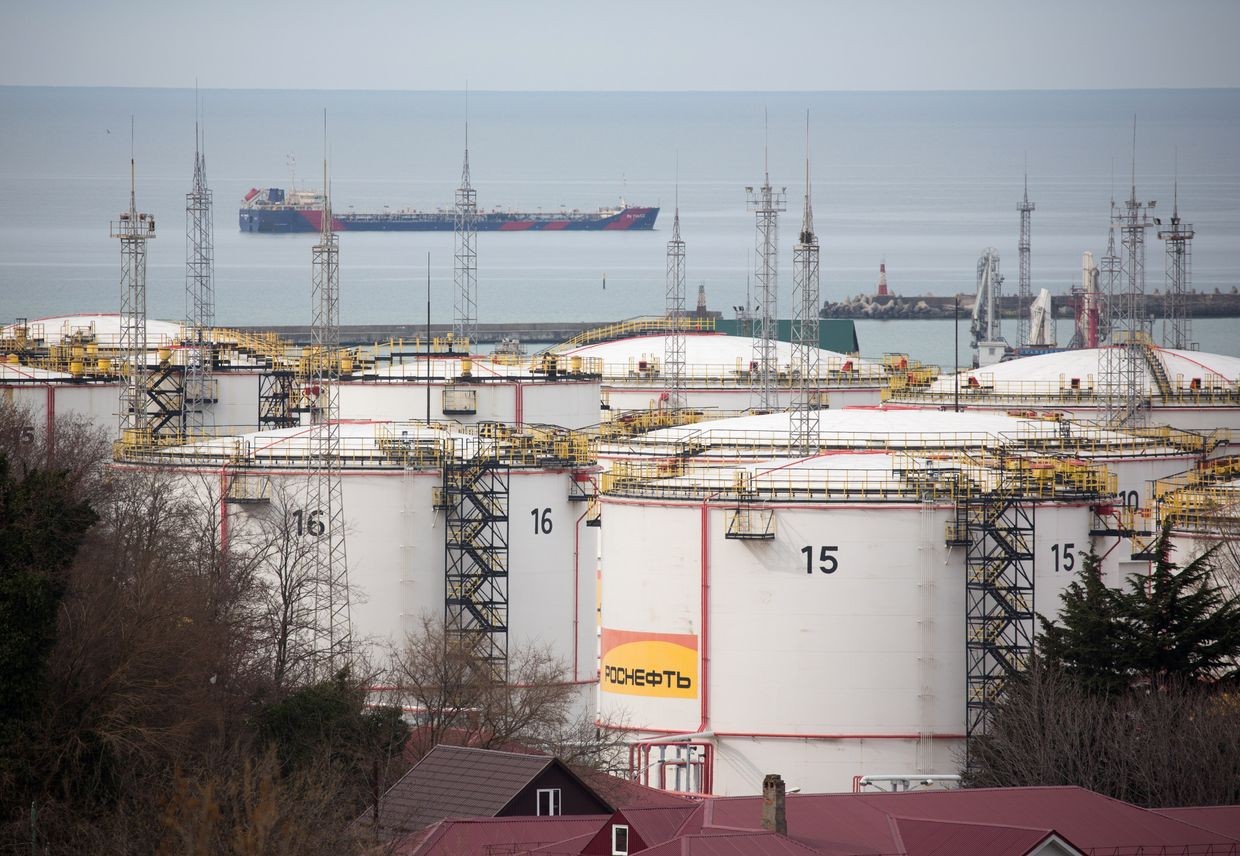
There's one massive problem with Trump's Ukraine diesel price theory

U.S. President Donald Trump pauses to take questions from journalists while walking across the lawns of Aras an Uachtarain to his official vehicle on September 12, 2026, in Dublin, Ireland. (Artur Widak/NurPhoto via Getty Images)
 on Google
U.S. President Donald Trump has a very simple solution to the very real problem of rising diesel prices.
"(President Volodymyr) Zelensky has to do one thing — he has to stop knocking out diesel fuel in Russia,” he told reporters on Sept. 13. "Let him go after targets but not diesel fuel, because he’s causing a shortage of diesel fuel… that’s hurting the world."
Trump's implication was clear — halting Ukraine's long-running, long-range drone strike campaign against Russian oil refineries would significantly ease record-high diesel prices at American pumps, something an administration already under pressure from high gas prices ahead of midterm elections in November would welcome.
There's just one problem with Trump's theory.
"Of course this isn’t true," Alan Riley, senior fellow with the Atlantic Council Global Energy Center, told the Kyiv Independent.
What's causing global diesel prices to spike?
The answer lies in the second part of Trump's statement to reporters, which he reiterated a few days later in a post on Truth Social.
"The World's Diesel price rise is mostly caused by the Russia/Ukraine war, not (the U.S. war with) Iran," he said, in a post in which he also falsely claimed that Ukraine and Russia had agreed to an energy ceasefire.
There is little evidence to back up his claim, and "almost all" of the explosive rise in diesel prices has been due to the U.S.-Israeli war with Iran, the closure of the Strait of Hormuz, and the disruption to refining capacity in the Gulf, Riley said.
The numbers are clear — at the start of the U.S.-Israeli war with Iran at the end of February, diesel prices in the U.S. were averaging around $3.60 per gallon, according to the U.S. Energy Information Administration (EIA). Prices at the pumps have now soared to $6.23 per gallon, the highest on record.
Diesel prices are surging across the world due to a confluence of factors, including higher crude oil prices and a lack of refining capacity. As a result, refineries in the U.S., the largest exporter of the fuel, are running at full tilt with the approach of peak winter demand and inventories depleted.
Crucially, in February 2026 when U.S. diesel prices began to surge, Ukraine’s deep-strike campaign was already in full swing and had been contributing to chronic fuel shortages in Russia since August 2025.
"The attacks are massive, coordinated, and repeated; they come in waves, and the refineries simply do not have time to repair the damage caused by the previous attack before the next one occurs," Boris Aronstein, an independent oil and gas analyst, told the Guardian that month.
Russia's Ryazan Oil Refinery, one of the largest such facilities in the country, was struck nine times in 2025 alone, forcing it to suspend operations on multiple occasions.
U.S. diesel prices in August 2025 averaged around $3.70, according to the EIA.

A study by Ukraine’s KSE Institute, shared with the Financial Times, assessed the U.S.-Israeli war with Iran had a far bigger impact on global diesel and gasoil supplies than Ukrainian drone strikes, estimating exports from the Persian Gulf fell by 152 million barrels between March and August, compared with a 68 million-barrel drop in Russian exports over the same period.
"The cumulative loss from the Persian Gulf was therefore around 2.2 times larger," the report said.
"Most refined fuel produced in Russian refineries is used in Russia," Riley said, adding: "That is why the strategy of the Ukrainian Armed Forces makes so much sense."
What effect do Ukrainian strikes have on global prices?
None of this is to say that Ukrainian attacks have had no impact on global prices.
"(Russia's) ban on exports of diesel has had a significant effect globally as Russia has historically been, along with the U.S., one of the top exporters of diesel globally," refined product analyst Henok Gheotom of analytics firm Kpler told the Kyiv Independent.
Ukrainian strikes against refineries intensified over the summer, leaving Russia struggling to keep up with repairs. Twelve major Russian oil refineries were hit in August alone, with a combined design capacity of some 100 million tons of petroleum products per year, according to the Ukrainian Defense Ministry. Refineries remain under fire in September.
"When export-oriented coastal or pipeline-linked refineries are hit, reduced diesel flows force global buyers to compete for replacement barrels from the U.S. Gulf Coast, India, and the Middle East, widening refining margins worldwide,” George Voloshin, an expert on Russian affairs and sanctions, told the Kyiv Independent.
"Russia's seaborne product exports are down 21% between January and July, roughly twice the fall across the global seaborne market, but Russia still accounts for only about a fifth of that decline," Luke Wickenden of the Centre for Research on Energy and Clean Air told the Kyiv Independent.
This decline is largely driven by diesel, which accounts for the bulk of Russian exports of refined products. “Russian exports are down by a third and the drop is equivalent to around 4% of the world's seaborne diesel and gasoil trade,” Wickenden said.
"That matters because diesel is one of the fuels whose premium has kept climbing while crude has unwound," he added.

What does it all mean for Russia?
While the global energy situation remains tumultuous, it is particularly stark in Russia. The prospects for the Russian economy look bleak, as the enormous cost of the war strains the state budget while businesses are increasingly harried by Ukrainian strikes and Western sanctions.
"In its desperation, [Russia] has started importing fuel, which is genuinely new: between 2023 and 2025 it bought almost nothing by sea, with no cargo arriving at all in 13 of those 36 months," Wickenden said.
"In August 2026, it imported 172,000 tons, three times what it bought in the whole of 2025, and gasoline went from 6% of its product imports to 74%," he added.
"The volumes are trivial for the world market, but a country that was the world's second-largest oil product exporter last year is now paying to have its own crude refined abroad and shipped back.”
Since the beginning of 2026, Russian gasoline prices have risen 21.16% to an average of 78.25 rubles ($0.93) per liter, while the cost of diesel has increased 18.4% to an average of 88.44 rubles ($1) per liter, according to official statistics reported by Interfax.
And Russian public sentiment appears increasingly gloomy as weekly state polls suggest drone strikes and fuel shortages are stoking anxiety as the war mars everyday life — adding to the Kremlin's concerns ahead of the first parliamentary elections since the 2022 invasion.