The price of doing business in Russia
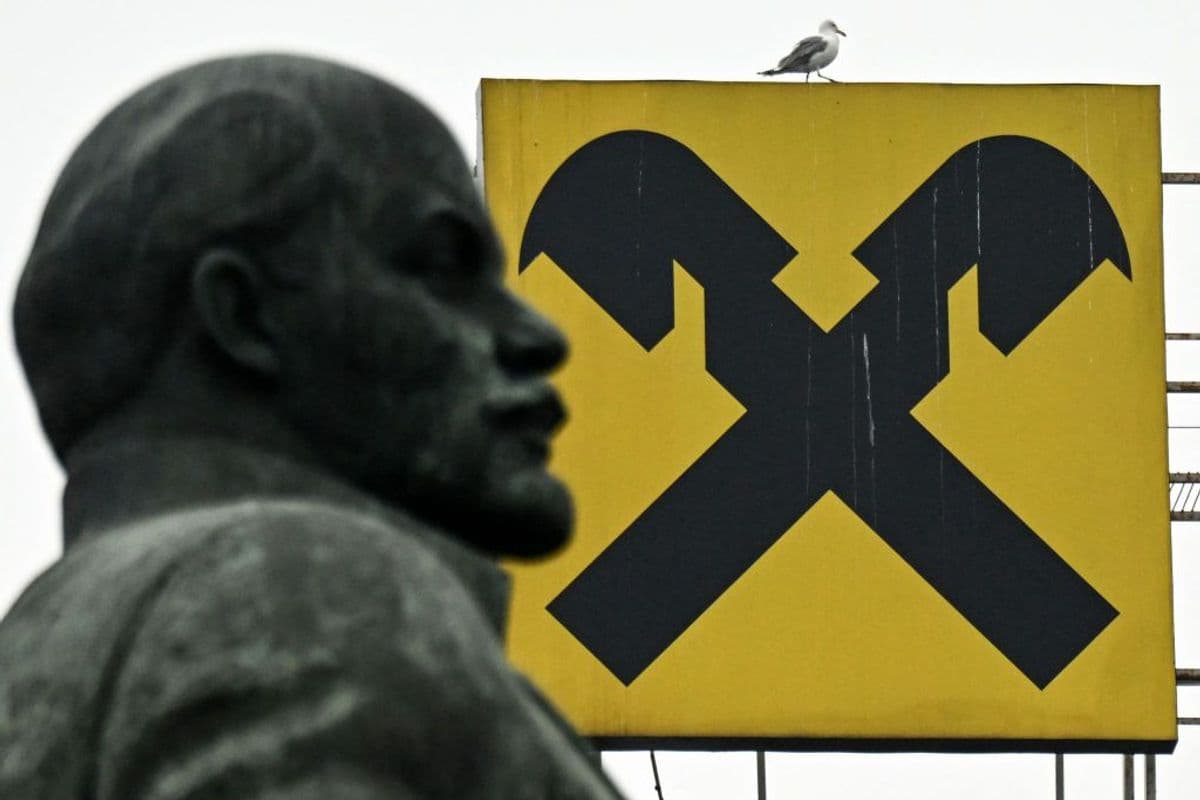
Seagull walks on a logo of Raiffeisen bank atop a building behind a monument of Soviet country founder Vladimir Ulyanov, also known as Lenin in Moscow on April 12, 2022. (Kirill Kudryavtev /AFP via Getty Images)
 on Google
When Moscow launched its full-scale invasion of Ukraine, most global businesses rushed for the exit.
Swiss food and drink firm Nestlé was not among them. The company hunkered down, a decision it framed as ensuring local people's "right to food."
It made little difference to the Kremlin. On Sept. 17, the Russian government placed Nestlé Russia under temporary external administration, a move that could lead to the company's ultimate confiscation or nationalization.
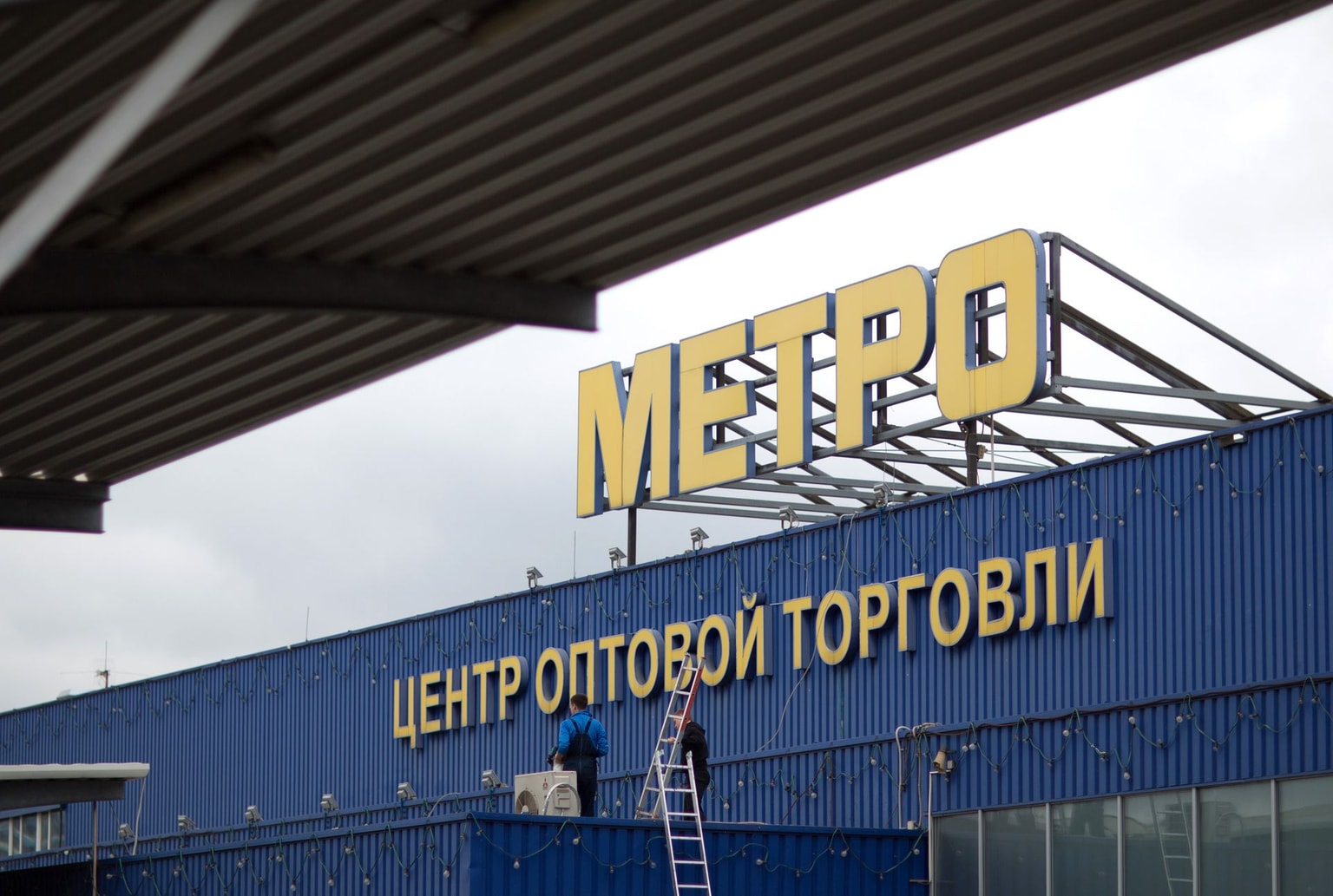
Nestlé now says it is "assessing the situation and its options." It is not alone. In recent weeks, French supermarket chain Auchan and German food wholesaler Metro have been among those who have also seen their assets placed under external control.
Auchan told Russian news outlet RBC that it was continuing operations and had sought further clarification from the government. Metro said that the effects of the decision were "currently being analyzed."
But there seems to be little prospect of returning to business as usual, with the Kremlin tying its decision to geopolitics and its war on Ukraine.
Kremlin spokesperson Dmitry Peskov told reporters that the companies were from "unfriendly countries" that were "actively involved in military actions against our nation, and involved in strikes carried out by Kyiv," he said.
High risk, no reward
When foreign businesses moved into Russia after the collapse of the Soviet Union, they found a market with both high risks and high rewards.
Multinational companies made phenomenal returns in Russia throughout the 1990s and early 2000s, says Charles Hecker, the author of Zero Sum: The Arc of International Business in Russia.
But they also made assumptions about how Russia would develop economically and politically.
"Companies failed to keep pace with the political change in the country," Hecker says. "They were making life-changing sums of money in Russia. And I think that that distracted us from some of the political and geopolitical realities."
Today, the Russian market is as risky as that of the 1990s, but offers little in the way of returns. While leaving is still an option, companies that do so face steep penalties. Foreign firms from so-called "unfriendly countries" must sell assets at an eye-watering 60% discount, while also paying a "contribution" to Russia’s state budget equal to 35% of those assets' market value.
Some companies paid up. Others hoped they would benefit from playing the long game, says Christopher Hartwell, a professor of international business policy at the ZHAW School of Management and Law.
"You think, maybe if I just keep my head down, it'll blow over. You think, if I'm going to come back in 10 years, after (Russian President Vladimir) Putin dies and this war is over, it's going to be very difficult to get back into the market because you have competitors who are using all of your assets. So maybe we need to stay here in terms of, you know, just keeping our foot in the door," he says.
Moscow also signaled goodwill toward such firms. In March 2025, Putin told a congress of Russian industrialists that Western companies that left but kept their staff and technology, with Russians running them under a different brand, had "made an independent and responsible choice."
Yet there had already been grave warnings of what was to come. Even if companies in 2022 could not have imagined their assets being expropriated by the Russian state, their calculations would have quickly changed when the Russian subsidiaries of companies such as Danone and Carlsberg were similarly placed under external administration in 2023.
Russian state news agency TASS reported on Sept. 29 that 135 companies linked to foreign firms had been placed under such controls.
"Anybody could have seen this coming from a mile away," says Hartwell.
All for the war
A transnational corporation such as Nestlé is a greater prize for the Kremlin, and its assets are likely to be used to buy the loyalty of groups on which the Kremlin relies, says geopolitical analyst Alexander Kokcharov.
Danone and Carlsberg are good examples of what is yet to come.
In 2023, Yakub Zakriev, reportedly a relative of Chechen leader Ramzan Kadyrov, was named head of Danone's Russian subsidiary, before it was sold on to another firm linked to a former Chechen official. Another Putin ally, Taimuraz Bolloev, was also named head of Baltika, the Russian brewer formerly owned by Carlsberg, before it too was sold on.
Many of these groups would usually receive money of some kind from Russia’s state budget, says Kokcharov. But as Russia’s economy continues to struggle and resources are instead pushed toward the war, gifting business assets can make up the shortfall.
As Moscow's war on Ukraine consumes Russian society, buying that loyalty and shoring up budgets have become more important than maintaining business relationships, says Kokcharov. Meanwhile, Nestlé's case suggests that the Kremlin is giving up on the idea of returning to "business as usual."
"My understanding was that the Kremlin saw war in Ukraine as temporary. The sanctions are temporary. The disruption of business relationships is temporary. And once Russia achieves what it wants in Ukraine, there would be some sort of a thaw, some sort of a reset," Kokcharov says. "My guess is that now they realize that this is not happening."
This shift in outlook means it's unlikely that Nestlé, Auchan, or Metro will be the last Western companies to face their assets being taken out of their control.
"If you're a Western company still trying to do business in Russia, you are playing with fire," says Kokcharov. "The entire political system is concentrated on the war, and it doesn't care about Western businesses or reputations, for that matter."
For those companies that have chosen to shelter in place in the Russian market, it is another stark warning to add to an increasingly long list.
"You can have a good run if you get in bed with authoritarians, but at some point you're going to wake up and realize that your wallet and your kidneys are gone," says Hartwell. "And was it really worth it?"