What does Russia's rising military budget say about its plans for the war?
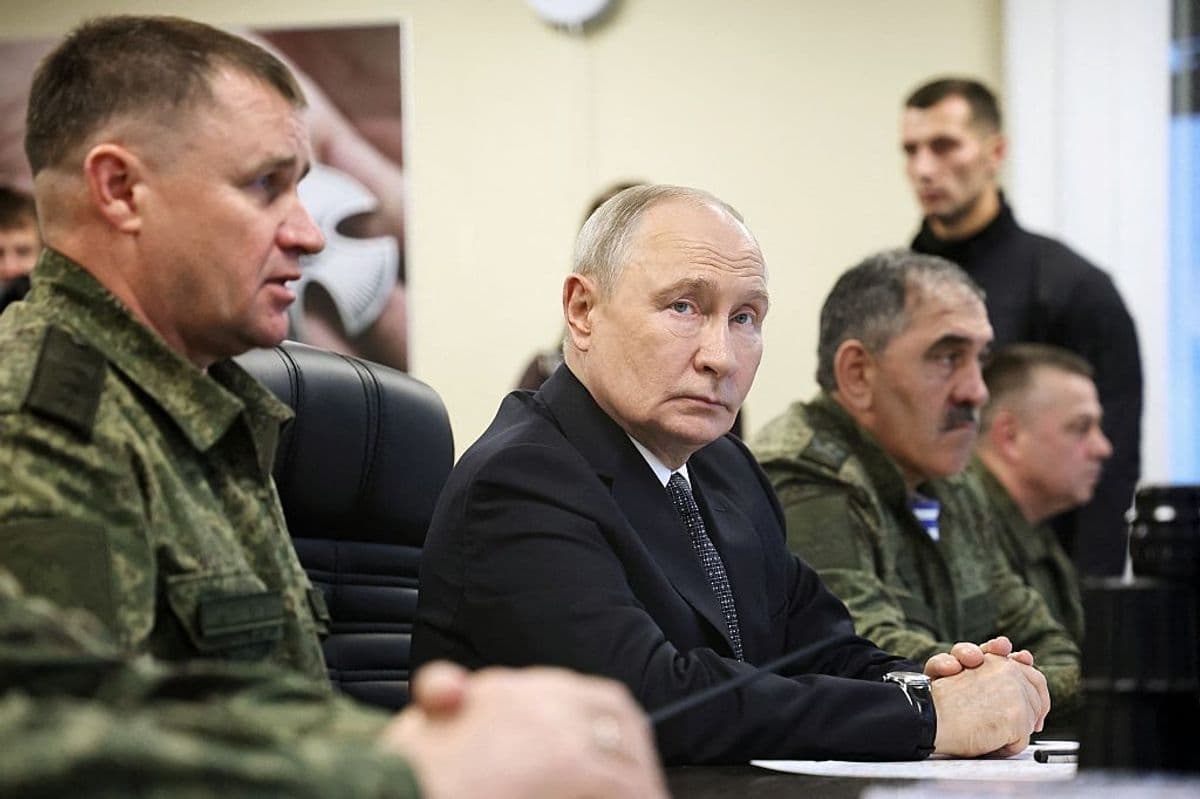
Russia's President Vladimir Putin (C) looks on as he visits an observation post during the "Center-2026" strategic command-and-staff exercise at the Chebarkulsky training ground in Chelyabinsk on Oct. 2, 2026. (Alexander Kazakov / POOL / AFP via Getty Images)
 on Google
The Russian government began the month by submitting a three-year budget plan to parliament, proposing yet another increase in funding for its war against Ukraine.
On the surface, the planned increase looks substantial. Russia's overall military budget is set to rise to around 17 trillion rubles (approximately $200 billion) in 2027, up from 12 trillion rubles in 2026 — a 27% increase in nominal spending.
When combined with spending on law enforcement, another heavy budget line, expenditures on the military and security forces account for 43% of the total government spending.
The figures are striking, but experts who spoke to the Kyiv Independent cautioned that they can be misleading.
Rather than pointing to a sudden surge in military spending, the latest budget figures suggest that Russia is continuing to gradually build up and sustain its military capacity, signaling a readiness for a prolonged war.
Big numbers
Next year, Russia's military and security forces will get more money than any other sector — only 21% of the 2027 budget is allocated to healthcare, education, and social payments combined. That is generally similar to what is directly funneled to the military, but only half of the number when allocations to security forces are added.
Russia's high military budget would also be maintained in 2028 and 2029, according to the three-year budget plan.
"It's difficult to speculate, but the planned budget hike suggests that (the Kremlin) may intend to recruit more people (into the army) under contract in 2027," said Michael Kofman, a senior fellow at the Carnegie Endowment for International Peace.
Guesses on the actual purpose of the increases can only be speculative, argued in turn Pavel Luzin, a researcher with the Center for European Policy Analysis.
On top of the already high military budget, the Russian government can additionally increase funding throughout the year without parliamentary approval, said Sergey Aleksashenko, an exiled Russian economist and former deputy finance minister.

"Basically, the numbers we are seeing, this is what the Kremlin wants us to see," he said. "Around May (this year), the Defense Ministry requested additional funding from Vladimir Putin, and this request was granted."
While Russia does not publish detailed data on military spending, Luzin agreed that the figures for 2026 were likely higher than what was settled in the Russian government's initial budget: "approximately 16-17 trillion rubles, in my assessment," the researcher told the Kyiv Independent.
As for funding on healthcare, education, and social payments, these are set to decrease next year, Russian economist Alexandra Prokopenko found in a recent study.
Nothing dramatically new on the military spending front
The 27% army budget increase may sound significant, but this number is a bit misleading, Aleksashenko said.
"Russian military expenditures are growing step by step, but not as dramatically as (this figure) would suggest, because that number was calculated on the wrong basis," the Russian economist added.
According to him, instead of basing the increase on Russia's initial plans for 2026, these should be compared to what Russia actually spent throughout the year: in that case, the increase would be much lower.
"It's not extraordinary that the government admitted that it will spend at least 17 trillion rubles on the military in 2027," Luzin agreed.
The bulk of the on-paper increase is linked to inflation, specifically cost-push inflation in the military industry, but also salaries and payments to wounded and families of killed Russian soldiers, the researcher added.

"At the same time, the Russian government is also beginning a new round of investments, trying to modernize the sector, because Russia's military industry cannot produce more than it did (at its peak) in 2024," he added.
In fact, Russia's upcoming budget says more about how the government wants to raise money for the war, Prokopenko explained — more than it does about how much money will be spent and on what.
"Officially, Russia's budget deficit is to be cut to 2.2% in 2027, but since the start of the full-scale invasion, the government never managed to stick to the original budget deficit plans," Prokopenko said. "For instance, for 2026, the plan was to keep the deficit to 1,6%, as opposed to 2,6% in 2025, but in the end the projection for this year is 3,2%."
Russia fills its deficit either through taking out money from its National Wealth Fund or by borrowing on the internal market, Prokopenko said.
However, the Russian government is having trouble attracting private businesses and citizens to invest in bonds — as a result, when Russia's Central Bank conducted its most recent bond auction, major state-owned banks bought around 84% of the total sum, Prokopenko said.
To raise money for the war in Ukraine, Russia also raised taxes, for instance by hiking VAT rates to 22% in 2026, by overall increasing income tax the previous year, and by introducing a planned tax on dividends and yields on bonds starting in 2027.
While Russia is clearly looking for money for the war, and the prime role of state-owned banks in financing debt can look awkward, this says little about the actual state of the Russian economy, Aleksashenko said.
"I don't see any problems on the financial or the economic side which would make Putin stop the war," the Russian economist argued.
"He is generally conservative with expenditures, so I don't think we'll be seeing a sudden boost in boots on the ground. As for the cost of this war (to the Russian economy), unfortunately, while it might not be sustainable in the long run, Putin sees the price to pay as acceptable."