The only winner of the Poland-Ukraine scandal is Putin
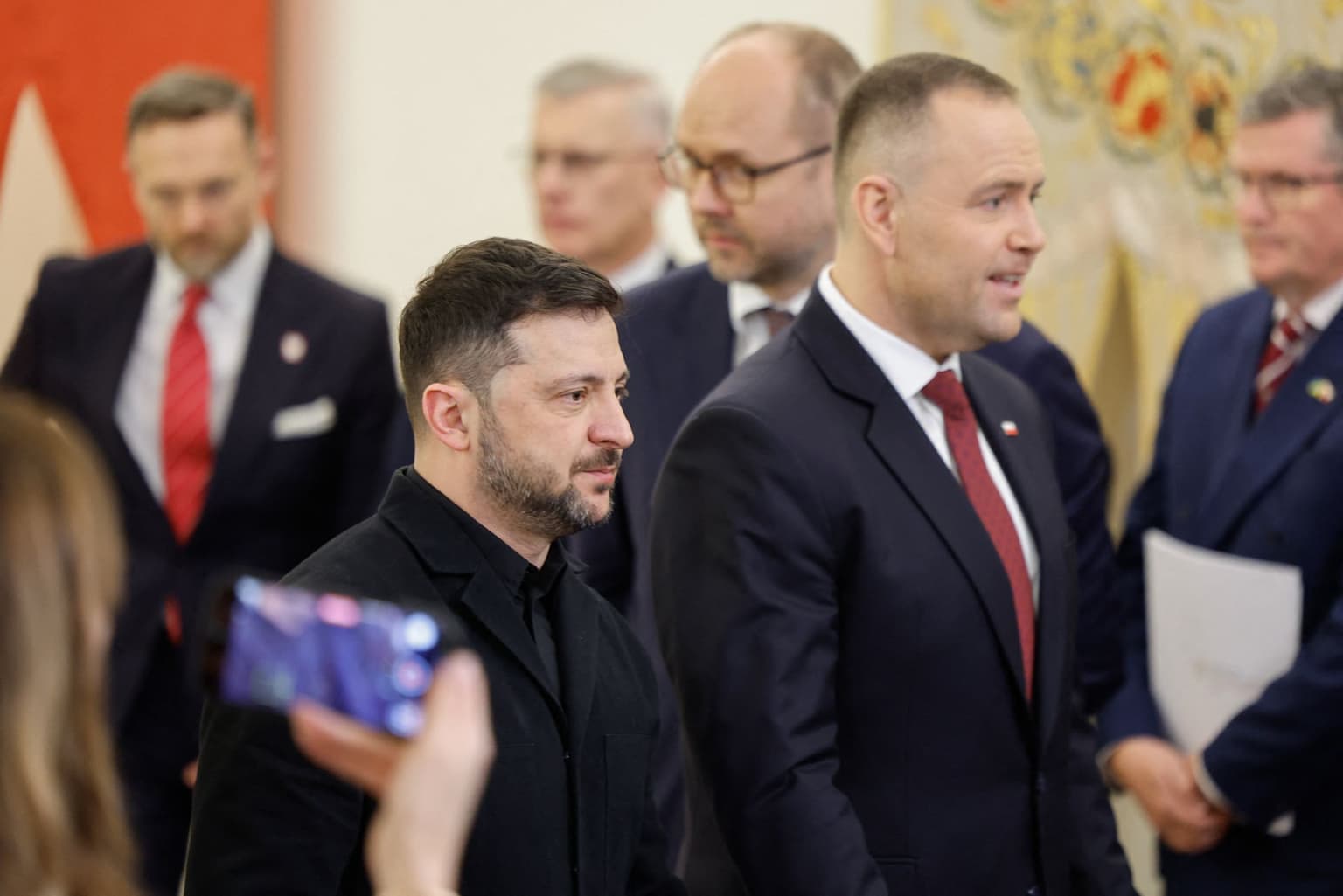
Poland's President Karol Nawrocki (R) and President Volodymyr Zelensky (L) in Warsaw, Poland, on Dec. 19, 2025. (Wojtek Radwanski / AFP / Getty Images)
 on Google
Jerzy Wojcik
Co-founder of the Media Liberation Fund
Vladimir Putin is losing the war he started. His army occupies every kilometer at a cost no economy can sustain, and the goals set in February 2022 have quietly vanished from his staff maps.
But this war has more than one front, and one of them runs through Poland. On this front, Russia is currently winning, and we, Poles and Ukrainians, are supplying its ammunition.
What we see today is a completely different Poland from the one in 2022.
In the spring of 2022, Polish train stations looked like field hospitals run by volunteers. Soup on the platforms, handwritten signs reading "Family with four children? We have a room," as hundreds of thousands of private apartments open to Ukrainian strangers carrying a single suitcase.
It was the most effective action in the history of Polish foreign policy, and entirely citizen-driven.
Four years later, we have a completely different Poland. There are fewer yellow-and-blue colors in Warsaw than in almost any other European capital. In a tram, Ukrainians now lower their voices before switching to Ukrainian, out of fear of retaliation.
Hundreds of incidents have accumulated so far: assaults on Ukrainians in public transportation simply for speaking their language in a normal tone, beatings, vandalized cars with Ukrainian license plates, and almost none of these actions have received a firm response from the state.

The state was busy with other things: it restricted healthcare for the oldest, sickest, and unemployed Ukrainians, and performatively deported individuals for offenses that would earn a Pole a fine at most.
This week, at a gas station near Poznan, an elderly man with a Polish flag on his lapel threatened a person in line: "I'd take a knife and cut that off, you Banderite!" — and then dictated into his phone: "Two men are enough. One should kick him in the balls, the other should knock his teeth out. Execute it!"
The reason was a badge with the flags of Poland and Ukraine on his jacket lapel. The victim was a well-known Polish journalist, the author of a book that accounted for the Polish pogrom in Lviv in 1918 more honestly than anyone before him.
"Banderite," from Stepan Bandera, the leader of Ukrainian nationalists in the 1940s, is the label used in Russian propaganda for every Ukrainian and their allies.
Now, I ask myself, "What happened between these two Polands?" If we look at the facts, Ukrainians in Poland work, pay taxes, and commit fewer crimes than the average, yet the narrative in the Polish public has changed. And it did not change on its own.
The Kremlin knows the futility of inventing new friction between Poles and Ukrainians, when history has left enough unhealed wounds for that, and there are always politicians willing to tear them open. That wound, in this case, is the memory of last century's hostilities between Poles and Ukrainians in Western Ukraine.
Volhynia really happened: the Ukrainian Insurgent Army (UPA) massacred tens of thousands of Polish civilians, and Polish units responded with brutal retaliation remembered to this day.
Operation Vistula also really happened: communist Poland illegally uprooted over 140,000 Ukrainians and Lemkos from their homes. The only work left for those who want to drive Poland and Ukraine apart is to keep these embers lit.

The renewed tensions began after President Volodymyr Zelensky named a Ukrainian special forces unit after the UPA.
I do not intend to tell Ukrainians how to name their military units. That is the sovereign right of a state that pays for its decisions in blood. I understand the logic: for soldiers fighting Russia today, UPA commanders were men who kept shooting at Muscovites well into the 1950s, when Europe had long gone quiet.
Yet the downsides are worth counting too. The name lands painfully on Polish ears — these are the grandchildren of civilians massacred in the 1940s, the same people who in 2022 gave up their bedrooms to Ukrainian families.
Beyond that, "denazification" is the central lie of Russian propaganda, and a battalion named after UPA commanders hands the Kremlin free material. Add to that Poland's blocking power over Ukraine's EU accession, and the question writes itself: is this gain worth this price?
As a Pole, however, I have incomparably greater grievances against my own president. Karol Nawrocki's announcement that he would strip Volodymyr Zelensky of the Order of the White Eagle — the highest Polish distinction, awarded to the leader of a country shielding NATO's eastern flank — was, I fear, a decision made with an opinion-poll calculator in hand.
It is the opening of the vilest possible election campaign, without regard for the consequences for Poles and Ukrainians along the Vistula.
The Polish nationalist right, from the president to the extreme Confederation party, discovered that bidding on anti-Ukrainian grievances mobilizes voters faster than an economic program.
The Kremlin does not even need to pay for this. Warsaw and Kyiv supply it with material every week: a dispute over grain turns into a dispute over Volhynia, a dispute over Volhynia into a dispute over a battalion, a dispute over a battalion into a dispute over whether refugees deserve a doctor.
At the end of this chain stands a person at the checkout counter who has heard the word "Banderite" so many times that it sounds like a verdict to him.
That same week, something shifted in the Sejm too. Opposition lawmakers began calling for investigations into people of Ukrainian origin holding positions in the Polish government. Donald Tusk — a prime minister who has himself had episodes of pandering to the right-wing electorate — stepped up to the rostrum. From individual insults, he said, a wave is beginning to form — a brown wave, the end of which Europe knows all too well.
As a person running a Polish-Ukrainian magazine and campaigns on both sides, I know what works well instead.
What works is what can be counted: thousands of generators for Ukrainian cities during blackouts, shelters in front-line schools so that children can return to classes. Three hundred people packing boxes in a parish hall do more for the Polish-Ukrainian alliance than three hundred ministerial statements. No one who has driven a generator to Kharkiv will believe a post about a "Banderite invasion."
Regarding the history of the 1940s, we must write the truth, exhuming the victims and safeguarding memory. We must not give it to politicians to use as a detonator.
A joint commission of historians with full access to the archives will advance reconciliation further than any order. What remains for politicians is what belongs to the living: defense against a common enemy and a future in Europe.
Can the brown wave end in pogroms — no longer symbolic, but literal? I hope not. But hope has never protected anyone. The answer depends on whether the Polish state begins to prosecute every assault with the full severity of the law, and on the daily reflexes of ordinary people — whether someone on a bus reacts or averts their eyes.
I believe that we should treat "never again" more seriously than just a historical quote.
If we surrender the interpretation of our shared history to the Kremlin, Russia will win the battle in Warsaw that it is losing near Pokrovsk — without a single shot, using our hands, using our language.
Editor's note: The opinions expressed in the op-ed section are those of the authors and do not purport to reflect the views of the Kyiv Independent.