Tensions mount in both Kyiv, Moscow ahead of Russia's Victory Day Parade
Russia appears very keen to dissuade Ukraine from striking the parade, threatening massive 'retaliation' strikes.
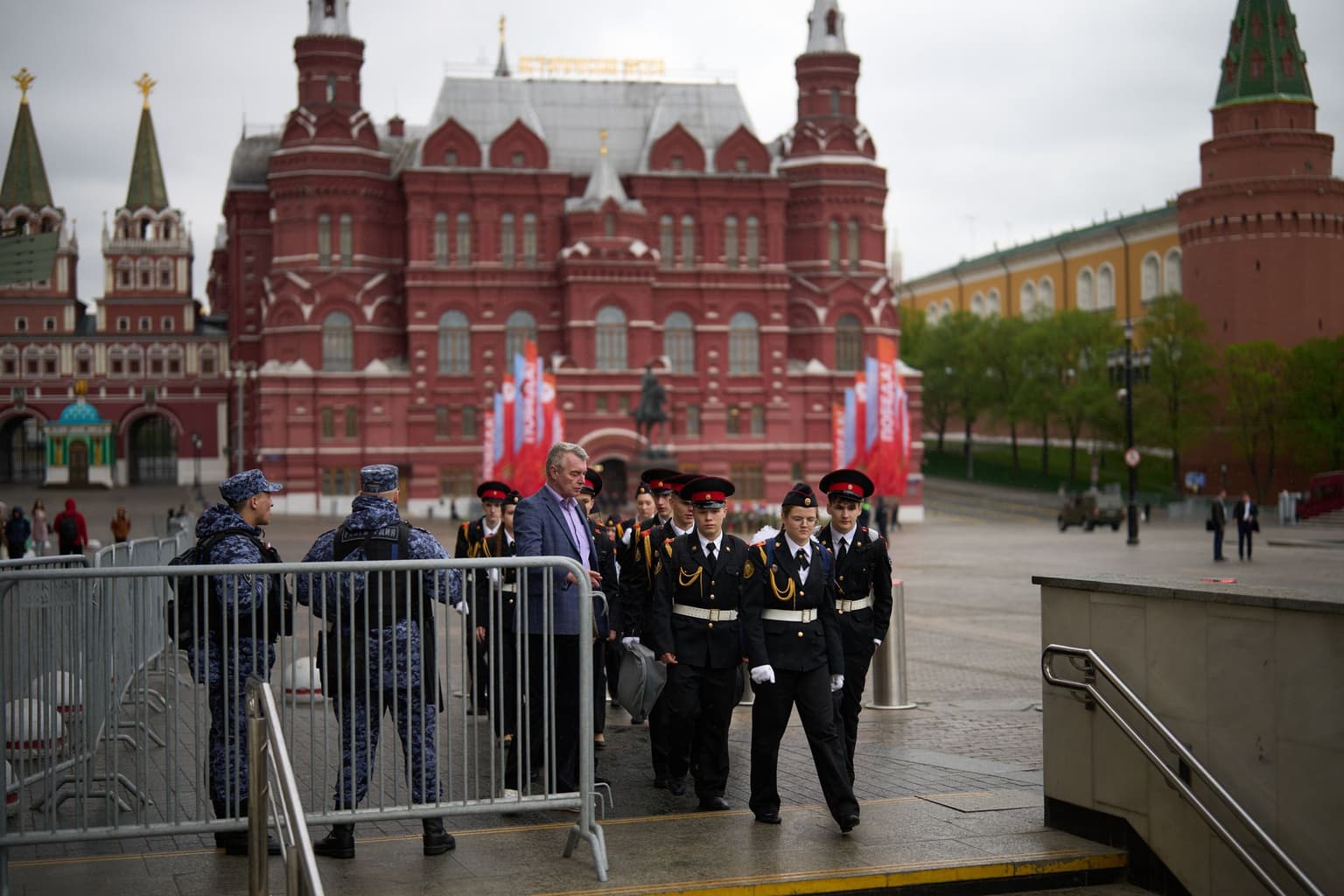
Russian cadets walk past police guarding Manezhnaya Square in Moscow, Russia, on May 8, 2026. (Alexander Zemlianichenko/AP Photo)
 on Google
Editor's Note: Read the latest developments on Victory Day and Trump's surprise 3-day ceasefire.
Tensions have been mounting this week ahead of Russia's Victory Day celebrations on May 9, with an apparent uptick in Ukrainian drone attacks prompting a flurry of speculation, ceasefire proposals, and threats of strikes and counterstrikes.
What’s happening this weekend?
If you take the rhetoric at face value, possibly a Ukrainian strike on Russia's most important parade of the year, and a massive "retaliatory" strike on central Kyiv.
Russia observes Victory Day on May 9, a hugely public holiday which glorifies the Soviet Union's defeat of Nazi Germany in World War II, but in more recent years has been used to spread propaganda justifying Russia's full-scale invasion in Ukraine.
Russia typically uses the occasion to display its military might with a large-scale parade in Moscow showing off all manner of tanks, missiles, and other pieces of military kit.
They will attack our cities regardless.
But this year there's a catch — Russia's celebrations have been scaled back and the Kremlin has said it will not display any military equipment at this year's event in large part because all those Ukrainian drones that are now flying in Russia's skies could put some pretty sizable dents in it.
Despite the change, the ministry said the parade will include a foot column of servicemen from military educational institutions representing various branches of Russia's armed forces, along with an aerial segment.
What's the deal with ceasefires?
There have been two, but neither one has been agreed upon by both sides, and both sides have accused the other of breaching both of them.
Zelensky said on May 4 that Ukraine would declare a ceasefire beginning at midnight on May 6, following Russian President Vladimir Putin's announcement of a temporary two-day "Victory Day ceasefire" on May 8–9.
On May 6 when Ukraine's proposed ceasefire came into effect, Zelensky said Russia had violated it a total of 1,820 times by 10 a.m. local time.
On Russia's part, Moscow claimed its forces had fully halted combat operations from midnight on May 8, but Ukraine claimed more than 140 strikes on Ukrainian front-line positions had been recorded by 7 a.m. local time.
Meanwhile, Ukrainian drones have still been busy in the lead up to May 9 — Moscow Mayor Sergey Sobyanin claimed that dozens of drones were headed towards the Russian capital overnight on May 8.


Sobyanin reported the first three downed drones approaching Moscow just after midnight, with a total of 26 downed drones throughout the night. Temporary flight restrictions were introduced at Moscow's Vnukovo and Domodedovo airports amid the reports of drones.
But while no one appears to be observing any ceasefires in the lead-up to May 9, the real test will come on Saturday when the parade is underway.
What has Russia said?
Russia appears very keen to dissuade Ukraine from striking the parade, with Foreign Ministry spokesperson Maria Zakharova on May 6 advising some foreign missions to withdraw personnel from Kyiv because of what she described as an "inevitable retaliatory strike" by Russian forces.
Russian state TV has also been playing clips showing maps of Kyiv overlaid with potential targets including government buildings and foreign embassies.
"It's all bluster," former UK Defense Attaché in Moscow, John Foreman CBE, told the Kyiv Independent.
"Firstly, Russia isn’t observing its own ceasefire but more importantly Ukraine isn’t going to attack Red Square as they’re not stupid — they haven’t done that since 2022.
"Better for them to respond to Russian attacks proportionately away from Moscow against military targets and watch Putin stew in his own misfortune at his pound shop parade."
Jenny Mathers, a senior lecturer in international politics at the U.K.'s Aberystwyth University, told the Kyiv Independent that there were "many signs of worry and panic" in the Kremlin, from "restricting internet access to banning previously essential components of Victory Day parades."
"All of these actions make Russia look weak and weary, and undermine the constant claims from the Kremlin that the war in Ukraine is proceeding according to plan and everything is under control," she added.
Ukraine has been vague about the possibility of an attack on May 9 — Zelensky said on May 6 that the fate of Russia's May 9 military parade "depends" on Ukraine's army.
And Russia's framing of any attack as "retaliation" is hugely problematic given they launched the full-scale invasion and could end the war at any time.
"This is typical Russian propaganda, and it's… always been schizophrenic," Ryhor Nizhnikau, a Russia expert at the Finnish Institute of International Affairs, told the Kyiv Independent.
Nizhnikau explained that for both domestic and international audiences, Russia frames its war as "Europe is an aggressor, and Europe is arming Ukraine" which allows it to frame any actions it undertakes as defensive rather than the unprovoked aggression it actually is.
"So on one hand, you are the one who has to some degree everything under control," you decide when the war ends, when ceasefires come into force, and so on," he said.
"On the other hand, you are a victim and you are defending yourself, which means that actually you can't decide when it's going to end because you are under attack — this kind of paradox has existed for a while."

What's the mood in Kyiv?
Kyiv is long-used to massive missile and drone strikes, but there's enough concern currently for some people to be taking precautions.
"I want to send my wife and our one-year-old child to the countryside, it seems to me that Russia is determined," a 48-year-old Kyiv resident who wished to remain anonymous told the Kyiv Independent.
"I was once in Moscow on May 9, and I used to have Russian friends — for them, it’s the biggest holiday of the year. If we try something during these days, they will definitely respond."
Anna Spirina, a 38-year-old interior designer, hoped Ukraine would use the parade to their advantage, striking places inside Russia that could be less defended with more of the Kremlin's air defenses placed in Moscow to protect the celebrations.
"I hope we will use this situation to our advantage — in whatever way benefits us, whether on that day or the next. I just want our military to approach this wisely," she said.
But she was less concerned about the possibility of Russia's so-called "retaliation strikes."
"I’m not worried that they will strike back. They will attack our cities regardless."
Note from the author:
Hi, this is Chris, one of the authors of this article.
At the Kyiv Independent, we keep our reporting free and accessible to everyone. If you value this kind of coverage, please consider supporting our work by becoming a member.
read also