Southern Europe lays siege to newest EU sanctions package
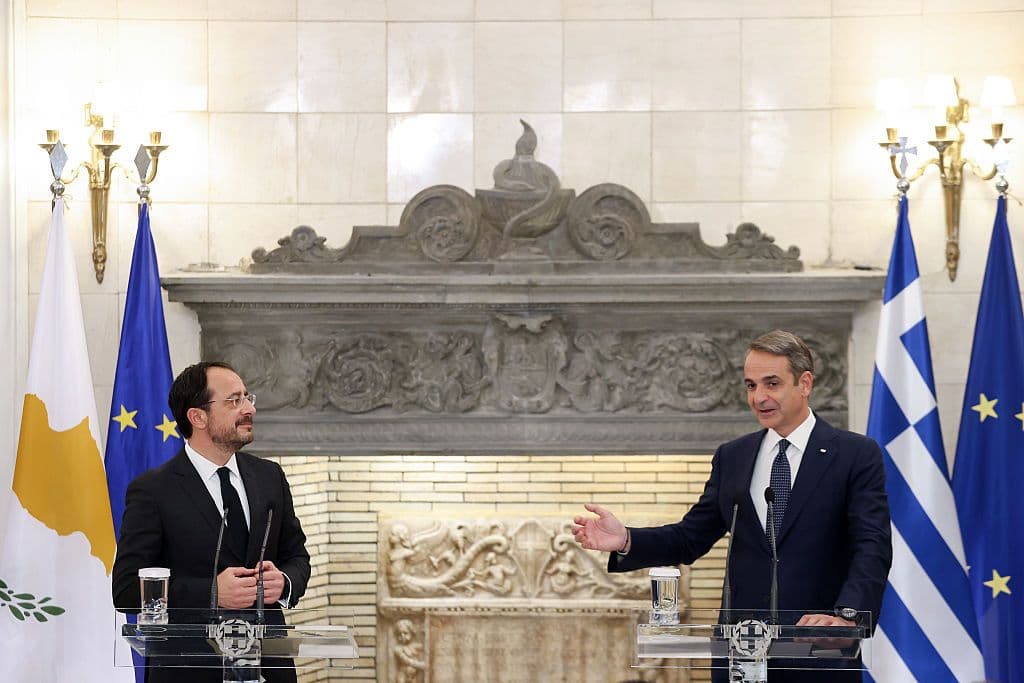
Greek Prime Minister Kyriakos Mitsotakis (R) and Cypriot President Nikos Christodoulides (L) hold a press conference during the 3rd Intergovernmental Summit between Greece and Cyprus in Athens at Maximos Mansion in Athens, Greece on Nov. 12, 2025 (Costas Baltas/Anadolu via Getty Images)
 on Google
BRUSSELS, Belgium — The EU is hoping to pass its 21st sanctions package at a July 13 meeting of foreign ministers, just in time for summer, but a spate of objections by largely southern countries threatens to deprive the European Commission's original proposal of most of its punch.
In its original proposal, outlined by Commission President Ursula von der Leyen on June 9, the 21st sanctions package was set to break new ground with measures targeting cryptocurrency, Russian fisheries, and entry bans on anyone who served in the Russian Armed Forces.
It was also going to include measures to ensure Russia could not benefit from energy price rises that followed the U.S. attack on Iran, and revisit the sanctions ideas that had thus far been blocked by the former Hungarian Prime Minister Viktor Orban.
Four separate EU diplomats told the Kyiv Independent on the condition of anonymity that Greece, supported by Cyprus and Malta, has been pushing hard to soften a proposed six-month price cap on Russian oil.
One of those diplomats said that "too large a difference between world market prices and the oil price cap would lead to reflagging of ships to third countries," and thus a loss of income for the three countries, which have significant shipping industries.
Compromise could still be reached. One diplomat said they expect that now that energy prices are falling again, the issue could, in part, resolve itself. Two other EU diplomats told the Kyiv Independent they expect the compromise position to be a freezing of prices for three months, to then be revisited in the autumn.
A fifth diplomat familiar with the Greek position said on condition of anonymity that Athens' stance is that "sanctions should impose a greater cost on Russia's war machine than on the economies of EU member states."
That same refrain had been deployed by Belgium to justify its opposition to sanctioning a Russian steel company in the country, and it seems to underpin some of the other objections around the 21st sanctions package.
Two EU diplomats confirmed to the Kyiv Independent that plans to reduce dependence on Russian fish, among the measures previously blocked by Hungary, are either set to be removed from the package of measures or significantly watered down.
One of the diplomats explained that cheap processed fish products, such as fish sticks, tend to have very low margins, meaning companies are ill-prepared for even small cost increases.
They mentioned that while Germany had expressed reservations in this area, Portugal has led the crusade to keep the Russian fish flowing.

And on the subject of crusades, Bulgaria's new Prime Minister Rumen Radev already said he would block measures against the head of Russia's Orthodox Church, Patriarch Kirill, allegedly because of support his country received in the nineteenth century against the Muslim Ottoman Empire.
Russia's doormat
Military personnel engaged in Russia's all-out war against Ukraine are also set to receive far softer treatment in the new sanctions measures than originally intended.
Von der Leyen floated a ban on current and former Russian combatants from entering the EU.
"Europe's door should not be open to Russia's (ex-)combatants," the EU's top diplomat Kaja Kallas wrote at the time.
But that measure is set to either be turned into something more akin to aspirational wording or postponed altogether, three diplomats told the Kyiv Independent.
France, Italy, and, to an extent, Spain, the countries that process by far the most tourist visas for Russians, have been leading opposition to the idea, largely on legal and procedural grounds.

Although EU Schengen visas, once granted, give a visitor access to the entire bloc, they are issued by EU countries, each with its own rules.
Estonia, which first floated the idea of a Schengen ban for Russian soldiers, has ceased issuing tourist visas to Russians altogether, whereas Paris, Rome, and Madrid are issuing them in increasing numbers.
However, a decision to ban Russian soldiers through sanctions would be uniform and apply across the entire EU, a foray into what is otherwise a national decision.
A more valid concern of the objecting countries is that there is no clear plan for implementing the ban. How do you verify who is and who is not a soldier? Where does the money come from for additional staffing and verification to ensure Russian combatants cannot sneak in?
For them, the European Commission needs to bring together a fully worked-out proposal, which means the measure would not be ready for adoption at the July 13 meeting of foreign ministers.
The alternative, to pass the measure in even a weakened form, could still be possible, but that leaves those EU countries that were supportive of the measure having to calculate if it is politically more advantageous to have a bad deal or no deal.