Belgium has a Russian steel addiction — and doesn't want to fix it
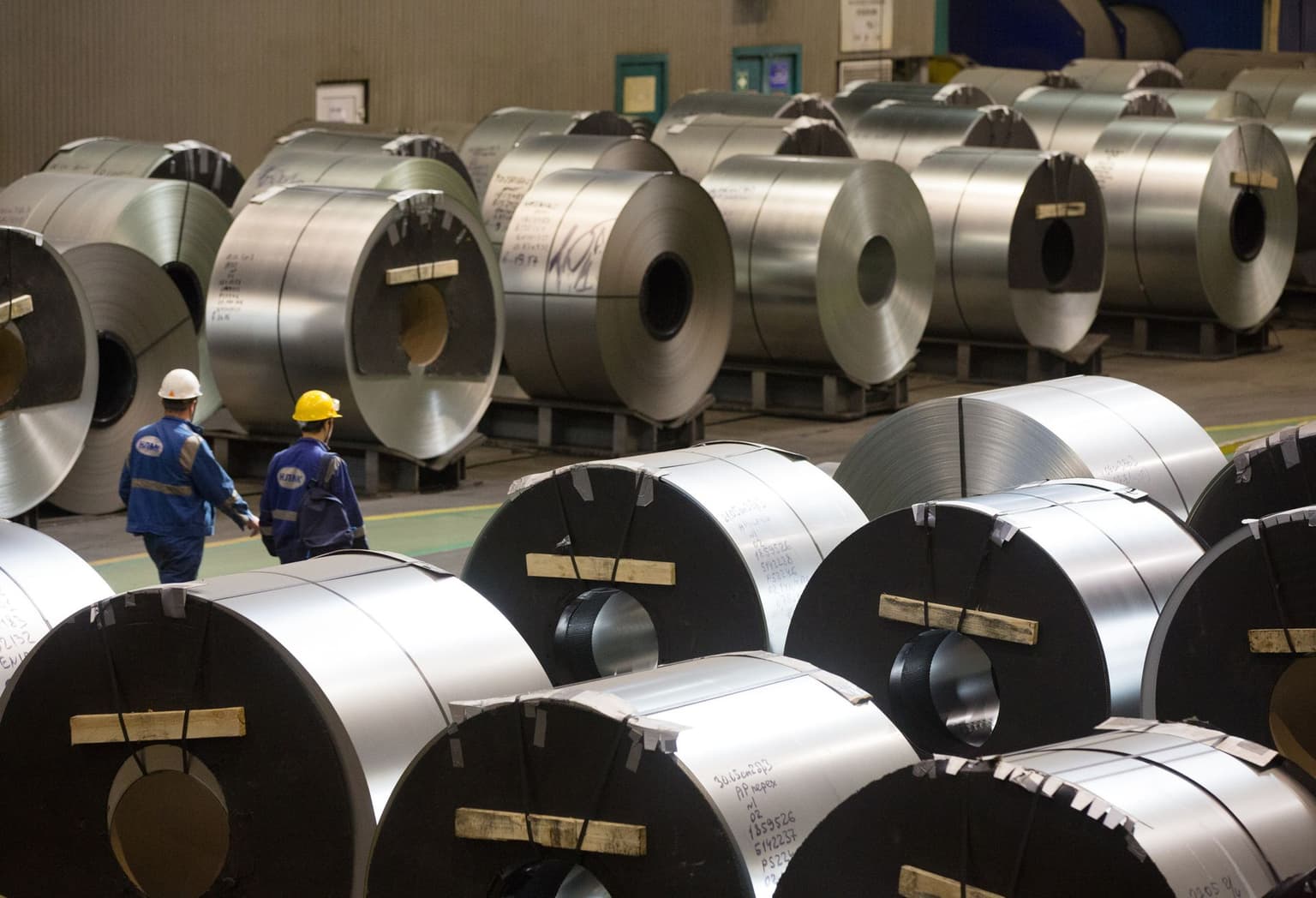
Galvanized steel rolls sit in a storage area following manufacture at the Novolipetsk Steel PJSC plant, operated by NLMK Group, in Lipetsk, Russia, on June 18, 2018. (Andrey Rudakov / Bloomberg via Getty Images)
 on Google
BRUSSELS, Belgium — More than four years after the EU began sanctioning Russian steel, Belgium remains a loyal importer — thanks to a sanctions exemption that allows a Russia-based steel giant to continue supplying its Belgian factories with low-cost slabs.
Despite sweeping EU sanctions against the Kremlin for its war in Ukraine, Belgium has opposed attempts to sanction the company, NLMK, and its Kremlin-connected billionaire owner, Vladimir Lisin. Belgian officials fear that taking action could hurt employment in an already economically deprived region. Critics say the arrangement is more money for one of Russia's richest oligarchs.
NLMK in Russia is supplying its European mills with slabs, according to the European steel association Eurometal. An industry slide deck seen by the Kyiv Independent says those slabs are sold at "ultra low prices," giving EU-based re-rollers "an artificial cost advantage."
While most forms of steel from Russia were sanctioned in the first weeks of the country's full-scale invasion of Ukraine, there was one exception: semi-finished steel slabs.
When steel is made, it can be cast into a basic "semi-finished" shape, which can then be "re-rolled" elsewhere into a final product, or finished steel. Slabs are one of these semi-finished shapes.
The EU agreed to a gradual phase-out of Russian slabs as part of its 12th sanctions package in December 2023, with an end date of Sept. 30, 2028.
Moscow currently supplies 58% of the EU's slab imports from third countries. A third of those slabs go to Belgium alone, with Italy, Czechia, France, and Denmark rounding out the top five importers.

While there are several steel manufacturers in Belgium, most are not using slabs at all, and ArcelorMittal Belgium, the largest entity in the country, "is not importing any Russian slabs or other semi-finished steel products to Belgium since at least 5 years," its CEO, Frederik Van De Velde, told the Kyiv Independent in a written comment.
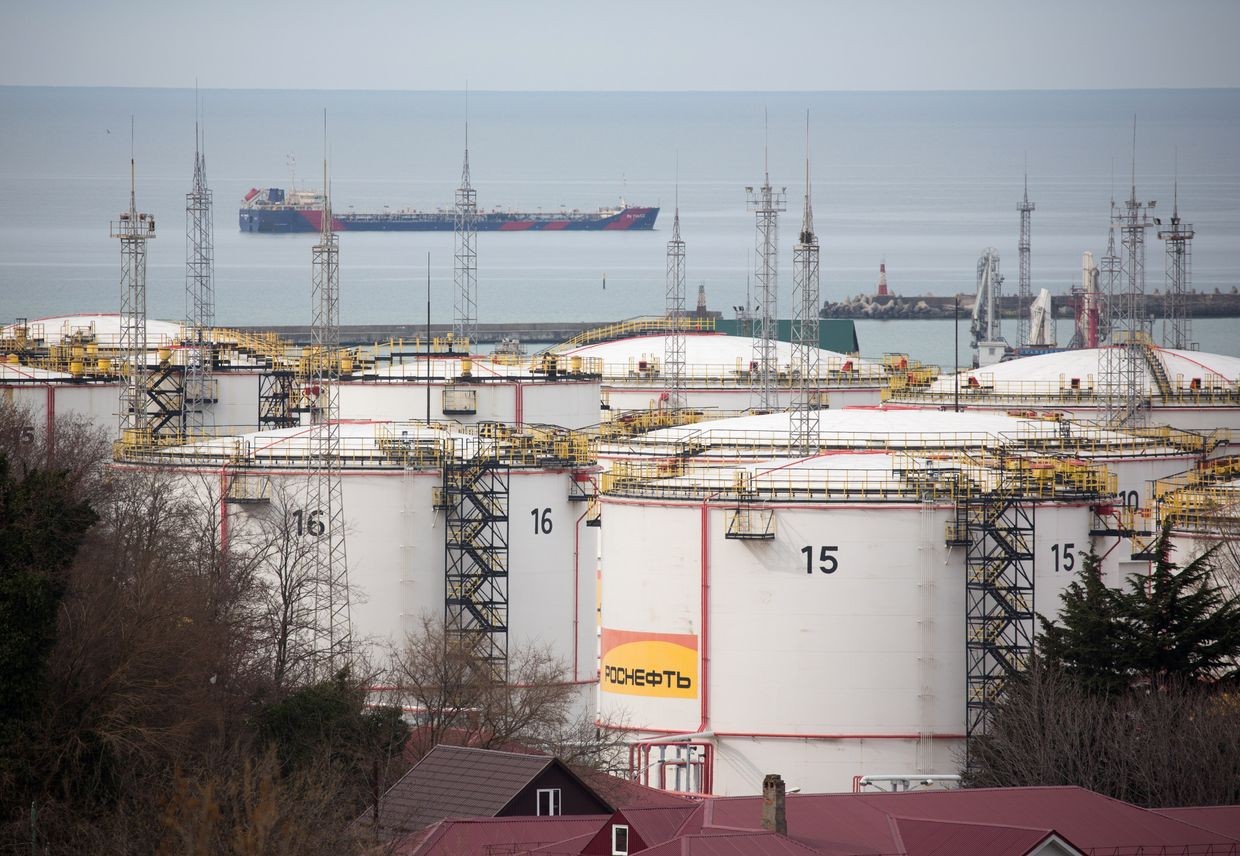
But the same cannot be said of two plants owned by the Russian Novolipetskiy metallurgicheskiy kombinat, or NLMK, the nearest of which lies a mere 22 kilometers from the EU's capital, Brussels.
NLMK is one of Russia's four largest steel companies. It owns 49% of NLMK Belgium, and an additional 2% via a connected entity called Tube De Haren et Nimy. The remaining 49% is owned by Belgium's French-speaking region via its investment vehicle Wallonie Entreprendre.
As of June 2026, NLMK's owner, oligarch Vladimir Lisin, was listed in Bloomberg's Billionaires Index as the world's 110th richest man, with a net worth of $23.5 billion.
Lisin has been sanctioned by Ukraine, Australia, and Canada. The Canadians describe Lisin as a "Kremlin-linked billionaire" among those who support Russia's full-scale invasion of Ukraine and who have benefited from the war.
He has not been sanctioned by the EU, something the EU's Defense Commissioner Andrius Kubilius questioned when he was a member of the European Parliament.
When asked if Kubilius still holds his former view, a European Commission spokesperson told the Kyiv Independent that EU sanctions policy is decided by unanimity, and that "sanctions discussions are confidential."
However, the Kyiv Independent was told by EU and national diplomats on the condition of anonymity that Lisin's name had been floated in earlier discussions, only to be removed from consideration.
A spokesperson for Belgium's foreign ministry said that "on the proposal to list Mr Lisin individually, Belgium has indeed expressed reservations, and that position has not changed."
But "sanctions must hurt the Russian war machine more than they hurt our own economies," the spokesperson added, before explaining that sanctioning Lisin "would have direct and disproportionate consequences for industrial sites and jobs in Belgium — workers and supply chains that have nothing to do with the Russian state."
EU officials in Brussels appear to see the purpose of sanctions differently.
"I can’t speak, of course, to what Belgium sees as the guiding principle … our language is more along the lines of putting pressure on Russia to engage in negotiations and do so on terms acceptable for Ukraine," one EU official told the Kyiv Independent on condition of anonymity.
And Belgium might not be Lisin's only protector. NLMK Europe also has facilities in Denmark, Italy, and France, all of which feature among the top five Russian steel importers in the EU.
Ukrainian lawmaker Oleksiy Honcharenko, who pushed earlier transatlantic efforts to sanction key Russian individuals and wrote to the EU's top diplomat Kaja Kallas about NLMK, told the Kyiv Independent that "by acquiring industrial assets within the EU, Lisin appears to have secured a form of 'insurance' against being added to EU sanctions lists."
The situation prompted social democrat EU lawmaker Thijs Reuten to ask "are we crazy?" on social media in response to new data showing just how much steel the bloc was still importing from Russia.
How does this end?
Belgium's foreign ministry spokesperson told the Kyiv Independent that the country will follow the 2028 planned phase-out date as planned.
"Russian steel must leave the European market, and it will …Belgium will fully implement this calendar, just as it has fully implemented every previous sanctions package," they said.
The slabs themselves are easily replaceable. The GMK Center, a Ukraine-based consultancy, notes China, India, and Brazil as alternative suppliers.
But that hasn't stopped NLMK's Belgian operations from trying to turn crisis into opportunity. Belgian newspaper L'Echo reported in October 2025 that NLMK intends to invest 1.2 billion euros ($1.4 billion) in a plant to sustainably produce steel slabs, but that it would require significant financial backing from the Belgian government and the EU.
One grassroots petition, which is gaining backers in the European Parliament, is now going further and calling for an immediate ban on the Russian steel trade.
"I strongly support the objective of this initiative," German conservative MEP Michael Gahler, a leading voice on Ukraine in the European Parliament, told the Kyiv Independent in a written comment.
"Challenges should not become an excuse for inaction — industry and policymakers should instead work together to find practical and creative ways to overcome them," he added.