A bridge, missiles, and billions in revenue: North Korea's role in Russia's war deepens again
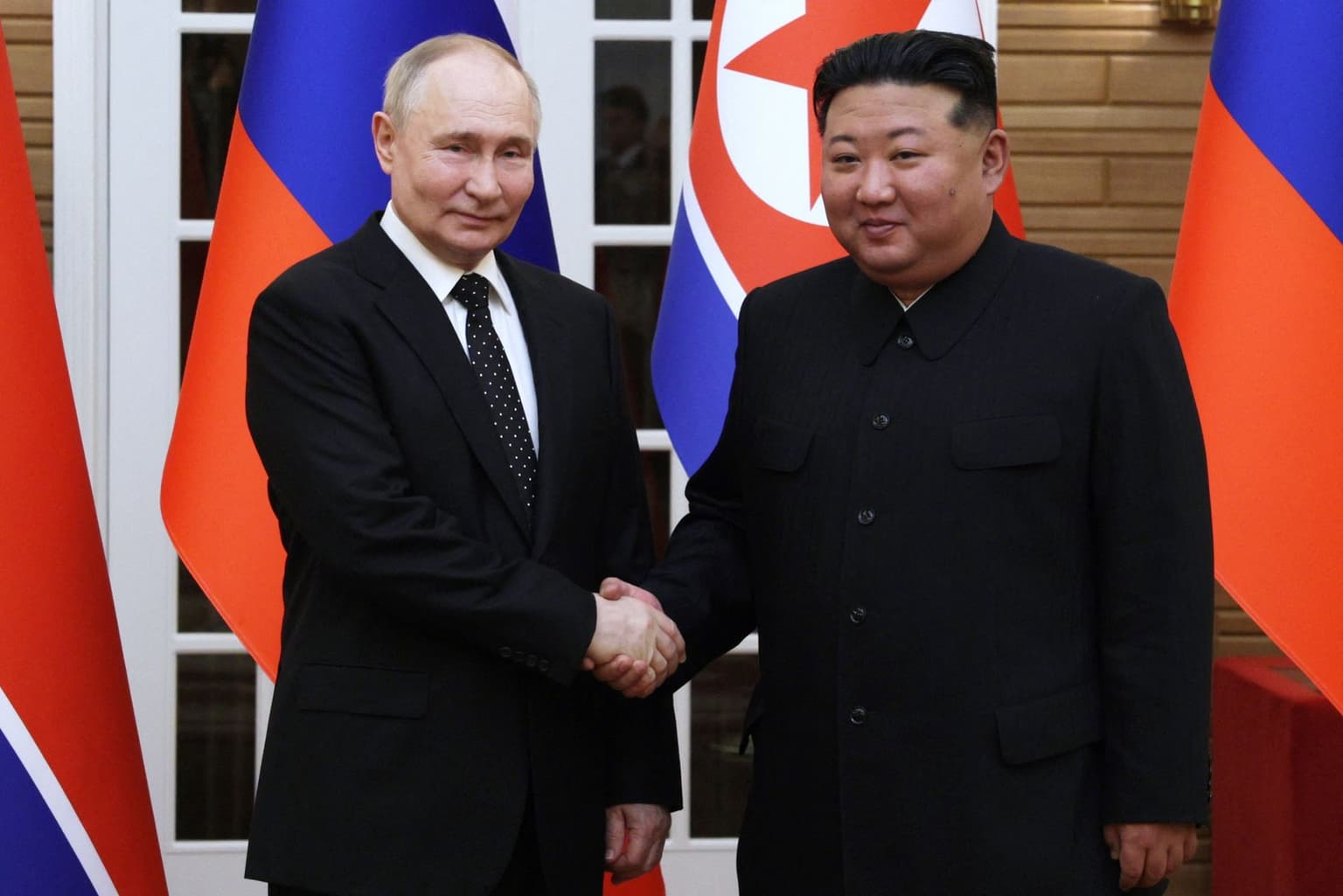
North Korean leader Kim Jong Un (R) and Russian President Vladimir Putin (L) shake hands after a welcoming ceremony at Kim Il Sung Square in Pyongyang, North Korea, on June 19, 2024. (Gavriil Grigorov / POOL / AFP via Getty Images)
 on Google
No longer a minor player, Pyongyang has become an essential cog in Russia's war machine. Now, Kyiv warns that its role may grow further still — but not overnight.
Ukrainian intelligence in August issued alarming warnings hinting that Russia could soon ask North Korea to contribute up to 50,000 more of its troops for its war against Ukraine, with missiles, drone operators, and technical brigades to follow.
This influx of additional troops and materiel would come on top of the soldiers, shells, and missiles that Moscow had already received, helping it accelerate its offensives against Ukrainian forces and ramp up strikes against Ukraine's cities.
While this mass deployment is unlikely to happen immediately, experts who spoke to the Kyiv Independent agreed that a 50,000-strong reinforcement force would be a significant boost for Russian forces in any case — and that Pyongyang will increasingly be helping Russia's army in the future.
read also
Important support — and a cash bonanza for Pyongyang
In almost any comparison, Russia and North Korea are hardly equals. The former has eight times the population of the latter, and the Russian economy is almost 100 times larger than North Korea's.
But when it comes to military production, the two countries are surprisingly complementary, with North Korea helping Russia's war on Ukraine in many areas.
“I wouldn't even say that North Korea is the minor partner in this relationship anymore," said Leonid Petrov, a researcher specializing in Pyongyang's international relations at the Australian National University.
Assistance is not limited to boots on the ground. Since 2024, Russia has, for instance, launched at least several dozen North Korean ballistic missiles on Ukrainian territory. While these missiles vary in type, they are generally considered more powerful – but less accurate – than their Russian equivalents.
Russia's dependency on North Korea does not stop there.
"This (dependency) was especially visible during the phase of the so-called 'artillery hunger' in Russian forces (in late 2022 and early 2023), when North Korea actively supplied Russia with ammunition," said Oleksandr Kovalenko, a military and political expert at the Ukrainian Center for Security Studies.
"Aside from that, (North Korea) produces high quantities of artillery powder, which Russian manufacturers cannot produce enough of," the researcher said.
Specialized personnel is also important, with Ukrainian intelligence estimating that North Korea had recently sent 400 drone operators to Russia.
Another case in point was Russia's efforts to push Ukrainian forces out of Kursk Oblast, a western Russian border region partially occupied by Ukraine between August 2024 and the spring of 2025.
Moscow's campaign there would have been "much slower" without support from North Korean soldiers, Kovalenko said, adding that Russian advances in other sections of the front line would have also been more difficult without North Korean military deliveries.
South Korea's Defense Ministry confirmed that Pyongyang is preparing for additional troop deployments in Ukraine.

This assistance is set to increase further, with Russia investing considerable funds to improve delivery logistics.
Currently, Russia's only land connection to North Korea is a rail bridge built in 1959, but differences in rail gauges between the two countries make it difficult to use.
This should change by the end of 2026, when Russia and North Korea plan to open their first car border crossing across the Tumen River, which separates the two countries.
Both sides claim that the bridge is intended to boost tourism and civilian economic exchanges and is not intended for military purposes.
"This is almost certainly not true," said Nazar Myhun from the Ukrainian NGO Truth Hounds, which investigated the bridge project. "Russian-North Korean (non-military) trade is valued at barely $20 million to $30 million per year. Tourism is almost non-existent, and the small number of tourists mostly fly directly through Pyongyang, in any case."
The bridge project is exclusively financed by Russia, whose military needs have funded a cash bonanza for the regime of North Korean dictator Kim Jong Un in recent years.
According to estimates, North Korea raked in around $22 billion in foreign revenue between 2022 and 2025, almost four times as much as in the previous four-year period.
"$22 billion is both a large sum and not really a big one at the same time," Petrov commented.
"On the one hand, North Korea's annual GDP sits just above that figure, so this is a lot of money for the regime. At the same time, this is not a huge amount on its own, and international sanctions mean it's difficult for the regime to use these funds."
A firm alliance — but with limits
Soon after Russia and North Korea signed their strategic partnership agreement in 2024, North Korean soldiers were deployed to Russia's Kursk Oblast against Ukrainian forces fighting there.
However, this precedent does not mean that Russia can simply demand a large number of troops from Kim and immediately receive them, Kovalenko said.
"Things like this do not happen overnight in North Korea," Petrov noted, citing the 2024 treaty, which came much later than Russia's first requests for North Korean military assistance in 2023.
"Normally, Kim Jong Un first contemplates the pros and cons, possibly consults advisors, calculates risks, then soldiers need to be trained and indoctrinated — all of this takes time," the researcher said.
South Korea's Defense Ministry confirmed that Pyongyang is preparing for additional troop deployments in Ukraine, but said it sees no signs that this should happen immediately.

North Korea has also set firm limits on troop deployments, refusing to send them directly into Ukrainian territory, Kovalenko said in turn.
"So, if thousands of new North Korean troops are sent to Russia, they will most likely be dispatched to Russian border regions, such as (the) Kursk or Voronezh (oblasts)," the expert predicted.
In theory, these forces could allow Moscow to free up soldiers stationed on Russian soil for new offensives on Ukrainian territory, especially after speculations that Russia could carry out a new wave of mobilization following parliamentary elections in September.
"In this scenario, North Korean soldiers are unlikely to be used as combat forces — but they could be used as an occupation force, if something changes and Kim Jong Un agrees to send troops directly to Ukraine," Petrov said.
Another scenario could involve Pyongyang focusing on deploying additional missile launch units — and other specialized forces — but refraining from sending soldiers to territories internationally recognized as sovereign Ukrainian territory, Kovalenko explained in turn.
"In any case, all of these scenarios are hypothetical, and it's unlikely that anything will change from one day to another, with tens of thousands of North Korean soldiers suddenly flowing into Russia," Petrov concluded.