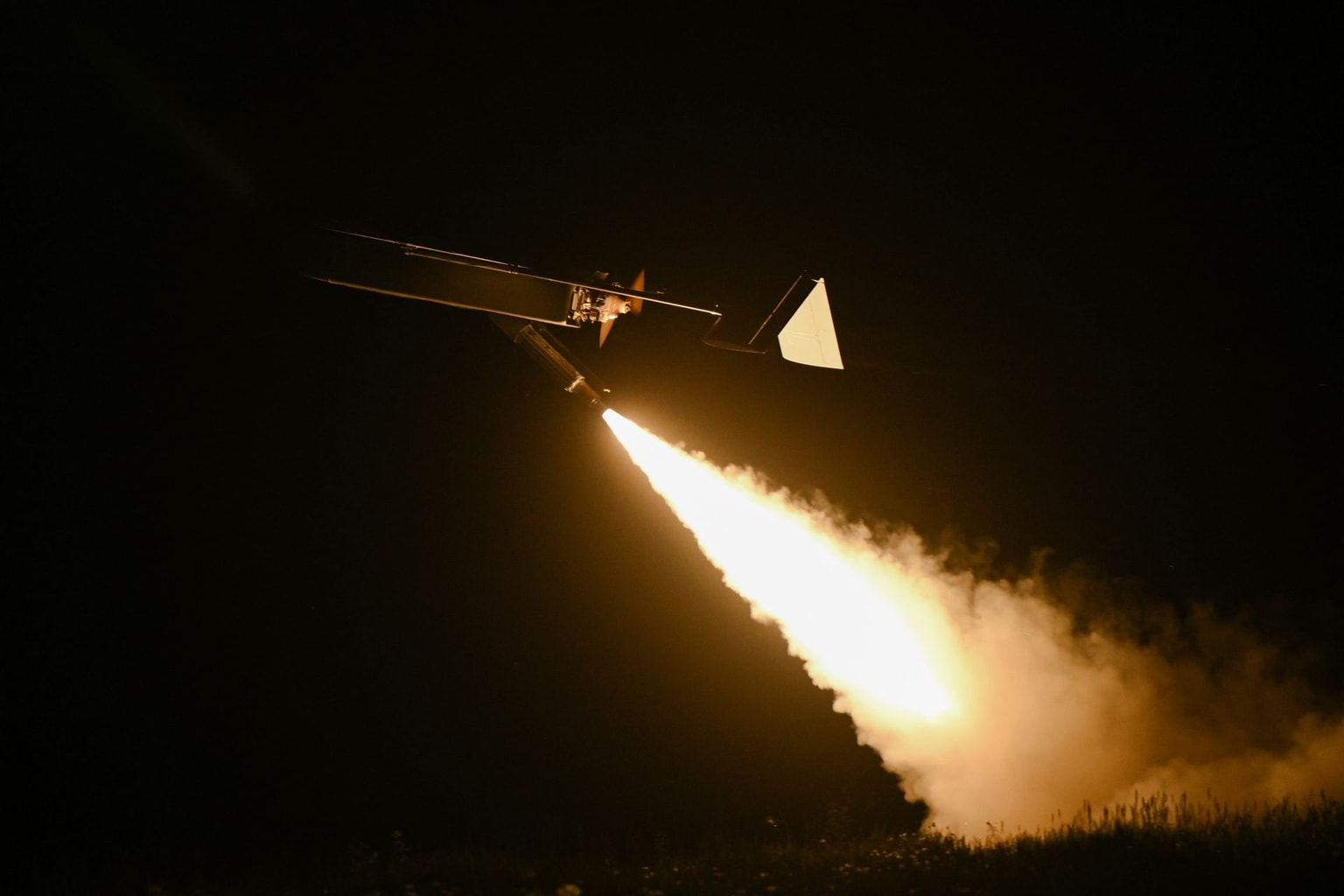
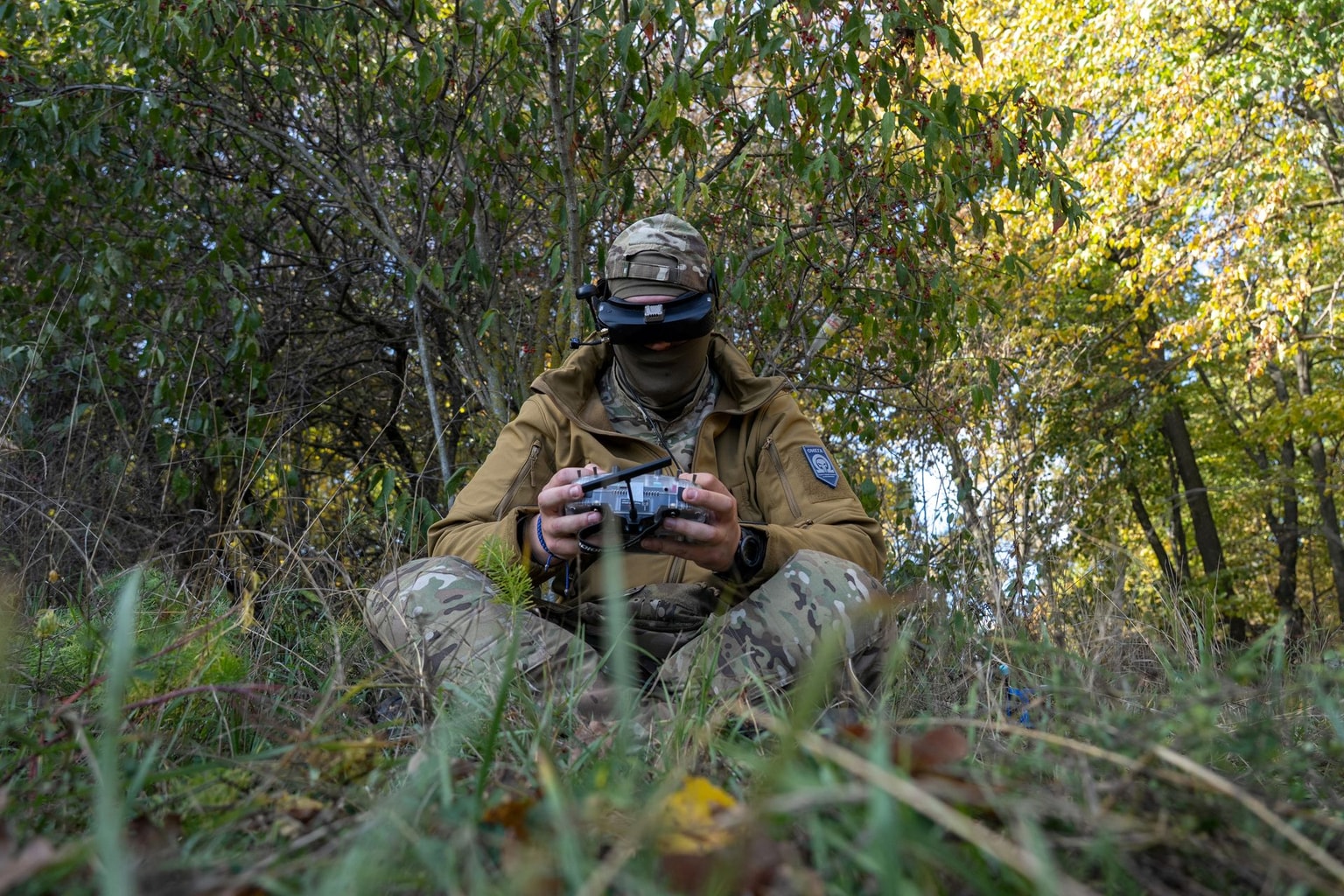
As Patriots run low, Ukraine may have invented a new way to down Russia’s 'unstoppable' Kinzhal missiles
Ukrainian EW specialists say their Lima stations can divert Kinzhals by disrupting satellite navigation.
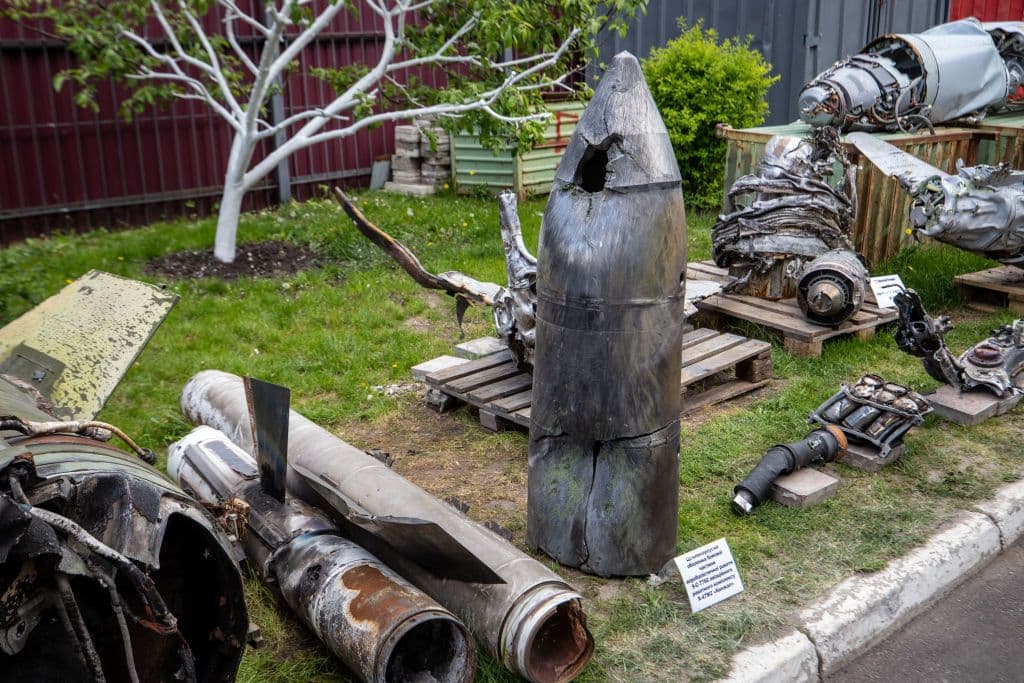
The remains of a Russian Kh-47M2 Kinzhal missile are at an exhibition showing the remains of missiles and drones that Russia used to attack Kyiv, Ukraine on May 12, 2023. (Oleksii Samsonov /Global Images Ukraine via Getty Images)
 on Google
A Ukrainian electronic warfare project claims to have cracked Russia’s vaunted hypersonic missile, the Kinzhal, one of the fastest and most feared of its kind in the world.
"When we put up our EW (electronic warfare) wall, of 58 of 59 launched Kinzhals, only one landed. All the rest were suppressed," Alkhimyk tells the Kyiv Independent.
Alkhimyk — "the Alchemist" — is the commander of the "Night Watch," an air defense unit that has built out an increasingly sophisticated network of electronic warfare stations across Ukraine since 2023.
Their core weapon is the "Lima," an EW station that has gotten good enough to bring Kinzhals to ground with a whimper rather than a bang.
A video that Lima developer Cascade Systems shared with the Kyiv Independent on April 20 shows a Kinzhal dropping harmlessly in a rural area.
Alkhimyk claims the Lima stations have a range of 300 kilometers (186 miles) when countering Kinzhals.
Cascade says that the project has stopped a total of 58 Kinzhals from hitting their targets since last summer, including 26 in the first three months of 2026 alone. If confirmed, that would amount to a near-perfect defense against one of Russia's most infamous weapons.
"The system really has no analogs."
It seems too good to be true. Yet Ukraine’s Air Force has tallied a sharp decrease in Kinzhal attacks in recent months, with only one of these feared hypersonic missiles seemingly making it through the night of March 28.
"In the report, before they found the Kinzhal, it was 'locationally lost' — one of those incomprehensible terms in the army," said Alkhimyk, who provided a video of the crash site they found after the Air Force's morning report. He said Limas had misdirected the Kinzhal in question to a stretch of empty field.
The key lies in the multidirectional satellite-navigation antennas Russia uses to guide its long-range weapons. Systems from Shahed drones to Kinzhals can navigate in several ways, including by tracking their own movement or orienting themselves visually. But when satellite navigation is available, they default to it.
Russia’s controlled reception pattern antennas, or CRPAs, are designed to keep weapons locked onto satellite signals despite electronic interference. The best known are Kometa systems, which have been a bane to Ukraine since the start of the full-scale invasion.
These CRPAs feature an array of what are, in effect, smaller antennas, which work together to identify false signals. Until recently, spoofing a CRPA required more signal-broadcasting stations in range than the CRPA had sub-antennas. Chinese developers then built mathematical models that let CRPAs overcome that approach, and sold them to Russia.
"These antennas were created to counteract a number of EW units that exceeds the number of units in the antenna," Alkhimyk explained.
Alkhimyk says the breakthrough was to prevent the CRPA antennas from recognizing where the spoofing signal was coming from, meaning it takes only 32 Lima stations to sever a Kinzhal’s link to the satellite signals guiding it.
A key feature is that while Limas generate jamming and spoofing signals, they have a third type of signal that, per Alkhimyk, actually hacks the Kinzhal in flight.
"The third type of signal is a cyberattack," Alkhimyk said. The attack, he said, targets the Kinzhal’s receiver. "In order for the receiver to make a decision, it has to download a lot of technical data from the satellite. We worked out how to load that data in such a way that it pulled incorrect data and didn’t update for a long time after it left our zone."
The project is the first of its kind to show real success against advanced CRPAs, the satellite-navigation antennas Russia uses to filter out false signals, Maksym Skoretsky, head of electronic warfare for Ukraine’s Land Forces, told the Kyiv Independent.
"The system really has no analogs," Skoretsky told the Kyiv Independent. "Nobody had managed to carry out suppression of 16- and 32-channel CRPA antennas before this, much less at these kinds of distances."
Skoretsky confirmed Lima's effectiveness "in 58 of 59 applications" against Kinzhals.
Kinzhals are among Russia’s top-line weapons. They are also expensive. The Center for Strategic and International Studies estimated last February that they cost $15 million each, though other estimates put the price far lower.
According to Ukrainian defense outlet Militarnyi, the cost of a Kinzhal under the latest contracts is roughly $4.5 million. As of Feb. 24, 2026, Ukraine’s Air Force tallied a total of 86 Kinzhals that Russia had fired at Ukraine in the preceding four years.

In May 2023, the entry into service of the first U.S.-made Patriot air defense systems was met by a salvo of Kinzhals, testing what Russia had previously considered an unstoppable object. While Patriot systems, particularly their PAC-3 missiles, proved exceptionally good at intercepting Kinzhals, future supplies of PAC-3 missiles to Ukraine are in jeopardy.
By contrast, Lima stations are Ukrainian-made and do not require expensive single-use hardware, such as PAC-3 interceptor missiles, making them far cheaper to use.
Alkhimyk said that Lima stations have also grown remarkably effective at dragging Shahed drones off course. A sticking point, however, remains the Iskander ballistic missile. The Iskander is closely related to the Kinzhal, but Alkhimyk credits Lima stations with a recent decline in the accuracy of Iskander strikes.
"Usually, before the change in our field, their accuracy was 10 meters. But during recent attacks, they’ve missed by anywhere from 100 meters to over a kilometer," he said.
"If you look at the whole country, if you want to close the whole country — to everything that flies, Shaheds and missiles — you need $1 billion in mechanisms," said Alkhimyk.
"If you want to add defense against ballistics, that’s another $800 million. But $1.8 billion — that’s just two Patriot systems."
Hi, this is Kollen, the author of the article above. Thanks for reading. Weaponry on the frontlines in Ukraine is evolving at a rate not seen since at least the Second World War. As we continue tracking the latest developments, please consider supporting our reporting.