'My first impression was it's hell' — Belarusian prison memoir brings attention back to Lukashenko's repressions
 on Google
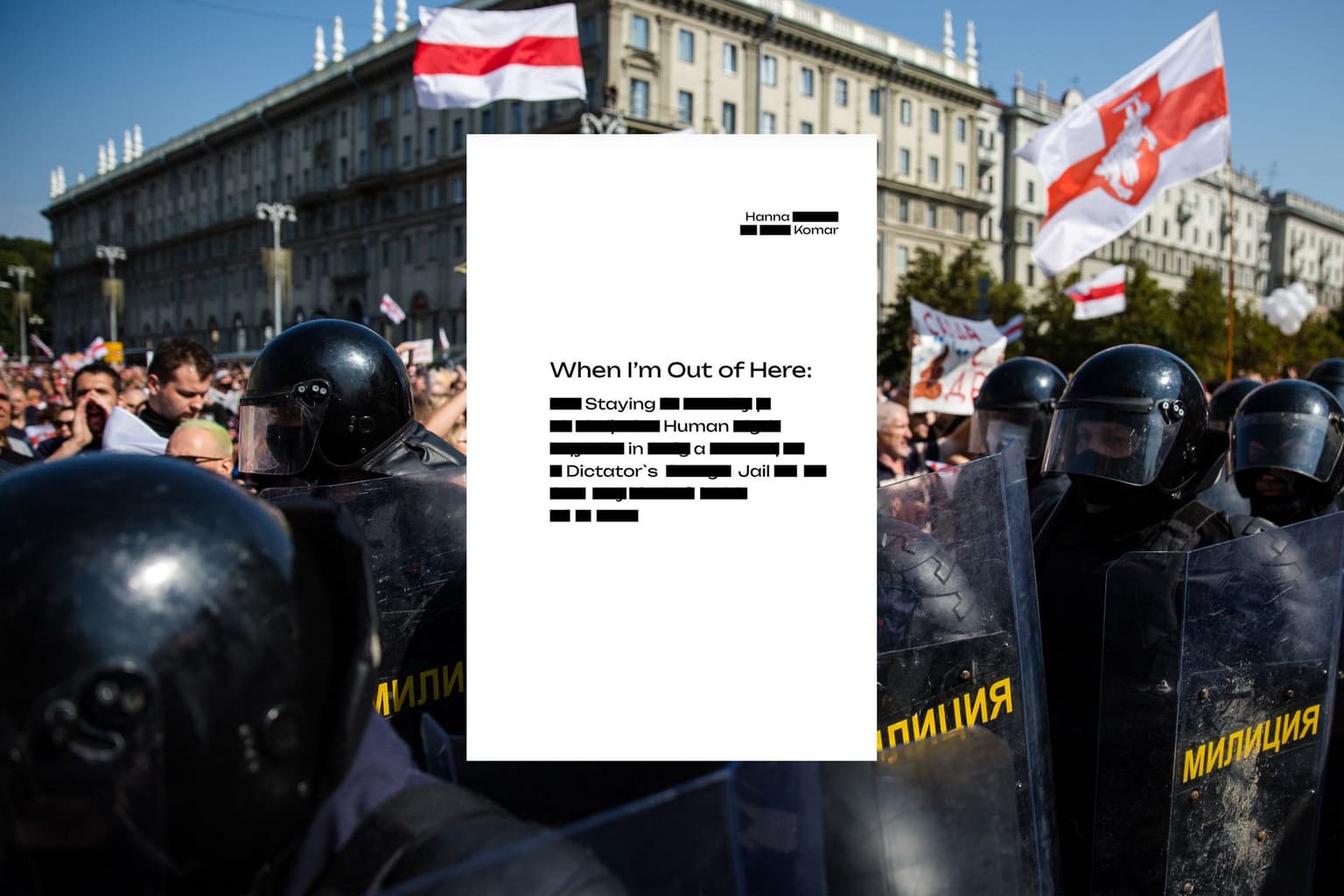
In a Belarusian prison, it's a simple note — "We are with you" — hidden inside a chocolate bar from a volunteer aid package that can move political prisoners to tears. In their tightly monitored environment, where isolation itself is a form of punishment, such gestures take on an almost sacred significance.
Hanna Komar's memoir "When I'm Out Of Here: Staying Human in a Dictator's Jail" details how these fleeting acts of solidarity become a means of holding on when living in an authoritarian regime. In some respects, they serve as reminders that the regime has not succeeded in its most fundamental aim: to sever the imprisoned from the society for which they risked their freedom.
Part prison diary, part political testimony, "When I'm Out Of Here" is less concerned with brutality than with the fragile, stubborn forms of humanity that persist alongside it. Komar recounts not only her own arrest and imprisonment, but the experiences of countless others swept up in the mass detentions that followed Belarus's 2020 uprising against Alexander Lukashenko. "When I'm Out of Here" situates these personal struggles endured in prison within a wider national trauma, turning individual memory into a collective record of resistance.
After the presidential election of August 2020, hundreds of thousands of Belarusians poured into the streets when Lukashenko claimed yet another implausible landslide victory. Independent observers and much of the international community regarded his main challenger, Sviatlana Tsikhanouskaya, as the rightful new leader of the country.
For weeks, Belarus witnessed the largest demonstrations in its post-Soviet history: an extraordinary, if brief, eruption of civic defiance in a country long thought politically inert. Though the movement was eventually crushed by mass arrests, torture, and exile, it brought Lukashenko's regime closer to collapse than at any previous moment in his three-decade rule.
Komar herself was arrested in September 2020 while marching in support of Maria Kalesnikava, one of the leading figures of the anti-government movement, who had just been detained after thwarting the authorities' attempt to force her into exile. Kalesnikava's dramatic refusal — tearing up her passport at the border to prevent her deportation — quickly became emblematic of the opposition's refusal to yield.


For Komar, the consequences of showing her solidarity with Kalesnikava were immediate. Her "crime," as she says, was little more than the public expression of hope for a democratic future. For this, Komar was detained and sentenced to nine days of administrative detention, on the strength of a police report alone, a procedural fiction that had by then become routine in Belarusian courts.
The brevity of her sentence is, in some ways, what makes the memoir so revealing. Komar writes from the threshold of the prison system rather than its depths, capturing the arbitrary machinery of Lukashenko's system of repression at the moment it first closes around ordinary citizens. Reading it, there is an implicit understanding that far worse is yet to come for those who are less lucky to get out sooner.
In the years following the failed revolution, thousands of Belarusians have faced arrest, imprisonment, or exile. Hundreds have spent years behind bars, with some having died in detention. Though recent months have seen the U.S.-facilitated release of some political prisoners, Lukashenko's apparatus of terror remains firmly intact, a reminder that the political crisis of 2020 was never resolved so much as systematized.
As a poet, Komar writes that she understood almost immediately that her experience of arrest and detention would need to be transformed into literature. Yet, as she explains in her introduction, she was wary of producing a narrowly autobiographical account, one that would reduce a collective political rupture to the confines of a single voice. The challenge, then, was not only to remember but to arrange memory in a way that could carry more than personal testimony.
For this purpose, she turns explicitly to the stylistic model mastered by Belarusian journalist Svetlana Alexievich, whose works — such as "Voices from Chornobyl" — assemble fragments of speech, recollection, and witness testimony from a number of people into a collective narrative form. By adopting this approach, Komar situates her book within a distinctly Belarusian tradition of documentary literature, one that treats individual voices not as isolated case studies but as refracted parts of a shared historical experience.
The testimonies in Komar’s book are so vivid and sensory that reading about life in prison can at times feel physically nauseating. What comes through is a world felt in the body’s most basic discomforts: the foul taste of food that barely passes for nourishment, bruises not just from guards but from trying to sleep on thin, unforgiving mattresses over metal bunks, and the relentless "attacks" of cockroaches.
The air itself becomes a compromise: the cold draft from an open window is at once intolerable and necessary, preferable to the suffocating lack of ventilation and useful, too, in masking the stench of the shared toilets. Life in prison is shaped not just by the absurd routines of cruelty masquerading as discipline, but by this steady erosion of physical comfort, where countless small sensory irritations pile up into a constant, grinding pressure meant to break prisoners.
Belarusians were confronted with the necessity of choosing what was right — standing up against Lukashenko's regime — while fully recognizing the consequences that would follow in trying to make it happen.
However, a recurring thread running through these testimonies is the effort of political prisoners to sustain a measure of psychological stability by emotionally supporting each other and thus reminding themselves, repeatedly, of the basic fact of their innocence. The knowledge that they were not criminals — that nothing they had done constituted wrongdoing — becomes a powerful coping mechanism. This insistence does not erase fear or humiliation, but it helps to hold it at a distance. It also leads to moments that take on a strange, darkly comic quality.
"We want to go to the toilet, but no one comes to take us anywhere, and they don't respond to our banging on the iron door. I sit down and pee in the drain, hiding from the CCTV. To keep warm, we're jumping and dancing. My feet are freezing in sneakers, and someone suggests that I should put sanitary pads instead of the insoles," Komar writes.
Komar also traces through these testimonies the effects of decades of sustained Russification in Belarus, visible not only in official policy but in the everyday attitudes of police officers, judges, and prison staff. In her account, language itself becomes a site of suspicion. Protesters are mocked for speaking Belarusian, or chided for "showing off" when they use it in official settings, as though linguistic choice were a form of provocation rather than a basic expression of identity. These exchanges, often fleeting, reveal how deeply cultural hierarchy has been naturalized within the apparatus of the state.
At times, the disconnect between prisoners and authorities becomes almost surreal. Komar describes detainees genuinely trying to appeal to whatever humanity their captors have left—confronting them directly, and asking how they can possibly justify helping to carry out Lukashenko’s policies. The responses, she notes, tend to arrive with mechanical indifference — a shrug, a phrase delivered "as if reading from a script." In such moments, enforcement appears less like ideological conviction than bureaucratic habit, yet the effect is no less devastating: it extends a longer historical pattern in which Belarusians are denied not only political agency, but the legitimacy of their own language, thought, and cultural self-definition.

Once out of prison, Komar says, the waiting for others to be freed is an even more difficult burden, sharpened by the acute understanding of what is happening to those who were denied their freedom. Across multiple testimonies, she returns to a shared sense of shock at the early violence of the crackdown, particularly the idea that police would attack protesters, including women and the elderly, an act initially regarded by many as "beyond the pale." That assumption of restraint, however, quickly collapsed as the scale of state violence became undeniable.
What follows in Komar's telling is not simply disillusionment but a forced recalibration of moral expectation. Belarusians, she writes, reached a point of no return in which action could no longer be measured against hope for safety or success. Instead, Belarusians were confronted with the necessity of choosing what was right — standing up against Lukashenko's regime — while fully recognizing the consequences that would follow in trying to make it happen. She describes a powerful countercurrent running through those weeks — what she calls the "intoxicating feeling of unity and victory over fear" — a brief but transformative suspension of isolation in which collective presence itself became deeply empowering.
The 2020 revolution, unfortunately, failed. Lukashenko remains in power, and people within Belarus continue to be harassed, arrested, and thrown in jail for their pro-democracy stance. Komar, like thousands of other Belarusians, fled the country in search of safety and a better chance at life. Despite the difficult circumstances faced by Belarusians post-2020, books like "When I'm Out of Here" remain an important documentation in the ongoing record of that moment, keeping alive the memory and language of a hope for a better future for Belarus that has been largely suppressed but not yet extinguished.
Co-translated by Komar and John Farndon, “When I’m Out of Here” is available in paperback and e-book from Skaryna Press, a Belarusian publishing house operating in exile.