How 'Russophobia' becomes a tool against political resistance
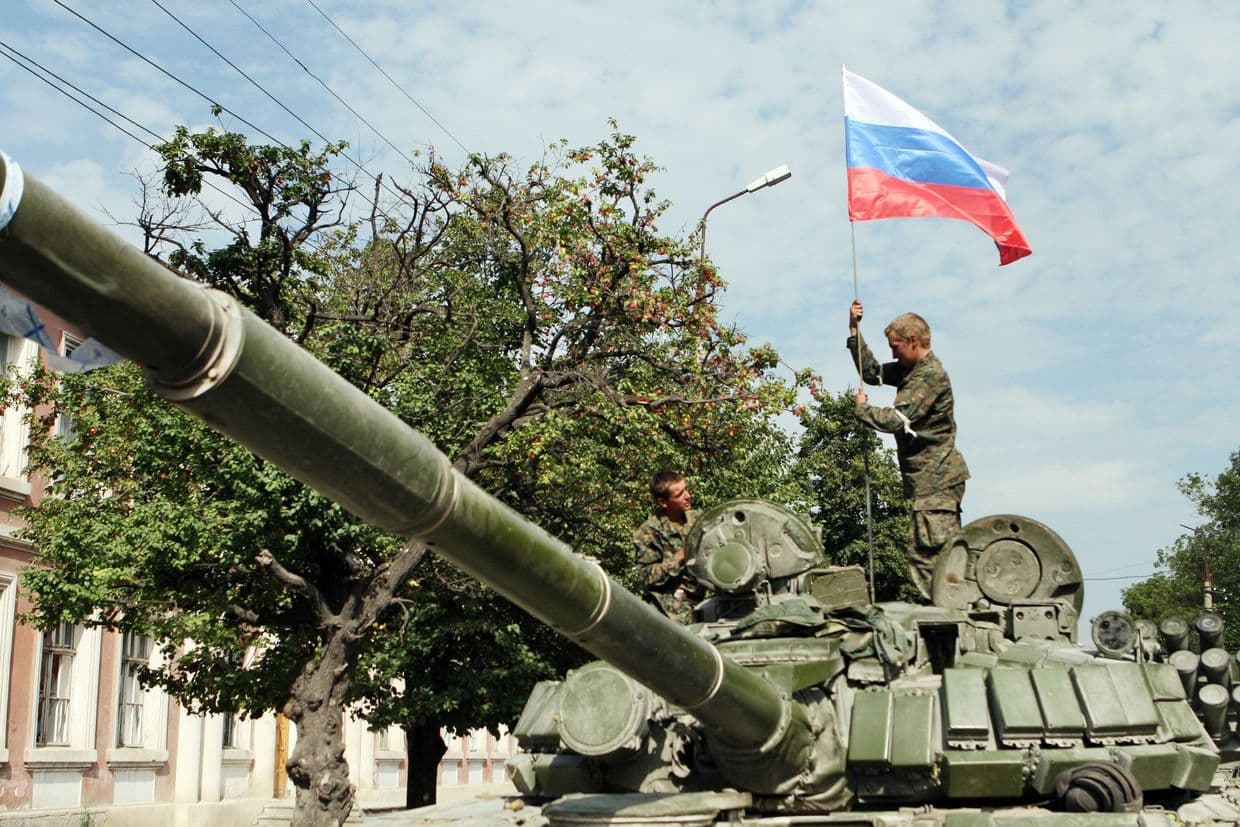
Russian soldiers place a Russian flag atop their tank in Tskhinvali, Georgia on Aug. 11, 2008. (Andrei Smirnov / AFP via Getty Images)
 on Google
Maka Dolidze
Georgian-Norwegian writer
Russia's new law authorizing the use of military force abroad to "protect Russian citizens" allows the Kremlin to deploy troops beyond Russia's borders if Russian citizens are deemed to face arrest, detention, trial, or other forms of perceived persecution by foreign states or international courts.
Many will read this primarily as a possible legal basis for future intervention. Yet there's one more application we should all be aware of.
Russia has previously justified military action beyond its borders through claims of protecting people in South Ossetia (Samachablo) and Abkhazia (Aphkhazeti), including holders of Russian passports, during the 2008 war in Georgia. Similar arguments concerning the protection of Russian citizens, passport holders, and Russian-speaking populations have also appeared in Russia's justification for actions in Ukraine.
Yet Russian strategies are rarely one-dimensional. Their effects must be read across countries, narratives, security structures, and political developments that reinforce one another over time.
This matters also because Western policy toward Russia has long rested on a difficult balance.
NATO itself describes its approach as strengthening deterrence and defense while remaining open to dialogue, and former NATO Secretary General Jens Stoltenberg has called this "a dual-track approach — deterrence and defense, and dialogue."
The new Russian legislation puts pressure on that balance.
Its significance lies not only in what Russia may do militarily, but in how the language of protection can be used politically: by Russia, by governments operating under Russian influence, and by actors who want to portray criticism of Russian power as dangerous, destabilizing, or unnecessarily escalatory.

"Russophobia" becomes a security issue
The same week that Putin's new law was announced, Georgian authorities moved to create a new special division within the Interior Ministry to systematically monitor "hate speech, offensive campaigns, and aggressive communication in public spaces," including posts, photos, captions, and videos on social media.
Officials also described the division as responsible for an "appropriate legal response."
At the same time, pro-Russian NGOs in Georgia launched a "Council for Monitoring Russophobia," aimed at identifying and analyzing what they describe as anti-Russian rhetoric, discrimination, and hate speech in public space.
According to OC Media, the council said it would pay particular attention to statements made after Russia's full-scale invasion of Ukraine in February 2022.
The practical consequences remain unclear, but the direction is not difficult to read.
The political value of the term "Russophobia" lies in its ability to portray political opposition as prejudice, intolerance, or a threat to social stability rather than a legitimate response to Russian influence.
Since Russia's full-scale invasion of Ukraine, Georgian political debate has repeatedly been shaped by warnings that stronger support for Ukraine, confrontation with Russian influence, or alignment with Western policies could bring war to Georgia itself. Critics of the government's approach have often been met with a simple question: "Do you want war in Georgia?"


The political value of the term "Russophobia" lies in its ability to portray political opposition as prejudice, intolerance, or a threat to social stability rather than a legitimate response to Russian influence.
When criticism of Russian influence is increasingly associated with escalation or threats to national security, it ceases to be solely a matter of political disagreement.
Russia's new law reinforces the legal preconditions for such an approach. Now, governments operating under Russian influence have stronger grounds to present opposition as destabilizing, justifying tighter restrictions, harsher penalties, and legal measures against those who challenge the political direction they promote.
History repeats itself
These developments echo Georgia's own history. In the 1930s, many of those who helped establish the first Democratic Republic of Georgia in 1918 were gradually arrested, deported, or executed as traitors because they opposed Soviet control. Members of my own family were among them.
Can one imagine the audacity of telling people who carry these histories within their own families that their experiences should be toned down to preserve a particular idea of peace that is increasingly in political dissonance with reality?
Many who advocate such positions live far removed from the consequences they ask others to accept. From the safety of comfort and stability, peace can become less about justice and more about preserving one's own sense of normalcy, even when others are expected to pay the price with their freedom or their lives.
In a country where much of the population is already tired of Russian hegemony, tired of political developments that undermine Georgia's democratic aspirations, and tired of living under the shadow of occupation, Putin's new law takes on a different meaning.
The risk is that Russia's own legal changes give local authorities abroad a framework for applying this logic to domestic law.
The pragmatism that moves the boundaries
The effects are not limited to countries operating under Russian influence. Western democracies face a different challenge. In societies that seek to balance deterrence with dialogue and stability with security, political pragmatism can gradually shift the boundaries of what is considered a reasonable response to Russian influence.
If criticism of Russian influence is increasingly framed as "Russophobia," extremism, or an obstacle to stability, the same logic can gradually shape political debate in Western democracies.
Warnings about Russian influence can more easily be portrayed as unnecessarily confrontational, while accommodation and compromise are presented as the only responsible alternatives.
This dynamic is particularly powerful in societies with long-established political, diplomatic, and economic relationships that benefit from stability and predictability. In such environments, the pressure to preserve existing arrangements can gradually outweigh the willingness to confront developments that challenge them.
Over time, criticism that would once have been understood as a legitimate response to authoritarian influence risks being dismissed as alarmist, escalatory, or "Russophobic."
What we end up with is the law that extends its military logic into the political dimension. The countries most exposed are those already experiencing growing Russian influence. There, the law strengthens political and legal frameworks through which criticism of Russian influence can increasingly be portrayed as a threat to stability, security, or peace rather than a legitimate democratic position.
In that sense, its function is not only to justify future actions, but to weaken resistance before such actions are ever required.
As these narratives become normalized, they can also influence democratic debate beyond Russia's immediate sphere of influence. In societies that value dialogue, stability, and de-escalation, criticism of Russian influence may increasingly be dismissed as alarmist, confrontational, or "Russophobic," narrowing the space for political disagreement.
Editor's note: The opinions expressed in the op-ed section are those of the authors and do not purport to reflect the views of the Kyiv Independent.