How Russia bought influence over culture in the West
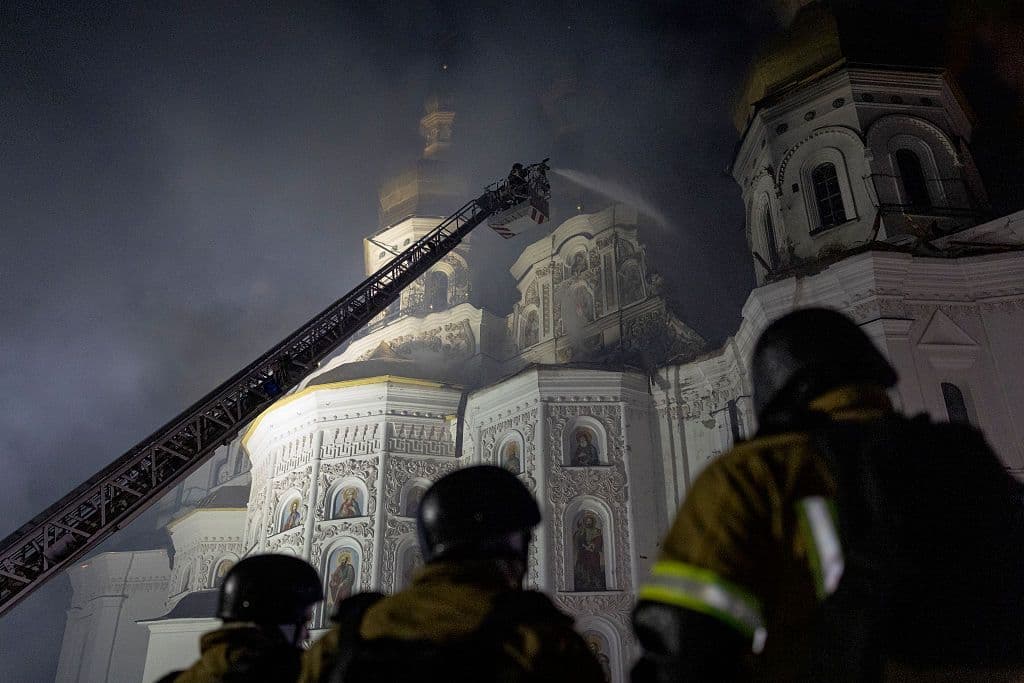
A view of the historic Kyiv Pechersk Lavra following a massive overnight Russian missile and drone attack on Kyiv, Ukraine, on June 15, 2026. (Andriy Dubchak/Frontliner/Getty Images)
 on Google
Agatha Gorski
Co-founder and General Director of the Shadows Project
At 7 p.m. on Saturday, my phone lit up with a message from a colleague in Kyiv. It read: "The Lavra is bombed. It's on fire."
The Kyiv Pechersk Lavra, founded in 1051, is the most important religious and cultural site in Eastern Europe. For nearly a thousand years, it has survived invasions, occupations, revolutions, and wars. And today, it joins a growing list of Ukrainian cultural landmarks damaged by Russian missiles.
According to Ukraine's Culture Ministry, this list has grown to 1,783 cultural heritage sites and 2,540 cultural infrastructure facilities across Ukraine. In recent weeks alone, attacks have damaged the National Art Museum of Ukraine, set ablaze priceless Ukrainian paintings at the Kharkiv Art Museum, and destroyed over 100k film costumes at the Dovzhenko center, which housed Ukraine's oldest costume collection.
Yet as the Kremlin's efforts to wipe Ukraine's identity off the map increase, Russian cultural narratives that deny Ukraine's existence continue to circulate largely unchallenged abroad.
Russian-centered films continue to appear at Western festivals. Some of the world's most prestigious museums, including the MoMA, Louvre, and Tate Modern, to name just a few, still tout Ukrainian artists as Russian.
And earlier this month, a senior American cultural official attended the forum in St. Petersburg International Economic Forum (the first high-ranking US official in a decade) to discuss US-Russia cultural exchange.
It is long past due for Western countries and their political and cultural institutions to start seriously curbing Russian cultural influence on their soil.
Got an opinion on anything you've read in the Kyiv Independent so far?
and it may appear in our Letters section.

For every Ukrainian, it is clear that the Kremlin is not simply attacking Ukraine's territory, but our very identity. Vladimir Putin made that explicit before the invasion, arguing that Ukrainians and Russians were "one people" and denying the legitimacy of a separate Ukrainian nation in an ahistorical essay in 2021, "On the Historical Unity of Russians and Ukrainians.”
The missile strike on the Lavra is the more obvious consequence of Russia's project.
The cathedral was founded almost a century before Moscow’s existence – a fact the Kremlin actively seeks to contest. Naturally, if you destroy evidence of our culture, you can lay claim to our history and subsequently our land.
Less visible but just as consequential is the persistence of Russian imperial narratives within Western cultural institutions.
Today, some of Ukraine's most celebrated artists, such as Kazymyr Malevych, Oleksandra Ekster, and Illia Repin, are still presented as Russian in many of the world's most prestigious museums.
An audit conducted earlier this year at Shadows found that 11 of the world's 12 most-visited art museums have at some point presented works by Ukrainian artists as Russian. Together, those institutions welcomed more than 41 million visitors in 2022 who believe that Russia, not Ukraine, produced pioneering artists who helped shape modern art and influence cultural movements in the Western world.
For decades, the Eastern European collections of Western museums have, at large, been funded by Russian donors and influenced by Russian-source scholarship, which has distorted Ukraine's historical record and reframed its artists' lives to reinforce narratives of Russian cultural supremacy.

Even after Russia invaded Ukraine, many of these narratives continue to circulate within Western cultural and artistic institutions, which has left Western museums hesitant to fix their labels.
The same patterns extend beyond museum walls into the information space, where Russia enjoys a near-monopoly. Its historic control of information has given Russia the upper hand in polluting the information space with billions of dollars' worth of propaganda on which, in 2026 alone, it spent approximately $1.85 billion, a 54% increase from the previous year.
One of the most striking and alarming places this money has targeted is Wikipedia. For many years, Russian actors have repeatedly run operations editing English-language Wikipedia pages of Ukrainian cultural figures to replace "Ukrainian-born" with "Russian-born" or relocate birthplaces from Ukraine to Russia.
This sustained effort influences how millions of people learn about Ukraine's culture and history.
It is no surprise that Russia continues to be treated as a country whose films are screened, whose music is performed on major stages, and whose cultural representatives are invited to discuss cultural diplomacy with Western counterparts — even as the same state loots cultural institutions, destroys artworks, and systematically levels centuries-old heritage sites through targeted strikes.
Last year, sick of the unrelenting Russian narratives that misconstrued history and mislabelled Ukrainian artists, together with my team at the Shadows Project, I launched the Stolen Art Campaign.
The campaign forces major Western institutions to correct mislabeled Ukrainian artists, supported by a public database of misattributions, an Instagram tool that lets museum visitors flag errors in real time, and English-language biographical sourcing for curators. Cleveland and Brooklyn revised their attributions within months.
The Tate, MoMA, and the Louvre opened formal reviews. The campaign reached over one million people and even triggered an unanticipated feature on Russian state TV.
The relevant fact for this article is not the campaign itself but that it shows how a sustained foreign cultural operation ran for decades inside the infrastructure of major Western institutions.
It also showed what can be achieved with limited resources. With a small team and almost no budget, the campaign triggered formal reviews and corrections at major Western museums, triggering a response from Russian actors.
Governments and large institutions have far greater resources and agency at their disposal, and they need to start using them.
Major cultural institutions — including museums, universities, and publishers — should conduct systematic audits of collections, catalogs, and reference materials with the involvement of Ukrainian experts to identify persistent misattributions and inherited imperial framing that distort the cultural record.
Editor's note: The opinions expressed in the op-ed section are those of the authors and do not purport to reflect the views of the Kyiv Independent.