PepsiCo said it would leave Russia. Last year, it paid $237 million to the state
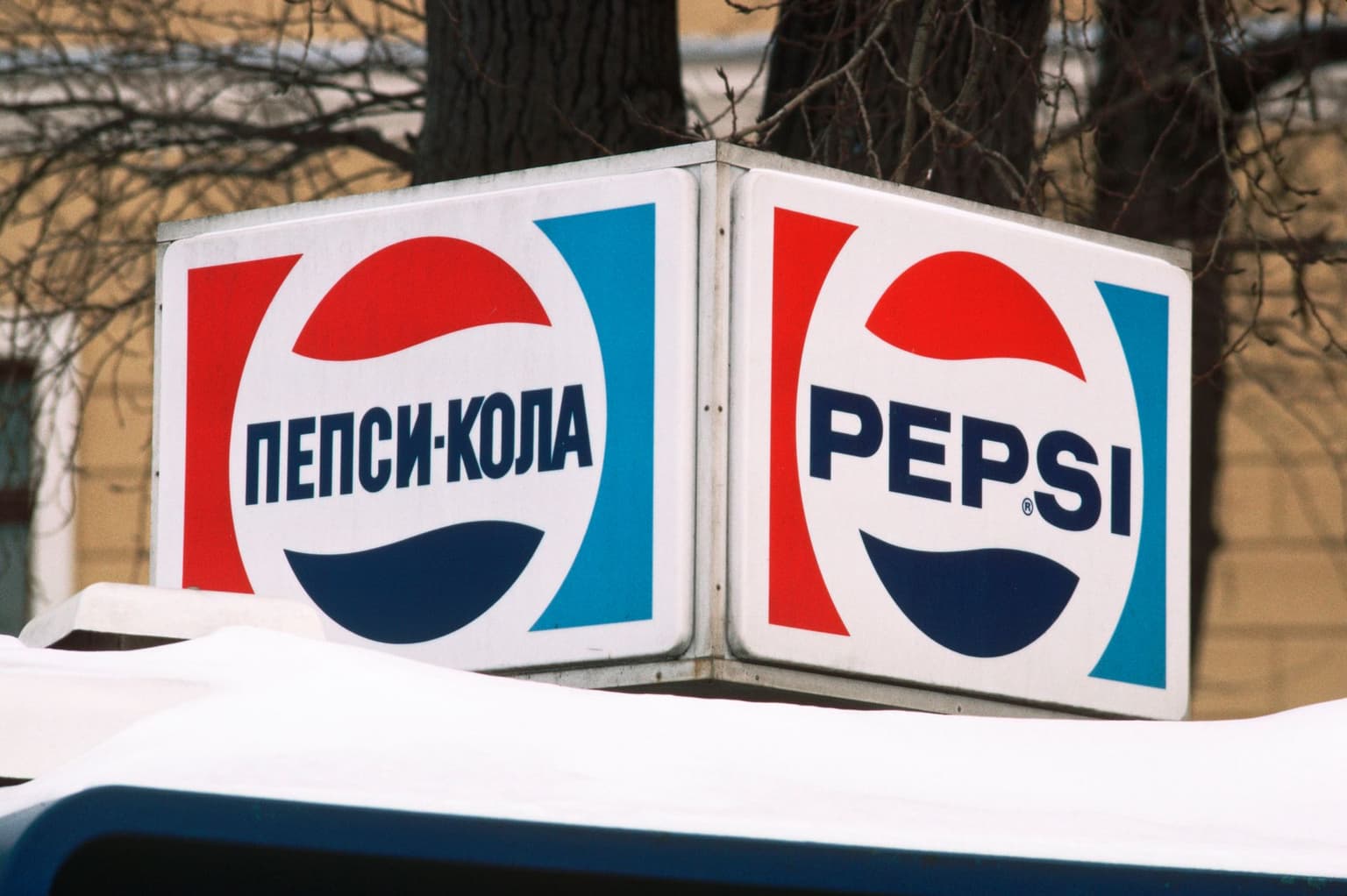
A Pepsi logo is displayed in English and Russian in Moscow, Russia in an undated photo. (Peter Turnley/Corbis/VCG via Getty Images)
 on Google
In response to Russia's full-scale invasion, PepsiCo announced it would suspend production and sales in Russia in March 2022 — and yet, last year it still paid $237 million in income tax to the Russian state.
PepsiCo, one of the largest food and drink producers in the world, remains Russia's fourth-largest foreign business — with 60,000 workers and 19 factories still producing Pepsi Cola for Russian shelves under new names, Lyubimaya Cola and Evervess Cola.
That continued presence means more money for the Kremlin. Tax revenue from major Western firms still operating in Russia together helps sustain a state budget focused on the war in Ukraine. PepsiCo was also the first American consumer brand produced and sold in the Soviet Union. Its refusal to leave shows how deep the ties it has established in the country run.
Donald Kendall, CEO from 1963 to 1986, got Soviet leader Nikita Khrushchev to drink Pepsi with then-Vice President Richard Nixon at the 1959 American exhibition in Moscow, where the pair debated the merits of capitalism and communism in a model American kitchen. Kendall received Russia’s highest civilian award, the Order of Friendship, from Russian President Vladimir Putin in 2004, and celebrated his 90th birthday at the Russian embassy in Washington in 2012. He is not an isolated case in PepsiCo’s relationship with Russia.

Indra Nooyi, CEO from 2006 to 2018, spoke highly of Putin, reportedly praising him as a "great leader" a few months after Russia’s 2014 illegal annexation of Crimea. She did not respond to a request for comment.
"For companies like PepsiCo, Mars, or Nestlé, which have exceptionally strong historical associations with Russia's opening to Western markets, a decision to leave would carry particular symbolic weight," Andrii Onopriienko, head of the Kyiv School of Economics Institute’s Leave Russia project, told the Kyiv Independent.
"These brands have long represented Russia's economic integration with the West. Their departure would underscore that this integration has been fundamentally reversed as a consequence of the Kremlin's own decisions," Onopriienko said.
Despite announcing it would suspend capital investments and all advertising and promotional activities in Russia, the firm has continued to sell what it calls "essential" products, such as milk, other dairy products, and baby food and formula. PepsiCo's Lay’s chips, juices, and bottled water can also be found across the country.
"We are the largest consumer goods company in the U.S., for example, or in Russia or South Africa. Big markets where we're very large, and the governments always pay attention to us. And we have a responsibility to improve society along with those governments."
The original blue cans of Pepsi are also still available across Russia through re-exports from third countries, such as Kazakhstan and Georgia. These parallel imports happen without the trademark owner’s permission.
PepsiCo is not the only Western company still operating in Russia. Ukraine’s National Agency on Corruption Prevention added PepsiCo to its list of international sponsors of the war in 2023, alongside confectionery group Mars. The list was developed as a way of putting reputational pressure on companies.
"While the contribution of any single company may be modest relative to total federal revenues, the cumulative effect of dozens of large multinational firms remaining in the market is significant," Onopriienko said.
A survey by B4 Ukraine, a coalition campaigning for Western businesses to exit the Russian market, showed that many Western shoppers are unaware of the company's contributions to the Russian state budget and the size of its operations in Russia. Three-quarters of respondents believe that PepsiCo should halt operations in Russia entirely and publicly condemn Russia’s violations of human rights.
In 2024, the company opened a new snack factory near Novosibirsk, where construction began in autumn 2020, at an estimated cost of 12 billion rubles (about $155 million), according to Russian state news agency TASS. Net revenue in the country jumped 22.9% to the equivalent of $4.77 billion in 2025, according to its annual report.
PepsiCo did not respond to requests for comment on its ongoing presence in Russia. CEO Ramon Laguarta, a year before Russia’s full-scale invasion, said: "We are the largest consumer goods company in the U.S., for example, or in Russia or South Africa. Big markets where we're very large, and the governments always pay attention to us. And we have a responsibility to improve society along with those governments."
In Ukraine, PepsiCo continues to operate three factories in the Mykolaiv and Kyiv oblasts, which shut down for most of 2022 but reopened the next year. In 2023, the firm prohibited any mention of the war in Ukraine in its corporate communications as it looked for a new public relations agency, according to B4 Ukraine.
PepsiCo is under pressure to turn the business around after years of weak performance and a share price lagging behind rivals. It shows no sign of abandoning the Russian market, its third-largest after the U.S. and Mexico.