Ukrainian parliament makes mixed progress on EU, IMF-mandated bills
 on Google
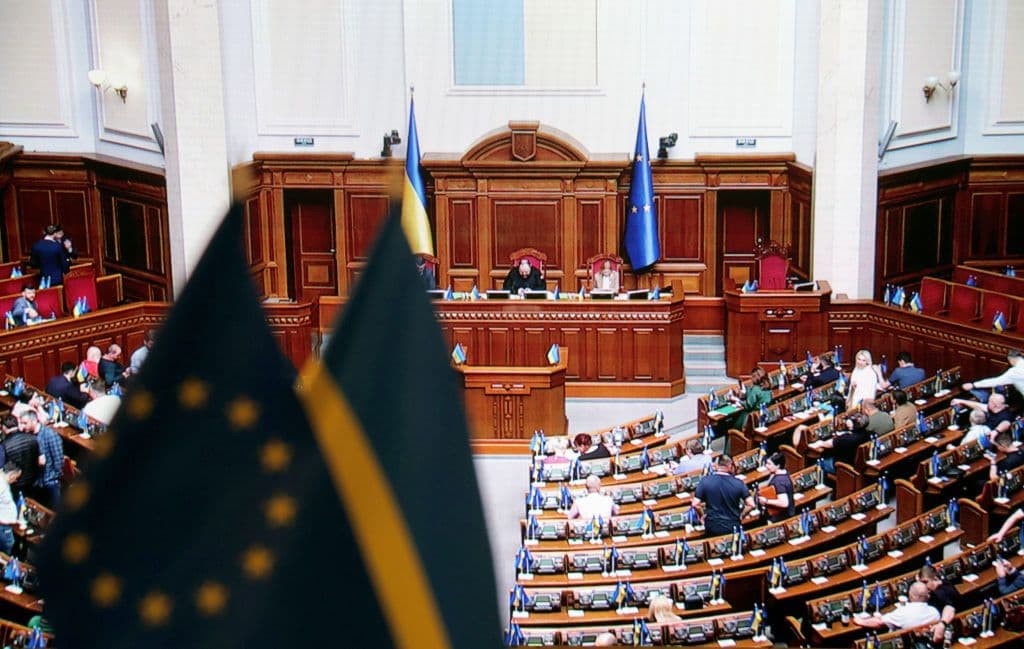
The Ukrainian parliament on June 9 passed some bills necessary for receiving funding from the European Union (EU) and the International Monetary Fund (IMF).
However, the Verkhovna Rada failed to gather enough votes for other bills demanded by the EU and the IMF, and one bill necessary for European integration was passed but was lambasted by experts as "imitation" rather than genuine progress.
Since last fall, the Ukrainian parliament has experienced a crisis as it repeatedly failed to support bills backed by the country's Western donors. Analysts and lawmakers have attributed the crisis to the President's Office's weakening influence over the legislature and a lack of communication between parliament and the Cabinet of Prime Minister Yulia Svyrydenko.
One of the bills passed by parliament on June 9 was a requirement for getting IMF funding. The legislation seeks to introduce taxes on income from digital platforms.
Parliament also passed a bill on checking the integrity declarations of judges — a mechanism for monitoring their compliance with integrity and ethics standards. The bill is a requirement for the EU's Ukraine Facility funding program.
However, the bill was criticized by judicial and anti-corruption experts.
"While presented as a measure to improve judicial integrity declarations, the bill would in fact make it easier for judges to evade accountability for false statements," judicial watchdog DEJURE said in a press release. "DEJURE calls on the Verkhovna Rada not to pass the bill in its current form and to amend it without delay. Ukraine does not need a box-ticking law. We need an effective mechanism that enables objective scrutiny of judges — including Supreme Court judges —and holds them accountable for lies and manipulation in their integrity declarations."
Denys Maslov, head of parliament's legal policy committee, denied the accusations in a comment for the Kyiv Independent.
"Overall, these claims do not accurately reflect the contents of the bill passed by parliament," he said.
Specifically, DEJURE said that judges' declarations would not have a section on whether their assets and income match their expenses, according to the bill. Maslov argued that the issue of assets would be covered in the section on the absence of grounds for disciplinary action against a judge.
DEJURE also said that the bill envisaged a 6-month deadline for checking judges' declarations. This would allow judges to escape responsibility if declaration checks are delayed after the deadline, and a second review of such declarations would be impossible, according to the watchdog.
Maslov responded that "this is consistent with the principle of legal certainty, as a judge cannot remain subject to a verification procedure indefinitely."
The President's Office did not respond to a request for comment.
Additionally, the Verkhovna Rada passed a bill on the implementation of EU standards on railway safety.
However, parliament did not have enough votes to pass bills on tighter rules for financial assistance provided by the government, a simplified bankruptcy procedure for small businesses, and creating a regulator for fighting organized crime.
A bill bringing Ukrainian law on biocides, including pesticides and antiseptics, in line with EU standards was not passed either.
In April, the Ukrainian parliament also passed an IMF-mandated bill to extend a military tax for three years after martial law is lifted.
The Verkhovna Rada also approved a public procurement law tied to a $3.35 billion World Bank loan in May.
However, parliament has so far failed to pass other bills demanded by the EU, the IMF, and the World Bank. These include bills introducing new taxes on small imported parcels and self-employed entrepreneurs.