Displaced to Ukraine's west, exiled Donetsk university expects influx of students from missile-battered cities
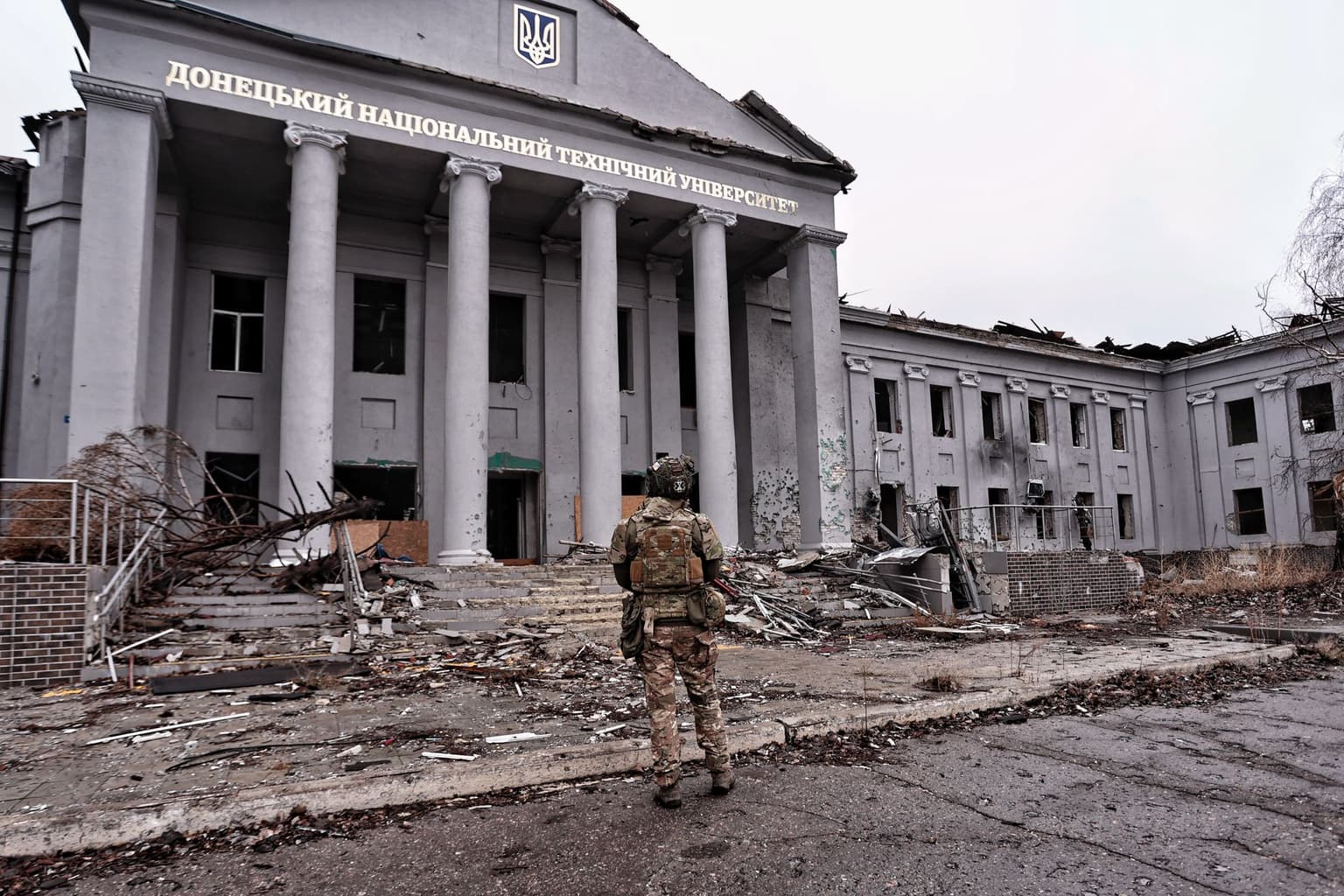
A Ukrainian serviceman looks at the Donetsk National Technical University building destroyed by Russian shelling in Pokrovsk, Donetsk Oblast, Ukraine, on Jan. 18, 2025. Photo for illustrative purposes, (Yan Dobronosov / Global Images Ukraine / Getty Images)
 on Google
One of Ukraine's first relocated universities expects a 50% increase in enrollment as students from across the country flock westward from missile-ravaged eastern regions.
The Vasyl Stus Donetsk National University (DonNU), displaced after its home city in eastern Ukraine was overrun by Russian proxy forces in 2014, is set to start its 12th academic year in its new temporary home — the central-western Ukrainian city of Vinnytsia.
After a rocky relocation that saw the university's student numbers drop to less than half, its rector and professor of international economic relations, Illia Hadzhinov, is finally seeing a "comeback" in student numbers and a revival of university life.
Young people are increasingly choosing to study in relatively safer towns across central and western Ukraine rather than at larger universities in much more exposed cities like Kyiv, Kharkiv, or Zaporizhzhia, especially as Russia's missile attacks grow increasingly destructive amid shortages of Patriot interceptors.
"Parents want their children studying in a more secure and safe environment," said Hadzhinov.
"Our university was the last building in Donetsk with the Ukrainian banner."
With last winter's conditions in mind, universities and other educational institutions are preparing for another wave of Russian attacks on Ukraine's energy infrastructure that could leave millions without light, heat, and even water for days on end.
But DonNU feels ready, owing to its experience with occupation and relocation — something that Kostiantyn Rodyhin, a professor of the department of journalism and social communications, described as "a rehearsal for the end of the world."

Starting from scratch
In September 2014 — months after Moscow started the war in Ukraine's Donbas region — Russian-backed proxy forces seized DonNU's administrative buildings and moved into students' dormitories.
Hadzhinov admits he knew his university was "dead" when Russian proxies raised their flag over the main building.
"Our university was the last building in Donetsk with the Ukrainian banner," he adds.
Serhii Radio, an associate professor of chemistry, remembers walking down the corridor to an abruptly scheduled teachers' council meeting.
"These people were armed; they had assault rifles. No one knew how this meeting would end," said Radio.
In Rodyhin's view, patriotism and the willingness to organize were the only reasons the relocation happened at all. Once the Russian proxies' flag was hoisted, students and professors gathered to protest the takeover and demand that Ukraine's Education Ministry intervene on their behalf. On Sept. 30, 2014, the ministry signed an order of relocation to Vinnytsia.
Yet more difficulties lay ahead.
After arriving in Vinnytsia, staff from all levels and departments were placed in a former jewelry factory, the Crystal plant, which had no chairs, tables, or blackboards. Professors jokingly recall how they fought for the single power outlet and beamed with happiness at spare chairs left on the side of the street.
"This is the kind of story that I don't really believe in sometimes, even now, because it sounds unreal," said Rodyhin.
Svitlana Zhyltsova, a professor at the department of biophysical chemistry and nanobiotechnologies, had to abandon all her laboratories and start from scratch. She remembers how some of her colleagues arrived in Vinnytsia with nothing, "in flip-flops," while others managed to salvage some personal belongings.
Previously enrolling close to 12,000 students, DonNU began its first academic year in exile with fewer than half that number. Most of them were either close to graduating or pursuing their Master's degree. After 2022, the numbers dipped to as low as 4,000.
Radio estimates that possibly 50% of the colleagues from his faculty stayed behind in Russian-occupied Donetsk.
"It wasn't easy or even always possible to leave," he said.

With Donetsk at heart
During the 12 years of displacement, DonNU has grown into a new entity that "adapted and continued to live," said Nataliia Steblyna, a professor in the department of journalism and social communications.
Part of this adaptation meant that the university introduced online classes before anyone else had thought of the need for it, helping to prepare the staff and the students for the Covid-19 pandemic and the full-scale invasion.
Steblyna said that while her class in 2022 numbered fewer than a dozen students, she now sees enrolment slowly approaching the pre-full-scale invasion levels. In Steblyna's view, the students' primary motive is likely safety.
1.4 million people have evacuated from the [Donetsk] region, including 210,800 children.
Since the end of February 2022, the Donetsk regional state administration estimates that 1.4 million people have evacuated from the region, including 210,800 children.
Others come to DonNU because of a sense of personal connection to their native Donetsk Oblast. Rodyhin told the Kyiv Independent that he had moved to Vinnytsia even before starting work at DonNU, initially maintaining contact only as a university graduate.
Yana Stupka from Kramatorsk, a front-line city in Donetsk Oblast regularly ravaged by Russian strikes, says she chose to study journalism at DonNU in Vinnytsia because it felt the closest to home.
"Many teachers come from Donetsk Oblast. University buildings have these beautiful paintings on the walls, with signs like 'I love Donetsk,' and it feels special," she says.
Radio said he is thrilled to see a 10% increase in the number of undergraduate students in his department. Hadzhinov notes that the university's overall enrollment numbers rose by 50% since the previous academic year.
While the majority were previously solely interested in maintaining a connection to their native Donetsk, many students from other regions of Ukraine are now coming to Vinnytsia.
The university is receiving this change positively, however. In addition to slowly heading toward their pre-relocation numbers, it is also an opportunity to create a new sense of community.
"We are not a Vinnytsia university, although we are in Vinnytsia," said Steblyna. Her colleagues add that they discovered an interesting parallel between the two cities.
"Vasyl Stus, after whom our university is named, was born in this region and later moved to Donetsk with his parents. He was our student."
Stus, one of Ukraine's greatest dissidents, graduated from the Stalin Pedagogical Institute, as the university was called in Soviet times.
The architect of DonNU's main building in Vinnytsia also designed the university's main administrative building in Donetsk.
"Some say that such different coincidences connect two regions, and we are still Donetsk. We understood that we are carriers of the Donetsk identity, of Ukrainian Donetsk, in Vinnytsia," said the university's rector.
For 77 years, DonNU has opened its doors to students on Universytetska (University) Street in the heart of Donetsk. Now, they are in charge of welcoming a new generation of Ukrainians hoping to experience university life in some sense of normalcy.
While Rodyhin believes "a university is not about walls, but about people," Steblyna said that she looks forward to the day DonNU will come home.
"After the liberation, someone will have to return," she said.