Ukraine's human capital crisis is Europe's threat
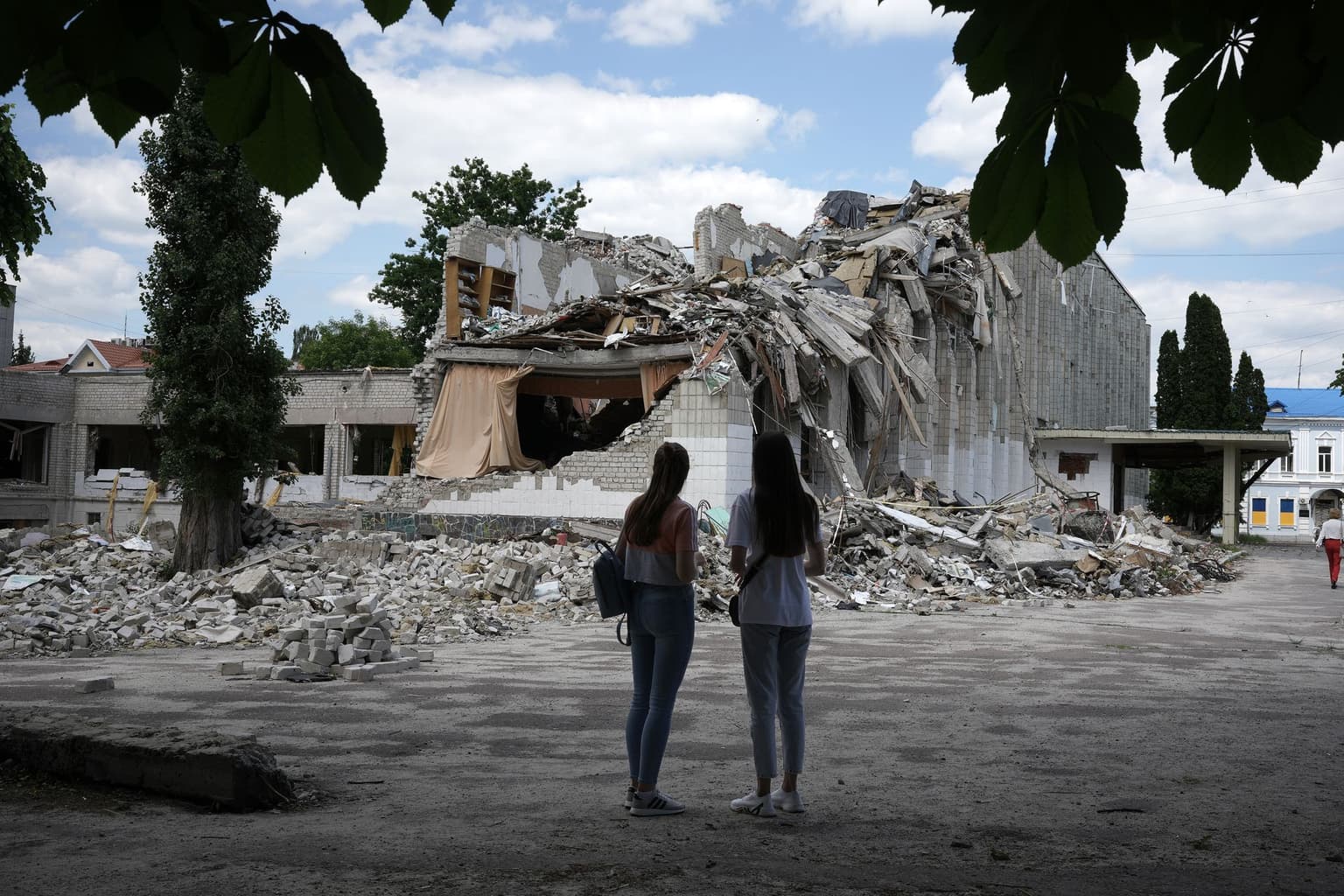
Two girls view the remains of the bomb destroyed Lyceum Number 25 School on June 07, 2022, in Zhytomyr, Ukraine. (Christopher Furlong/Getty Images)
 on Google
Yevhen Kudriavets
First Deputy Minister of Education and Science of Ukraine
During a recent visit to a newly opened underground school in a front-line town, I spoke with the children once again.
What is particularly striking is that they usually talk about how happy they are to finally return to classrooms. Some of them are experiencing in-person schooling for the very first time in sixth grade (first due to COVID-19, and then because of Russia's full-scale invasion).
Yet online education or learning that is repeatedly interrupted by constant attacks, displacement, blackouts, and air raid sirens — does not come without consequences.
Today, in the fifth year of Russia's full-scale invasion, Ukraine's most painful and profound loss is its people. The country is losing soldiers on the battlefield, civilians are being killed in missile and drone attacks, and millions have been forced to live under occupation or abroad. Even before 2022, Ukraine faced a serious demographic decline.
The war has dramatically accelerated this trend, and Ukraine is now a country where death outruns birth three to one.
But alongside these visible losses, another equally critical challenge receives far less attention: the decline in the quality of human capital. This is precisely one of the long-term consequences of disrupted education during war.
At its core lies a question: whether Ukrainians will have the education, skills, and opportunities necessary to fully realize their potential.
Why is this fundamentally important? First, the quality of human capital determines whether Ukraine can, today, serve as Europe's shield against aggression. An educated and skilled population drives economic and scientific growth, and therefore national strength.
Second, it determines whether Ukraine will be able to rebuild and develop across all sectors in a way that prevents future aggression. Third, the quality of human capital is what makes Ukraine a strong partner for Europe, for companies operating in Ukraine, and for the global economy.
This means that the quality of Ukraine's human capital is a matter of European security, stability, and even global sustainable development. Strengthening it must be a strategic priority for Ukraine and its partners. And the most effective instrument for doing so is education.
The loss of human capital quality begins with educational losses
The erosion of human capital quality is evident in educational losses resulting from prolonged remote learning and the consequences of full-scale war. Ukrainian students face a learning gap equivalent to 1.5 to 2 years of schooling.
These losses carry direct economic consequences.
According to the World Bank globally, unaddressed learning losses from pandemic-related school closures alone could сost this generation about $17 trillion in lifetime earnings.
In Ukraine alone, disrupted access to education and skills training has already resulted in an estimated $11.7 billion in losses, most of it driven by learning gaps. As the war continues, these costs will rise, undermining both students' future earnings and the country's economy.

Quality education is the most effective way to prevent learning losses and their long-term economic impact. Restoring access to safe, in-person learning, building underground schools, and advancing systemic reforms at all levels, this is a recipe for action.
Both for the Ukrainian government, which already prioritizes education, and for its partners.
Another acute challenge is the widening skills gap. More than 85% of current vacancies in Ukraine are in skilled trades. Meanwhile, up to 25% of the workforce will require retraining or reskilling, including displaced persons and veterans.
The solution to these problems also lies in education, particularly in the vocational education and training system and professional pre-higher education.
Ukraine is now undertaking the first comprehensive transformation of this sector in the last 30 years, modernizing infrastructure and introducing policies that give institutions more autonomy while directly involving businesses.
Strengthening this effort is a chance to accelerate reconstruction and secure long-term economic returns linked to Ukraine's recovery and integration into the EU market.
Threats to scientific potential
The decline in human capital quality also weakens scientific potential. Without research and innovation capacity, no country can remain competitive in a technologically driven world.
Ukraine inherited one of Europe's largest research networks — more than 700 higher education and research institutions. In scale, this compares to major European states. In funding, however, it does not yet: public expenditure on research stands at only around 0.35% of GDP, among the lowest levels in Europe.
What is more, these institutions have uneven performance, with a few excelling, while others have limited economic or international research impact.
Driven by the necessity to address these challenges, Ukraine has launched its first comprehensive science reform. It cannot wait until the war is over. The war itself has accelerated technological adaptation, especially in defense technologies.
The challenge now is to institutionalize this expertise, scale it, integrate it into long-term national development, and transform it into knowledge that can benefit the EU and the global scientific community.
The development of each of these areas is already a priority for the Ukrainian government, but it also requires sustained partnership — public, private, and international.
By helping Ukrainian students and researchers thrive, international partners help ensure Ukraine's resilience today, a prosperous and secure Europe, and a world where Ukraine can continue contributing to scientific progress, technological innovation, and shared security.
Editor's note: The opinions expressed in the op-ed section are those of the authors and do not purport to reflect the views of the Kyiv Independent.