Exclusive: Freshly made European, American components found in Russian drones attacking Ukraine
Evidence obtained by the Kyiv Independent reveals American and European components made in 2026 in downed Russian attack drones.
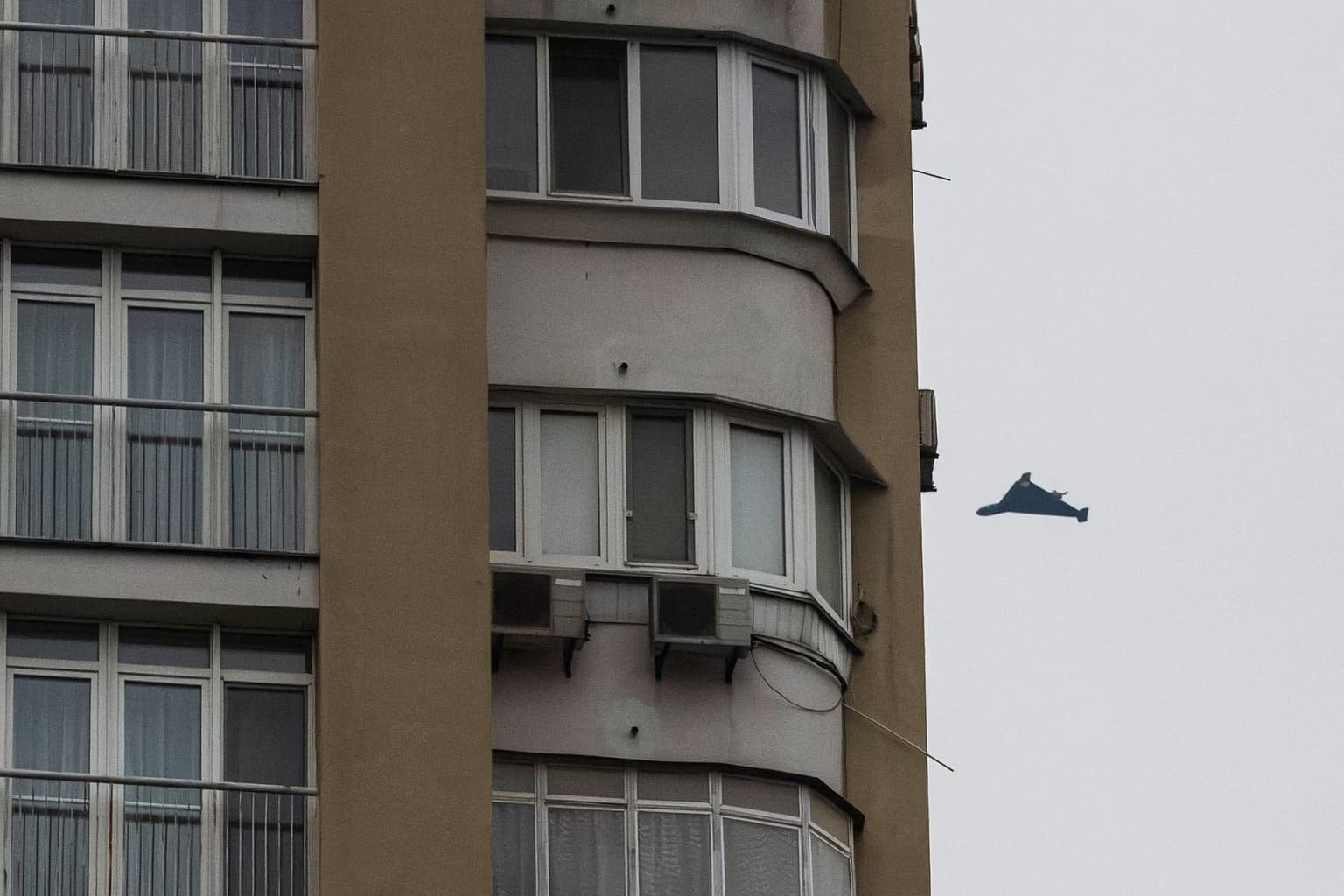
A Russian Geran drone flies over Kyiv, Ukraine, during an aerial attack on Nov. 1, 2026. (Vladyslav Musiienko / AFP via Getty Images)
 on Google
Note: This story was produced in collaboration with the Organized Crime and Corruption Reporting Project (OCCRP), De Tijd (Belgium), 15min (Lithuania) and Paper Trail Media (Germany).
In mid-August, a Russian Geran-4 jet-powered attack drone was shot down over Kyiv Oblast.
Some of the drone’s components were made by U.S. and European manufacturers mere months before Russia launched it at Ukraine, according to a Ukrainian intelligence report seen by the Kyiv Independent.
The report's findings suggest that, more than four years into the full-scale war, Russia is still obtaining newly made, restricted Western technology through sanctions-evasion networks operating via third countries.
Inside Russia’s jet-powered Shahed
Earlier this year, Russia began mass-producing the Geran-4 (also known by the Iranian name Shahed), which flies faster and higher and is more maneuverable than earlier Geran models. Moscow has since used the drone en masse against Ukraine’s civilian infrastructure.
According to Ukrainian military intelligence, the Geran-4 drone downed in August, was manufactured in the Alabuga Special Economic Zone, home to Russia’s largest production site for these drones.
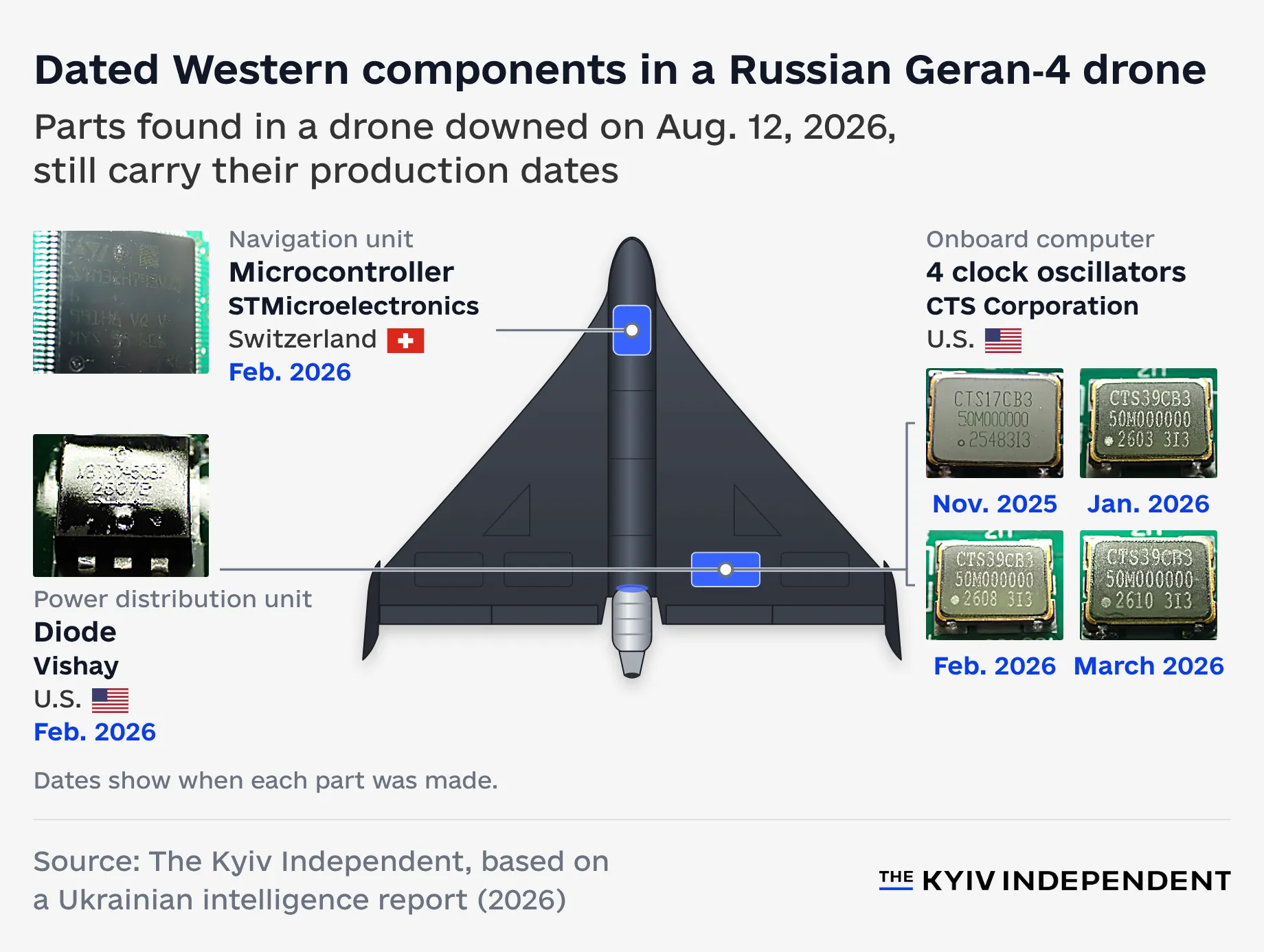
The drone contained several timing chips bearing markings consistent with those of the U.S.-based CTS Corporation. According to their date codes, some were produced in January, February, and March 2026.
One small power diode, attributed to the U.S.-based Vishay Intertechnology company, bore the date code 2607, indicating that it was made in the seventh week of 2026, or mid-February.
A microcontroller — a small computer on a single chip containing a processor and memory — attributed to the Swiss-headquartered Franco-Italian company STMicroelectronics was marked with the date code 2606, meaning it was produced in early February 2026.
Based on the inscriptions, the microcontroller was assembled and tested in Malaysia, where STMicroelectronics operates a major back-end manufacturing plant.
In a matter of months, these components traveled from Western-owned factories to the inside of a Russian drone — and in August, it targeted Ukrainians.
In total, the drone wreckage contained nearly 100 non-Russian components, most of which were attributed to various American tech companies.
Not all of the parts carried markings that reveal when they were made, but 12 do. None of them are from pre-war stockpiles: Seven were produced in 2026, three in 2025 and two in 2024.
In other words, they were made years after the EU and the U.S. imposed export restrictions on microchips to Russia following its full-scale invasion of Ukraine in 2022.
The Kyiv Independent and its partner outlets sent images of the components to their manufacturers, asking to clarify how the parts reached Russia.
In a written response, the European chipmaker STMicroelectronics did not address the specific component or explain how it might have ended up in a Russian drone. Instead, the company noted that it no longer has operations in Russia and maintains a comprehensive global trade compliance program.
U.S.-based Vishay Intertechnology likewise offered no explanation for the specific components that wound up in the Russian drone. Instead, the company said it had blocked all shipments to Russia in February 2022 and actively prevented its products from being exported in violation of U.S., EU, "or any other applicable export compliance laws and regulations."
CTS Corporation did not respond to repeated requests for comment.
Lithuanian SIM cards for Russian attack drones
Another Ukrainian intelligence report seen by the Kyiv Independent contains images of eight SIM cards issued by a Lithuanian telecom operator and recovered from drones that Russia launched at Ukraine in 2025.
SIM cards help drones navigate in flight, according to Jonas Ohman, co-founder of Blue/Yellow, a Lithuanian organization that supports Ukrainian soldiers. By connecting to a mobile network, a drone can transmit its location, adjust its route and stream video back to operators.
“Essentially, it’s a flying mobile phone,” Ohman said.
Russia has already been known to use SIM cards from domestic operators, as well as from Belarus, Kazakhstan, and even Ukraine, in its drones.
But the intelligence report suggests that Russia may also have found a way to obtain European SIM cards for its attacks on Ukraine.
Unlike their Russian counterparts, foreign SIM cards help Moscow avoid detection by Ukrainian forces, Ohman said. “In that case, it becomes much more difficult to understand what the card is being used for. Essentially, it looks like ordinary mobile communication.”
The eight SIM cards come from the same mobile carrier: Pildyk, the prepaid brand of the Lithuanian mobile telecom operator Tele2 Lietuva.
The cards were purchased and activated in 2024, Linas Marcinkevicius, head of credit and risk control at Tele2 Lietuva, said in a written response to this investigation.

So how did Russia get hold of these European SIM cards, with EU sanctions firmly in place?
According to Tele2 Lietuva, its Pildyk prepaid cards are sold only in Lithuania but can be misused by fraudsters and smugglers.
"We suspect that specialized groups are engaged in the purchase, activation, and ultimately resale of these cards," Marcinkevicius wrote.
"They may supply the cards to criminals, particularly those involved in telephone fraud, as well as to smugglers and, ultimately, as we have seen, to agents of hostile states. No provider is immune to this."
Exporting SIM cards to Russia is prohibited under EU sanctions and is allowed only in exceptional cases, with specific authorization from national authorities, a European Commission spokesperson said in a written response.
“The main challenge is often not formal export from the EU to Russia or Belarus, but rather diversion, illegal procurement, resale, stockpiling, or misuse of already issued cards,” the spokesperson added.
Anonymous prepaid SIM cards can make criminal activity easier. When the eight Pildyk cards were activated in 2024, Lithuania did not yet require users to verify their identity.
That changed on Jan. 1, 2025, when the country made ID mandatory for buying new prepaid SIM cards from any operator.
“In addition, the number of cards that can be purchased per person has been limited, and the ability to activate them in foreign countries has been disabled,” Marcinkevicius of Tele2 Lietuva said.
Yet in some EU countries, SIM cards can still be bought without identification.
According to the European Commission spokesperson, there is no EU-wide obligation to register prepaid SIM cards. "This is a national competence, and practice varies: Germany, Poland and others require ID, while other member states do not.”
16,000 components from various countries
Since the start of the full-scale invasion, investigators have identified more than 16,000 foreign-made components in Russian drones, missiles, and other weapons, Ukraine’s Prosecutor General’s Office said in a written response to the Kyiv Independent. The parts bear the markings of manufacturers from more than 30 countries.
That figure is well over double the roughly 6,300 components made public so far by Ukraine’s military intelligence agency, HUR, on the War & Sanctions portal.
To trace the supply channels and verify compliance with international sanctions and export controls, the Prosecutor General's Office has sent 28 requests for mutual legal assistance to authorities in other countries.

Meanwhile, Ukraine is still pulling the latest Western components out of Russia's newest weapons, according to Vladyslav Vlasiuk, the president’s envoy for sanctions policy.
“In September, in a downed Geran-5, we found a transistor from a major European manufacturer that was made in February of this year,” Vlasiuk told the Kyiv Independent. “That’s seven months from the factory to a Russian drone over Ukraine.”
Kyiv isn’t accusing manufacturers of supplying Russia directly, Vlasiuk said. What it wants is for them to take far more control over their distribution channels.
“The products don’t reach Russia directly. They pass through a chain of three or four intermediaries — front companies in third countries,” he said.
Closing that pipeline, Vlasiuk argues, will take three things: Intermediaries need to be criminally prosecuted, not just added to sanctions lists. Manufacturers should bear responsibility for the end users of their products. And the G7 needs to go after the financial flows that keep the trade running.
“Financial intelligence should follow the money behind chips the way it follows drug money,” he said. “Someone paid for every component that reached Russia, and some banks processed that payment.”
Note from the author:
Hi, I’m Alisa, the author of this story.
Thank you for continuing to follow our reporting on foreign parts in Russian weapons. For Ukrainians, this is quite literally a matter of life and death.
If you’d like to support our journalism, consider becoming a member of the Kyiv Independent. Together, we can do more.