Can this $77 million state initiative bolster Ukraine's cultural sphere?
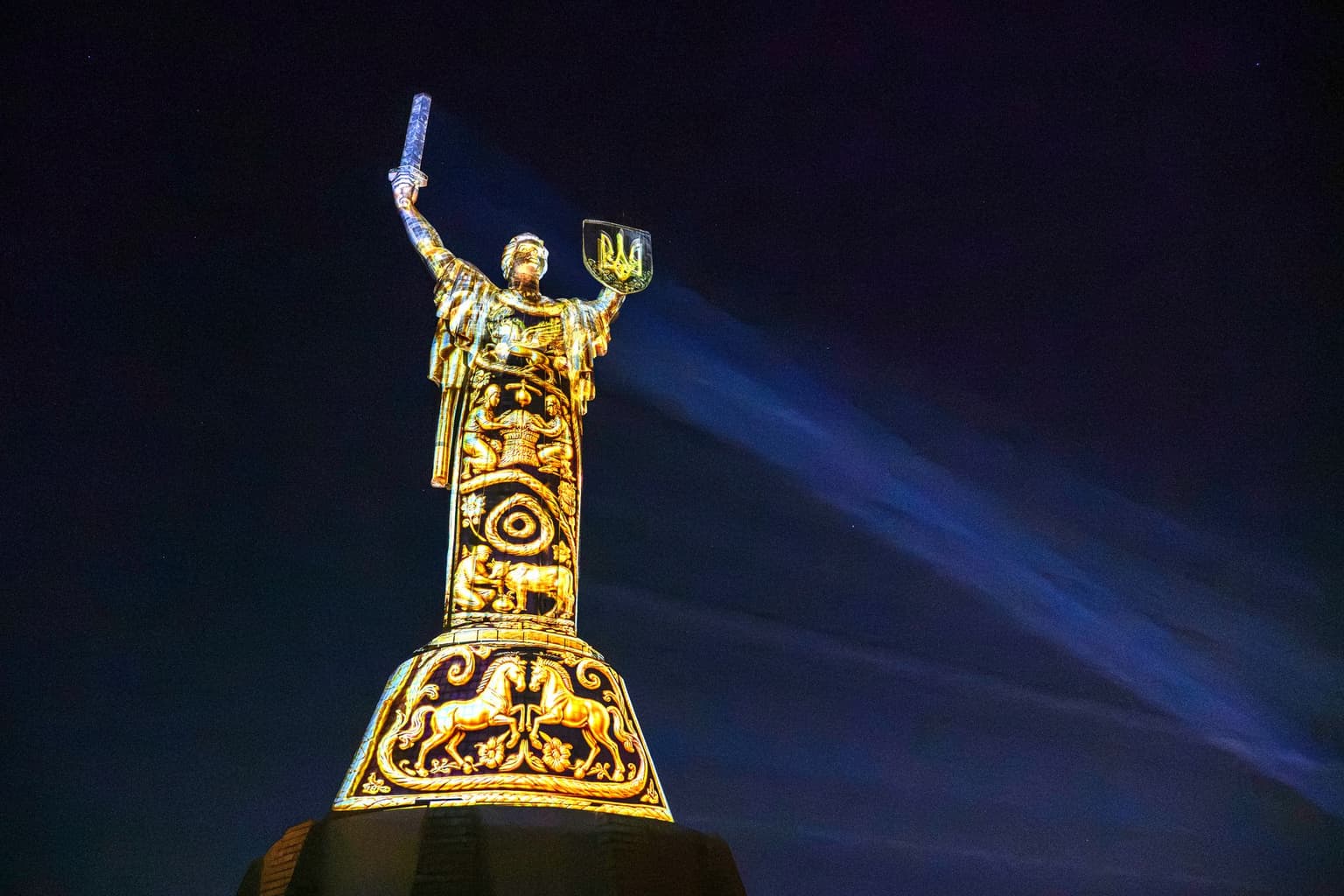
The "The Future Remembers" light installation is projected onto the Mother Ukraine Monument in Kyiv, Ukraine, on Aug. 20, 2026. (Maxym Marusenko/NurPhoto via Getty Images)
 on Google
With Ukraine's cultural heritage threatened by Russia's all-out war of annihilation, Kyiv is ramping up its efforts to support Ukrainian artists at the state level.
"Tysiachovesna," or "1,000 Springs," is a project originally proposed by President Volodymyr Zelensky in the fall of 2025 to use Hr 4 billion ($76.7 million) of the state budget to support the creation of 1,000 hours of Ukrainian-language content.
The Culture Ministry formally launched the initiative earlier this spring, encouraging artists to submit funding proposals.
According to the government, the goal of "1,000 Springs" is not just to support Ukrainian culture during wartime, but also to boost the presence of Ukrainian-language content and reduce the influence of Russian-language material in the country.
The hope is that the initiative will generate more stories about Ukraine told through a distinctly Ukrainian lens, while cultivating a competitive landscape among artists.
Culture Minister Tetiana Berezhna has frequently emphasized the need to promote Ukrainian culture as a matter of national interest. Speaking to the Kyiv Independent back in early May, the minister said that culture should be seen not just as a form of entertainment but "a vital part of our economy."

A test for the judges
The "1,000 Springs" website encourages artists to submit projects across a broad range of subjects, from Ukraine's history, folklore, and natural heritage to life during the war, mental health, and preservation and development of the Ukrainian language.
Applicants faced three stages of review, with the final round of presentations to expert panels of judges concluding on Aug. 19. However, given the size and scope of the initiative in its first year, this process was not without its setbacks.
A number of people from across Ukraine's cultural sphere raised concerns about whether the application criteria were adequate to fairly evaluate such a diverse range of projects.
"I was surprised that short films, features, and series could all be placed in the same category, along with films for children and adults, live-action and animation, auteur films and films aimed at a broad audience," filmmaker Iryna Tsilyk, whose animated film "Red Zone" was among the selected applicants, wrote.
"In other words, they all belong on very different shelves, and I wouldn't want to be the expert who had to evaluate, say, a live-action film for toddlers and an auteur animated documentary for adults at the same time."
The experts assigned to judge applicants' projects in the final stages reportedly included both people familiar with the project and those engaging with it for the first time.
With just five minutes to present a film and three minutes for a question-and-answer session, Tsilyk worried the time was too short and that certain valuable projects could have gone unnoticed.

Ninety-two projects were selected in the "Feature Film and TV" category from 404 proposals in the third stage; 70 of 354 in "Documentary TV and Film"; and 30 of 170 in "Children's TV and Film."
An additional 144 were selected from 293 for "Contemporary Music," 133 from 282 for "Performative Arts," 77 from 191 for "Visual Arts," and 135 from 465 for "Audiovisual Shows and Video Clips for Social Media."
The judging process came under scrutiny by some for concerns over potential conflicts of interest, although the Culture Ministry said it took significant steps to address the issue.
"Understanding this situation, my team and I worked out a system for identifying and preventing conflicts of interest, which operated at every stage of the program," Berezhna said at a press event on Aug. 20.
Projects were assigned to experts for evaluation through a closed lottery system, where balls were drawn at random, so no one knew which expert was judging which project. If an expert had a conflict of interest, they submitted a statement, and the project would be reassigned to a "reserve" expert, also chosen by lottery.
"A great many people who make decisions about allocating funding for the following year are watching the discussion around '1,000 Springs.' So, as people who care about Ukrainian culture, we simply need to sit down and have a serious discussion together about what we can improve in the competition so that it can be perfected for next year," Berezhna added.
Lessons for the next year
Reflecting on the outcome of the first "1,000 Springs," writer Oksana Moroz, who served as one of the experts for the "Audiovisual Shows and Video Clips for Social Media" category, advocated for a stronger emphasis on promotion and distribution in future competitions.
"Applicants described the idea, its advantages, how it would be filmed and edited in great detail. But only about a third (of candidates in the category) wrote about distribution and promotion or provided projected viewership figures," Moroz wrote.
"Another particular headache was (calculating projected viewer) reach instead of (just) views. A typical example would read: 'This project will have a reach of 800,000 views on Channel X.' You'd go to the channel and see that its typical videos had 400–500 views."
Moroz also proposed creating an "online school" for future applicants so they can better understand not only how to plan the distribution, promotion, and budgeting of their projects, but also their concepts — namely, the value they bring to society and what makes them stand out from preexisting work.

The idea is not unprecedented. The Ukrainian Book Institute, a state agency under the Culture Ministry, holds online seminars for prospective applicants to its Translate Ukraine program, which provides financial support to publishers worldwide for publishing translations of Ukrainian books.
As participants, organizers, and observers alike engage in candid public discussions about what worked — and what did not — in the inaugural "1,000 Springs," it is apparent that there is a collective will for the project to evolve.
During the final stage of judging, held in the western Ukrainian city of Ivano-Frankivsk from Aug. 12 to 19, Zelensky expressed his hope that "1,000 Springs" would become an important tradition.
"I am convinced that we need to maintain this pace (of supporting culture at the state level) for at least five to 10 years. Today we are already seeing the capacity of the industry, while the state, accordingly, is providing its support," Zelensky said.
Sign up for our newsletter