'Unprovoked terrorist strike' — Russia attacks bus carrying Ukrainian civilian miners, killing at least 12, injuring 16
 on Google

Editor's note: This story is being updated.
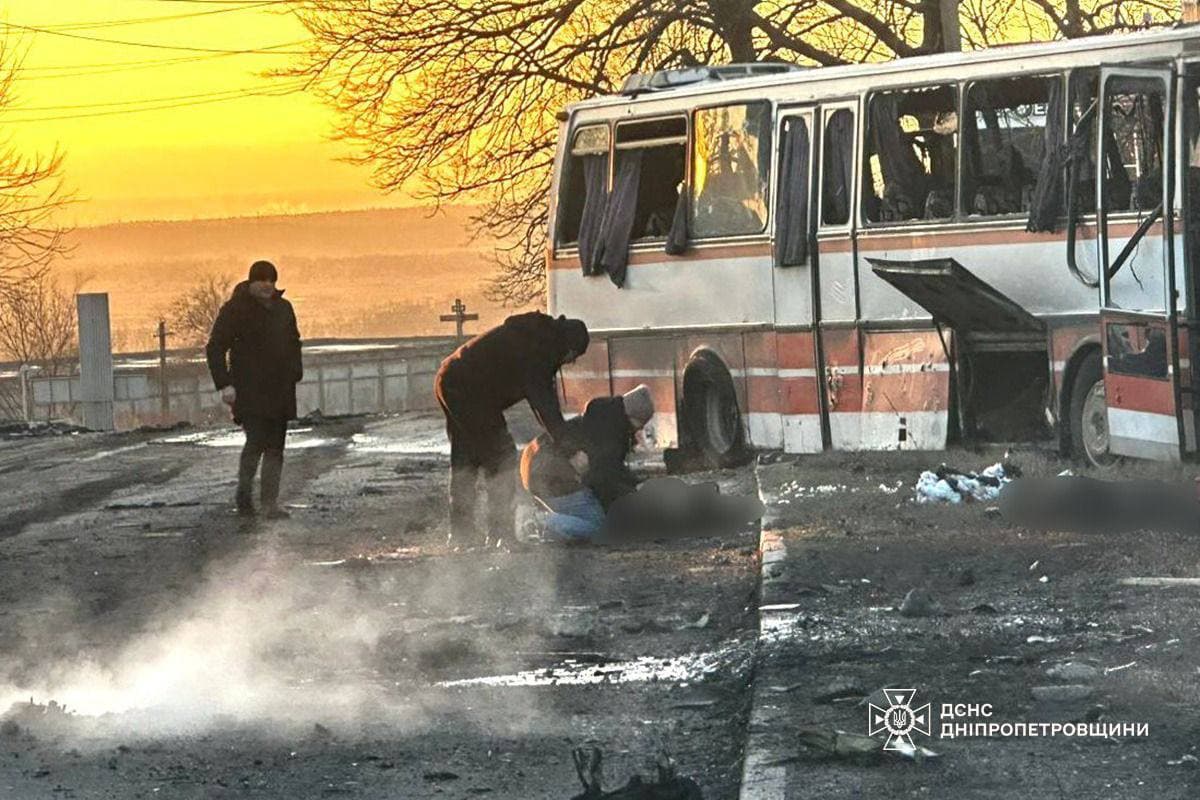
A Russian drone attack on a bus outside Pavlohrad in Dnipropetrovsk Oblast killed at least 12 miners and injured 16 others on Feb. 1, according to DTEK, Ukraine's largest private energy firm.
The strike came amid a broader Russian assault on DTEK mines, the company said. The drone hit a service bus in Ternivka as it was carrying miners after their shift.
At least 12 miners have been killed in the strike and 16 others injured, according to DTEK's latest report.
The area near the bus was struck by the drone, Dnipropetrovsk Governor Oleksandr Hanzha said. Fourteen of the injured victims have been hospitalized, with seven in critical condition. The full consequences of the strike are still being investigated.
"The service bus was carrying mine workers — civilians who were not involved in the combat. This is yet another brutal attack with casualties, just for today," Ombudsman Dmytro Lubinets said.
Foreign Minister Andrii Sybiha condemned the strike, stressing that the bus was "no military target" and that the miners were "just hardworking men returning to their families after their shifts." He added that "Russian murderers responsible for this and other atrocities must face justice," calling accountability "essential for a just peace."
The Russian drone operators who attacked the bus made a deliberate decision to attack civilians, according to Serhii Beskrestnov, adviser to Defense Minister Mykhailo Fedorov.
A group of Shahed-type drones controlled online were flying along the road when the pilot of the first drone saw the bus and chose to attack it, Beskrestnov said. When the drone hit the area near the bus, the driver lost control and crashed into a fence.
"Injured people began to leave the bus, helping each other. At this time, the operator of the second Shahed drone saw people and directed the drone directly at the civilians," Beskrestnov said.
"Operators from Russian territory 100% saw and recognized the target as civilian, saw that it was not military, and made a conscious decision to attack."


The attack represents the largest single loss for DTEK since the start of the full-scale war, CEO Maksym Timchenko said.
"(T)his was an unprovoked terrorist strike on a purely civilian facility, for which there can be no justification whatsoever," he said.
"This attack has become the largest single loss for DTEK since the beginning of Russia's full-scale invasion and one of the darkest days in the company's history."
Mykhailo Volynets, chairperson of the Independent Trade Union of Miners of Ukraine and lawmaker from the Batkivshchyna party, told the Kyiv Independent that Russia's latest attack is part of an ongoing campaign against Ukrainian mines, energy facilities, and energy workers.
"The Russian aggressor is daily targeting the mines," Volynets said.
"Russia attacks coal enterprises, energy facilities, substations, and specifically the mining territories. .... There is not a day that goes by without miners having to be lifted to the surface from de-energized mines in emergency conditions."
Hanzha said Feb. 2 was declared a day of mourning in the region.
Ukraine had 145 coal mines at the start of 2014 — the year Russia launched its invasion of Donbas and illegally annexed Crimea. Now, due to Russian attacks, only 14 remain, according to Volynets.
U.K. lawmaker John McDonnell condemned the strike on social media, calling it "appalling" and highlighting international support for Ukrainian workers amid continuing Russian attacks.
"This is another appalling attack by (Russian President Vladimir) Putin on working-class Ukrainians," McDonnell said on X.
"U.K. trade unions have provided practical support to this Ukrainian trade union for some time in the face of the Russian aggression. I send my solidarity to the union and my condolences to the miners' families."
The attack came amid ongoing efforts to negotiate a peace deal between Ukraine, the U.S., and Russia.
As Moscow's attack pushed Ukraine's energy system into a crisis, U.S. President Donald Trump announced on Jan. 29 that Russian President Vladimir Putin had agreed to suspend attacks on Ukrainian cities for one week. However, Moscow later said that this would only apply to Kyiv and would last until Feb. 1, just before the next cold snap.
President Volodymyr Zelensky said that the attack on the miners demonstrates Russia's commitment to escalating aggression, even amid attempts to negotiate peace.
"Today's Russian attack on a bus in Dnipropetrovsk Oblast is a crime, a demonstrative crime, which once again shows that it is Russia that is responsible for the escalation," he said in his evening address.
Earlier in the day, Russia also launched two attacks on the southern city of Zaporizhzhia, injuring at least nine people, including a child. One of the attacks targeted a maternity hospital.