The main problem with Ukraine's corruption prevention watchdog
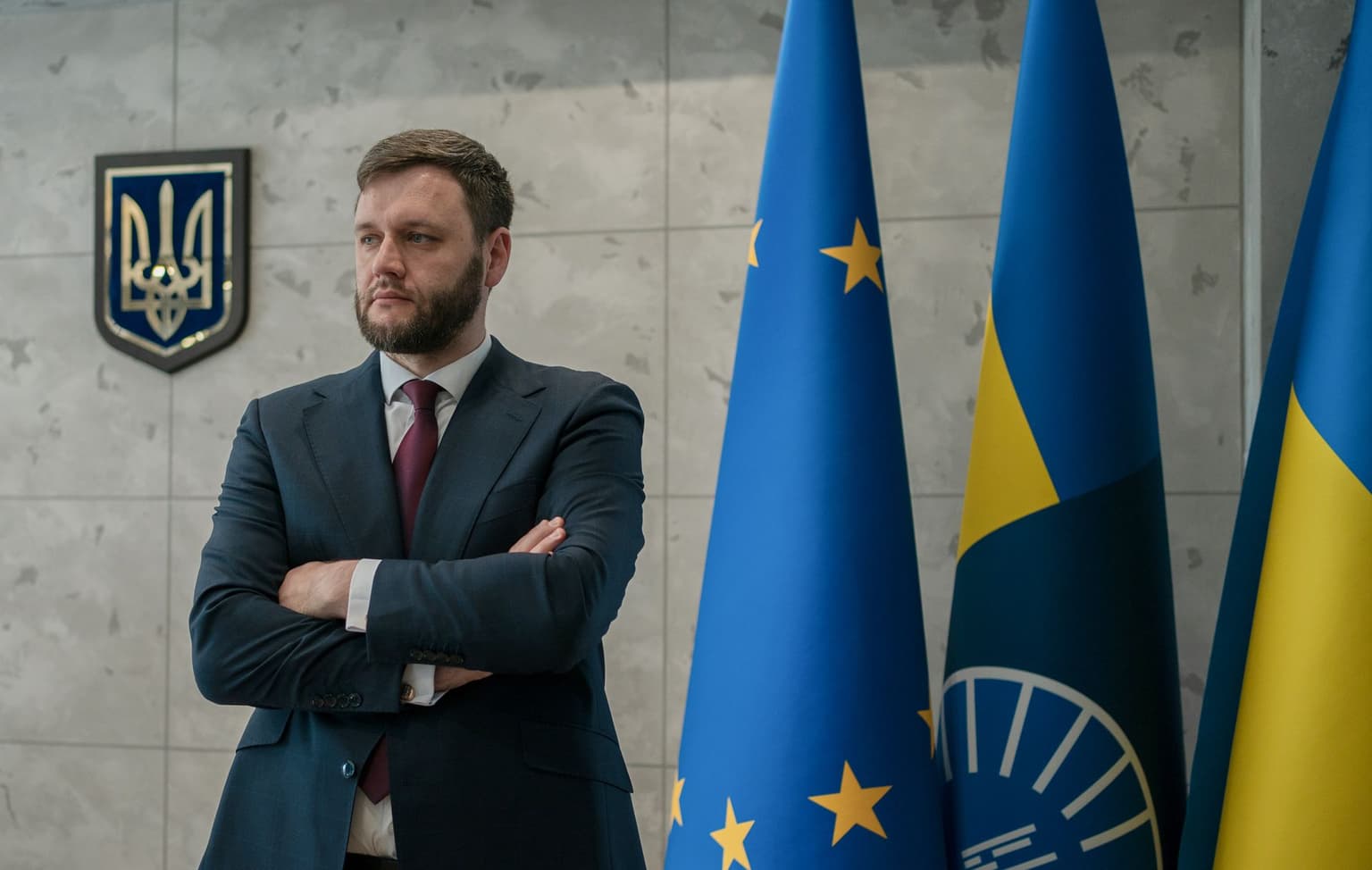
Viktor Pavlushchyk, head of Ukraine's National Agency for Corruption Prevention (NACP), in his office in Kyiv, Ukraine, on April 15, 2026. (Elena Kalinichenko / The Kyiv Independent)
 on Google
Viktor Pavlushchyk, head of Ukraine's National Agency for Corruption Prevention (NACP), was praised for his work as an anti-corruption investigator.
After his promotion, Pavlushchyk is in the hot seat.
He was appointed to his current job by a commission including independent foreign experts as part of Ukraine's anti-corruption reforms in 2024 in a contest that was widely applauded.
The National Agency for Corruption Prevention, set up in 2015, has a broad mandate, including determining the government's anti-corruption strategy, checking officials' asset declarations, protecting whistleblowers, and examining corruption risks in legislation.
And yet Pavlushchyk finds himself increasingly at odds with Ukraine's civil society and anti-corruption watchdogs. They accuse him of being utterly ineffective at exposing corruption and and of lacking independence.
Pavlushchyk struck a defensive tone in an interview with the Kyiv Independent, saying that his agency is not to blame for the breakdown in communications with civil society.
He argued that the agency had organized an event in March, "invited everyone and answered all the questions raised by the public."
Exposing top-level corruption
One of the accusations that Pavlushchyk faces is that the current procedure for checking officials' asset declarations is ineffective.
Until 2023, asset declarations were checked by NACP employees exclusively manually, after which the agency transitioned to an "automated" system in which most declarations are checked by computers. In some cases, declarations are still checked manually if there are suspected violations.
These automated checks have been criticized by anti-corruption watchdogs and the European Commission. Experts argue that they are purely formal and fail to find violations.
Previously, the agency first checked the declarations of top officials, and only after them those of mid-level and lower-level officials. In 2023, a law was passed to change this approach, and asset declarations are now checked based not on rank but on risks that are identified.
The problem with this approach is that there are too few full manual checks of top officials.
Under Pavlushchyk's purview, the agency has completed full checks of only two ministers: former Deputy Prime Minister Oleksiy Chernyshov's declaration for 2021 and ex-Foreign Minister Dmytro Kuleba's declaration for 2023.

"More attention to high-level officials is needed in the practical application of financial control tools, in light of the number of allegations of unexplained wealth and hidden assets that have been reported," the European Commission said in its Ukraine report in November.
Commenting on these accusations, Pavlushchyk argued that "the agency is tasked with preventing corruption across the entire country in every sector, and for every public official — not just top-level corruption."
He said that if the agency "only checks those who are the focus of public demand, then the other 699,000 officials will never be checked at all."
In 2025, the agency completed 970 full manual checks of asset declarations and identified inaccuracies worth Hr 3.8 billion ($86 million), evidence of illicit enrichment worth Hr 463.2 million ($10.5 million), and unjustified assets exceeding Hr 129 million ($2.9 million). In 56% of the manually checked asset declarations, there were either inaccuracies, unjustified assets, or illicit enrichment.
In 2025, courts issued 12 verdicts in criminal cases where the agency identified false information in asset declarations.
Protecting anti-corruption infrastructure
The agency has also been lambasted for failing to publicly condemn the law that effectively eliminated the independence of anti-corruption agencies back in July. The National Anti-Corruption Bureau's (NABU) independence was later restored following street protests, the first major ones since the start of the all-out war.
Ironically, Pavlushchyk himself worked as a NABU detective from 2015 to 2024 and was praised for his investigations.
"The way the agency acted during last summer's attack on the anti-corruption bodies is a glaring disgrace for the institution," Daria Kaleniuk, executive director of the Anti-Corruption Action Center, told the Kyiv Independent. "They didn't issue a single statement about the attack — they just kept their heads down. After that deafening silence, I have no trust whatsoever in the agency or in its head."
Pavlushchyk said that, although the agency did not comment on the law publicly, it did criticize it in its communication with parliamentary committees and told them it did not comply with European requirements.
"The position was set out clearly — both in writing and in official documents submitted to parliamentary committees and to parliament itself, as well as through our representatives' participation in committee meetings," he said.
Anti-corruption watchdogs also argue that the agency failed to use its authority to scrutinize or suspend the law that stripped anti-corruption agencies of their independence. The European Commission has also lambasted the agency for failing to sufficiently use its authority to monitor corruption risks in draft laws put up for a vote.
Pavlushchyk argued that the agency did not have the power to scrutinize or suspend the law targeting NABU because its text became available only after it was approved by parliament.
Ukraine's biggest corruption case
Apart from being accused of inactivity, the agency is also directly implicated in recordings published by the anti-corruption bureau as part of an investigation into corruption at state nuclear power monopoly Energoatom and in the defense industry.
One of the suspects, Dmytro Basov, allegedly gave a $20,000 bribe to the agency in May 2025, according to the NABU recordings.
Pavlushchyk said in January that the agency had conducted an inquiry into the allegations and found no violations.
(...) if the agency "only checks those who are the focus of public demand, then the other 699,000 officials will never be checked at all."
"No such facts were confirmed," Pavlushchyk said. "Therefore, it is not possible to determine who was involved, or even whether the incident actually took place."

He said that "this is something that could have happened — or might not have happened at all."
Kaleniuk was skeptical about the results of the inquiry.
"I don't trust the agency or the results of its checks," she said. "And I have little confidence that the agency can properly review or investigate itself."
Checking a powerful minister
The agency has also come under fire for failing to check or identify any violations in the declarations of suspects in the Energoatom corruption case, including former Energy and Justice Minister Herman Halushchenko.
Halushchenko was charged with money laundering and organized crime in February.
His declarations were automatically checked by computers in 2021 and 2024, and no violations were found.
There were no manual checks of his declarations until the Energoatom scandal, which forced the agency to start a manual check in March.

Pavlushchyk said that he sees no problem with that.
"If someone thinks that an automated check is supposed to detect everything — or that if it doesn't, it has somehow failed — that's simply not true," he said. "An automated check compares the information declared by an official with the data the state actually has on that person. So interpreting the absence of certain findings — say, undisclosed foreign assets or other information the state cannot access — as a flaw in the check is misleading."
Pavlushchyk also said that "the state does not have data on overseas bank accounts, on where Ukrainian citizens or their family members live abroad, or even on something as basic as a person's cash holdings."
"I find it odd that Halushchenko had been in office for several years, and the agency never got around to conducting a full audit of his asset declaration," Kaleniuk said. "A person who ran the energy sector, where schemes worth hundreds of millions of dollars existed, somehow didn't fall into any high-risk category for scrutiny."
Checking Ukraine's former second-in-command
Apart from Halushchenko, concerns have been raised over the agency's approach to auditing Zelensky's former Chief of Staff Andriy Yermak, who resigned in November.
From February to May 2025, the agency conducted a full manual check of Yermak's asset declaration. Minor inaccuracies were found, but no violations of the law were identified.
However, no information on the check was published at the time — in contrast with most other declaration checks. It became known long after the check was completed and after Yermak resigned, in January 2026.
The agency said that it had concealed the information due to a request by an unnamed law enforcement agency for security reasons.
"I do not see this as a mere formality," Pavlushchyk said. "The decisions that have been made were taken with due regard to the legal framework and the circumstances the country is currently facing."

Kaleniuk, Kateryna Ryzhenko, an expert at Transparency International Ukraine, and other anti-corruption experts say that the agency involved was the Security Service (SBU), which did not respond to a request for comment.
Coincidentally, Pavlushshyk graduated from the SBU Academy with a law degree in 2008 and worked at the Security Service from 2008 to 2015.
"What kind of procedure is this, where the SBU can ask the agency to classify a particular official so that their full asset declaration either is not checked at all or the check is made secret?" Kaleniuk said. "What's the rationale — why should the very fact of a full audit be classified? I don't see what security risks would justify that, or why the agency went along with it. It's complete nonsense."
Meanwhile, Ryzhenko wondered "how the SBU found out about the declaration check if it was not publicly available information," which implies that someone leaked the information.
"What’s the rationale — why should the very fact of a full audit be classified?"
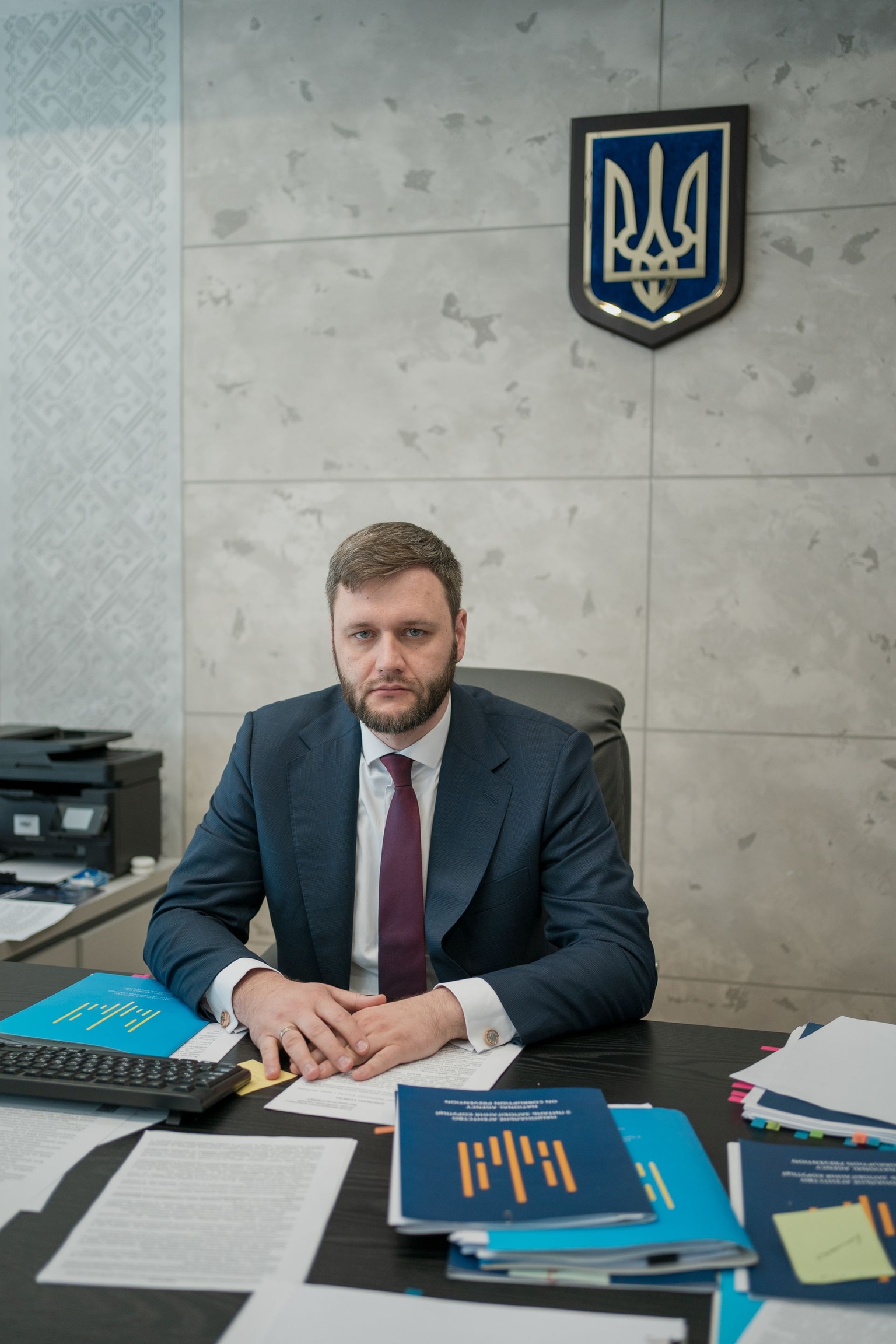
Viktor Pavlushchyk, head of Ukraine's NACP, in Kyiv, Ukraine on April 15, 2026.(Elena Kalinichenko/The Kyiv Independent)
She also said that it's not clear if the decision to hide the information was legal because nobody saw the legal grounds.
Asked whether Yermak or the President's Office influences the decisions made by the agency, Pavlushchyk said: "It's an interesting question, because which is it: Yermak personally or the President's Office?"
"Those are different things, as I understand it," he added. "(The President's Office) does not influence us. A key priority for me is safeguarding the independence of the institution."
Kaleniuk argued, however, that the agency's actions on Yermak, Halushchenko, and other top officials indirectly prove that it is not independent.
"Taken together, all these facts suggest that under Viktor Pavlushchyk's leadership, the National Agency for Corruption Prevention has been extremely loyal to the President's Office and has kept a low profile," she said.