The oil spill in Tuapse and the lessons Russia didn't learn
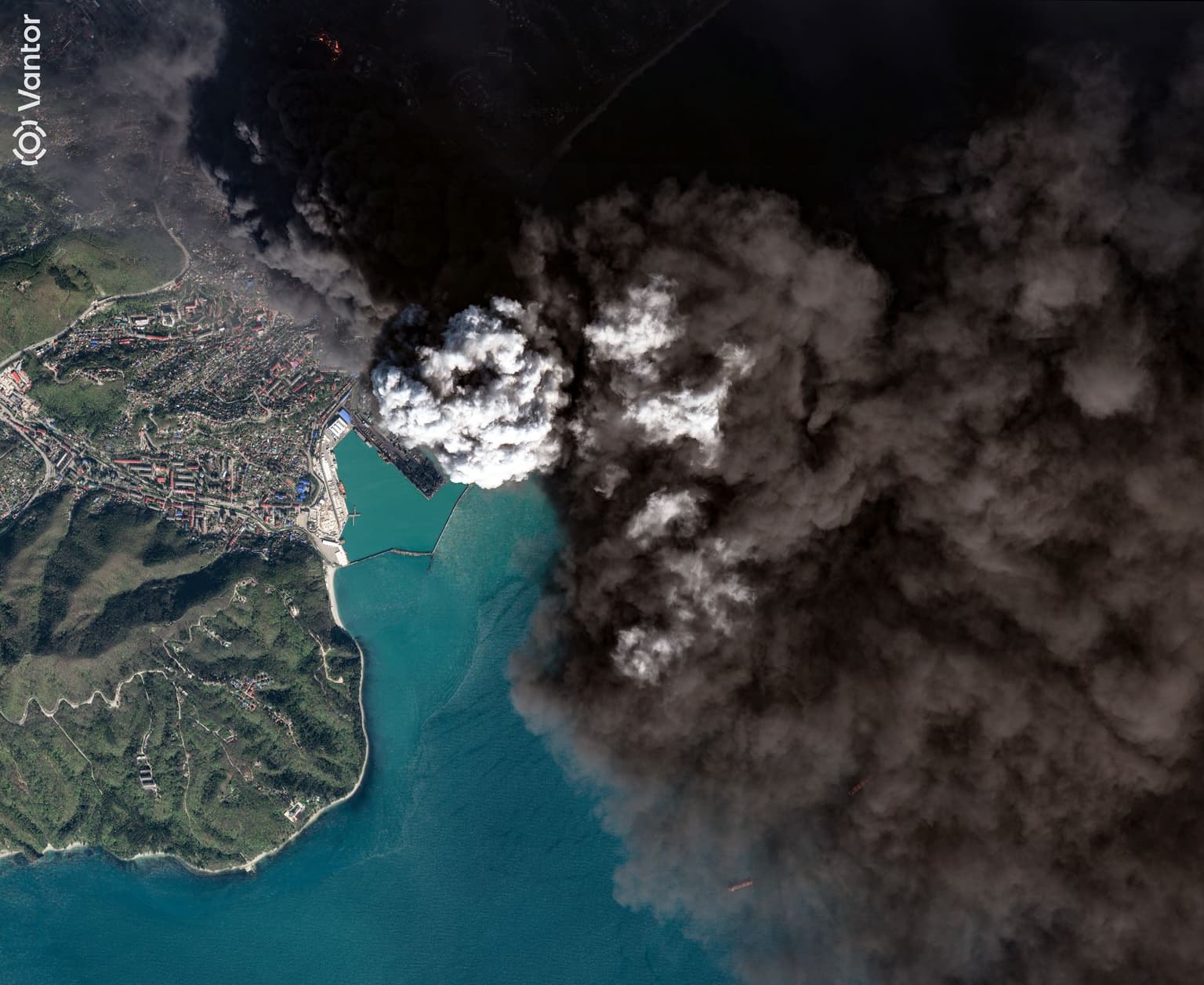
A satellite image shows fires and thick smoke rising from oil storage tanks at the Tuapse oil refinery in Tuapse, Krasnodar Krai, Russia, on April 16, 2026. (Satellite image / 2026 Vantor / Getty Images)
 on Google
While the human toll of Vladimir Putin’s invasion of Ukraine remains its most devastating consequence, another aspect of Russia’s onslaught is often overlooked: Moscow’s war on ecology.
Responding to Russia's growing air attacks against Ukraine, over the past 10 days, Ukrainian forces carried out a multitude of drone strikes targeting an oil refinery in Russia's port city of Tuapse.
Tuapse, on the Black Sea, has served as a primary point for Russia's oil exports, the proceeds of which are then used to finance the Kremlin's attacks on Ukraine.
As a result of the destruction, hundreds of tons of oil leaked from the facility, turning the city and the shore into a contaminated disaster area.
While Ukraine carried out many strikes on refineries across Russia over the past months in an attempt to halt Russian oil exports, the profits of which support the country's all-out war against Ukraine — the situation in Tuapse stands out.

In conversation with the Kyiv Independent, Russian independent environmental experts explained that while the oil spills happened after Ukrainian strikes, their effects could have been avoided if Russian authorities had reacted to the situation appropriately.
Damage control should have begun immediately after the first attack on April 16, the experts agreed, yet oil continued to massively leak even after the second and third attacks on the refinery.
A disaster for the environment and humans alike
Since the start of Russia's full-scale invasion of Ukraine, oil spills in the Black Sea region have become increasingly common: up to now, however, nearly all major incidents were linked to the activities of Russia's so-called "shadow fleet" of tankers.
The most serious of these, in December 2024, involved two such Russian ships: clearly unfit for service. The vessels sank in the middle of a storm, releasing thousands of tons of oil into the Black Sea.
On one hand, in that disaster, the volume of pollution was greater than following the recent attacks in Tuapse. On the other hand, the latest events have had a much more direct effect on public health.
"When the Russian tankers sank, this affected maritime ecosystems: in Tuapse, pollution also extended to the air and to the soil," explained a Russian environmental expert who asked to stay anonymous. "It's still too early to fully understand the effects, but this will also harm infrastructure, farming, animals, many different areas."


As opposed to previous oil spills in the region, this time the local population is more seriously exposed to air pollution by toxic substances. While the effects are still hard to estimate, this could affect the health of "thousands" of people in the area, who are now at an increased risk of developing cancer or other illnesses in the future, the environmental expert estimated.
In parallel, local ecosystems, which have already been weakened by recent oil spills, will now need to rid themselves of an extra amount of oil.
"The Tuapse river estuary ecosystem is obviously seriously damaged," said Eugene Simonov, an expert with the Ukraine War Environmental Consequences Work Group (UWEC).
"I assume that dolphin populations, which already see peak mortality (rates) in April, will be additionally hit by combined pollution. Birds are migrating now, and they are the other obvious victims. As for the rest of the ecosystem, this will only be known later, but impact paths, for now, look largely similar to what happened in 2024-25 (after the Russian 'shadow fleet' tankers sank)."
A tragedy that could have been avoided
In the context of the strikes, environmental experts who spoke to the Kyiv Independent said they were surprised — if not appalled — by the limited reaction to the incident by Russian authorities.
"A state of regional emergency was only declared on April 28," the Russian environmental expert said. "This should have been done immediately after the first strike (on April 16) and, actually, authorities should have declared this a federal emergency."
In parallel, instructions given to the local population seemed to downplay the seriousness of the situation. Russia's public health watchdog, Rospotrebnadzor, for instance, only issued safety recommendations to people in Tuapse on April 28, twelve days after the first strike: locals were told to stay indoors and wear medical masks when possible.
Commenting on the situation on the same day, Putin also refused to acknowledge that an ecological disaster had already taken place.
"Medicinal masks are clearly not enough," said in turn Vladimir Slivyak of Ecodefense, a Russian environmental group operating from exile. "In these situations, only respiratory masks are sufficient, as they offer protection from toxic fine particles, some of which can provoke cancer."

As for evacuation orders issued to locals, these were only given on April 28 as well, almost two weeks after the first strikes and the initial fire at the Tuapse oil refinery.
But even these orders were "insufficient," Slivyak said, explaining that authorities had only told people in the immediate surroundings of the plant to leave.
As for the actual spill, this too could have been avoided, according to the environmental expert who spoke on condition of anonymity.
"Oil refineries should normally be surrounded by a hermetic embankment, which stops oil spills from spreading," the expert said. "Even if this embankment in Tuapse was not perfect, if there were holes in it, for example, why was nothing done after the first attack? It would have taken just a few hours to patch any holes with a bulldozer."
While this apparent inaction could come as a surprise, past ecological disasters in Russia show a pattern of often insufficient and overdue reactions, Slivyak argued.
"When disasters such as this happen, Russian authorities usually start by just ignoring the problem. Then, when the problem becomes too big to ignore, they try to minimize its importance. And if you look at the reaction to this situation by authorities — especially Putin's recent comments — you will see that this time, this is exactly what happened too."