Ukraine raises $500 million extra in revenue amid efforts to reassure partners
 on Google
WASHINGTON — Ukraine collected $500 million more revenue than expected in the first three months of this year, the country’s Finance Minister Serhii Marchenko said, as Ukraine tries to better line its war coffers and reassure key partners.
"Revenue mobilization is strong," Marchenko said at the U.S.-Ukraine Partnership Forum hosted by the U.S. Chamber of Commerce on April 15 in Washington D.C., where he spoke on a panel on financing Ukraine’s recovery.
Big donors to Ukraine, including the International Monetary Fund and the European Union, want the country to boost revenue collection and reduce tax evasion and avoidance.
Now in its fifth year of fighting Russia’s full-scale invasion, the country relies heavily on foreign cash — especially from the EU — to fund its 900,000-strong army and keep the state afloat.
But while Kyiv is unable to raise all those funds domestically and is likely to rely on allies for years to come, partners want the country to bear more of the burden — especially in preparation for an eventual peace when financing might not be so generous.
Marchenko explicitly recognized the temporary nature of foreign cash, while also alluding to the need to attract private capital going forward.
"We need to think about what we can do if we don’t have access to this money," he said.
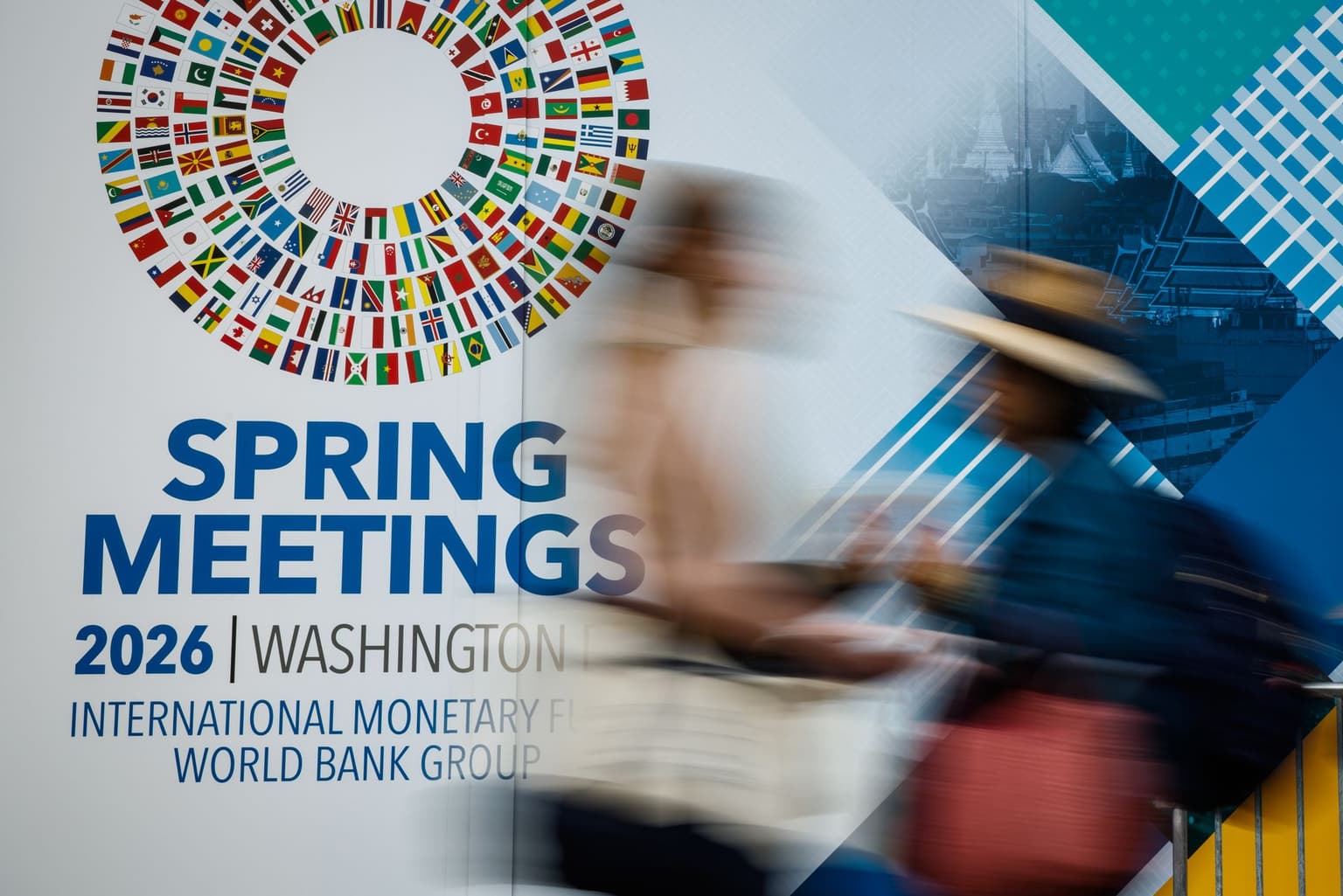
The comments come as a large Ukrainian delegation attends the IMF and World Bank Spring Meetings in Washington, D.C. this week for a series of high-level meetings.
That includes talks with the IMF, with whom Kyiv signed an $8.1 billion loan program with Ukraine in February this year.
Part of the deal is for Kyiv to implement four new taxes. Ukraine also most recently appointed a new head of its notorious customs service, which has been accused of possessing a sieve-like ability to collect revenue — fulfilling a longstanding IMF requirement.
But the war-torn country has since missed a March 31 deadline on three of the taxes, including a widely unpopular VAT tax on self-employed entrepreneurs in the country, a status widely used by companies to optimize taxes.
Ukrainian parliamentarians, speaking to the Kyiv Independent on the condition of anonymity, have said that they expect Ukraine to try and soften that requirement over the course of this week’s meetings.
Nevertheless, Managing Director of the IMF Kristalina Georgieva praised Kyiv in an interview with Face the Nation on April 12, pointing out that the country collected 34% of its gross domestic product in tax revenues — a high level for a country in its fifth year of war.
"We are working with Ukraine so they can continue on this path of reforms that gives them the credibility to earn massive support from the rest of the world, especially from Europe," she said.
Marchenko also spoke more widely about Ukraine’s economic prospects, as global headwinds led the IMF to downgrade the country’s growth prospects for 2026 in their flagship report yesterday.
"We are struggling," he said, highlighting Russia’s attacks on Ukraine’s energy infrastructure and the creeping rise of inflation following the war in the Middle East.
Despite being on a downward trajectory since May last year, inflation rose to 7.9% in March according to the National Bank of Ukraine.
But Marchenko said that despite the attacks on Ukraine’s energy infrastructure over the winter and the difficult challenges faced, there are already signs of recovery.
The finance minister was also upbeat on a 90 billion euros ($105 billion) loan from Ukraine, which is likely to be unlocked in the coming weeks following Viktor Orban's electoral defeat in Hungary on April 12, who had blocked the loan.
"I hope that the successful resolution of the European loan to Ukraine will help us to boost additional investment incentives to Ukraine."