What we know about Starobilsk strike Russia turned into propaganda flashpoint
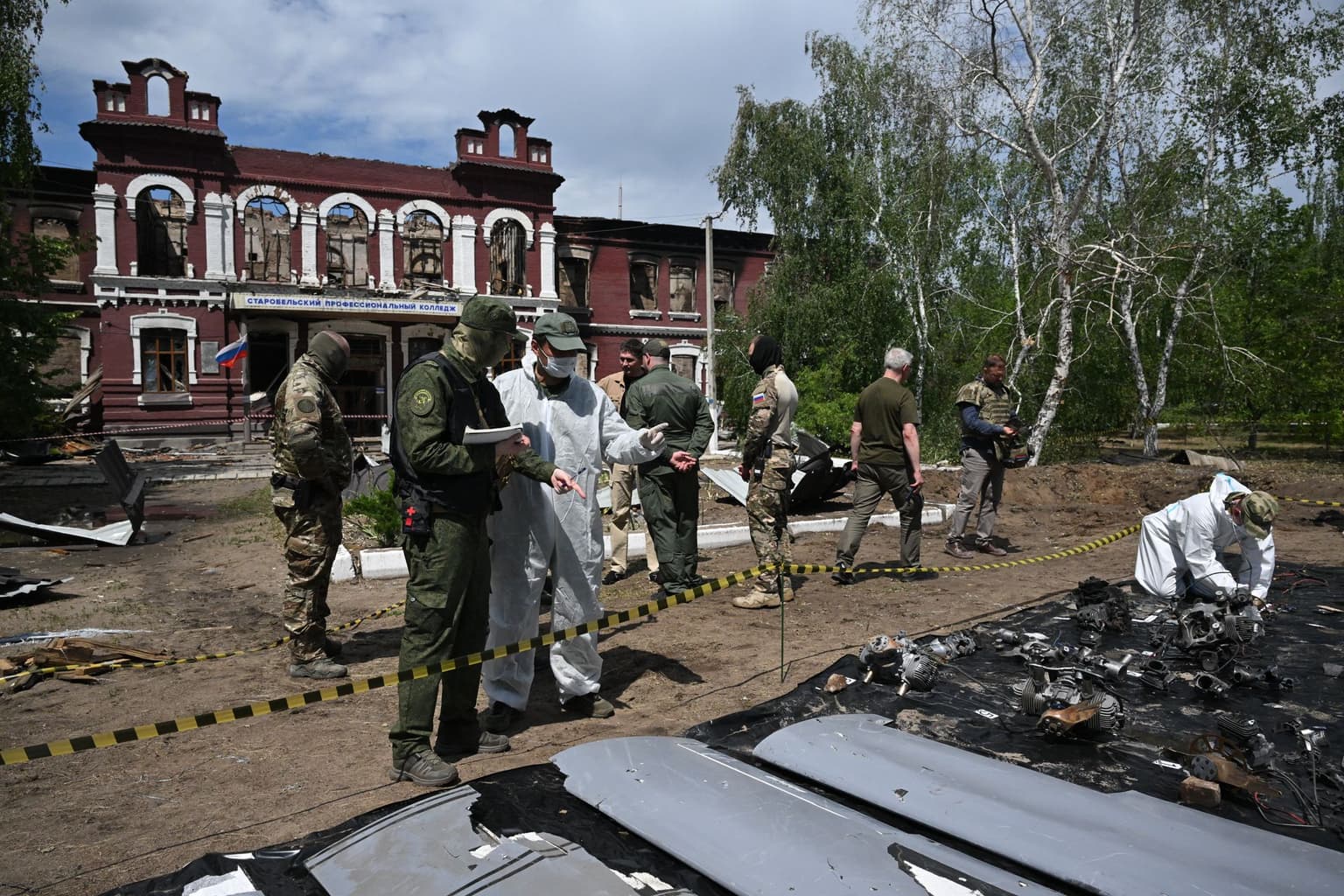
A Russian investigator examines parts of drones outside the destroyed building of the Starobilsk Professional College following a drone attack in Russia-occupied Starobilsk, Luhansk Oblast, Ukraine, on May 24, 2026. (Igor Ivanko / AFP / Getty Images)
 on Google
When a Ukrainian strike hit Russian-occupied Starobilsk on May 22, Moscow seized on the attack almost instantly, with Russian officials claiming that 21 students of a local vocational college were killed and dozens more injured and portraying the strike as a deliberate attack on civilians — which Ukraine denied.
The incident soon became a centerpiece of Russian state messaging, used to accuse Ukraine of terrorism, rally public outrage, and justify subsequent strikes on Kyiv on May 24 and June 2.
Russian President Vladimir Putin has repeatedly invoked the strike, including on June 5 while responding to President Volodymyr Zelensky's open letter proposing direct talks to end Russia's war. He questioned why Kyiv was seeking negotiations while carrying out strikes, citing the attack on Starobilsk.
Russia has long weaponized claims of civilian casualties from Ukrainian strikes, whether real, disputed, or fabricated, to portray Ukraine as deliberately killing civilians in the occupied Donbas. Moscow used that narrative to justify both its 2022 invasion and its 2014 invasion in eastern Ukraine and Crimea, falsely portraying the conflict as a "civil war" between Ukrainians and Russia as a protector rather than an aggressor.
Following the strike, Russian officials and pro-war commentators pushed several recurring narratives, according to a disinformation monitoring team at the Ukrainian-founded tech company LetsData.
Its analysis of 277 Russian-language posts on Telegram and X found that the attack was predominantly portrayed as a "terrorist act" targeting students, implying a possible coordination of phrasing. Russian officials also accused Western media outlets of ignoring the incident, presenting limited coverage as evidence of Western complicity.
Moscow further called for an emergency meeting of the United Nations Security Council on May 22, where it accused Ukraine of deliberately targeting students and civilians.
Ukraine rejected Russia's accusations over the Starobilsk strike as disinformation, saying the attack targeted military sites, including one of the headquarters of Russia's elite Rubikon drone unit in the Starobilsk area in Luhansk Oblast.
Ukraine's General Staff told the Kyiv Independent on June 12 that it will not be providing any further information about the attack beyond its original statement.

With independent access to the occupied town in Luhansk Oblast impossible, many details remain difficult to verify. The Kyiv Independent reviewed open-source evidence, official statements, and reporting from both sides to establish what is known about the strike, who the victims were, and which questions remain unanswered.
What happened in Starobilsk
Starobilsk is a city in Russian-occupied Luhansk Oblast with a pre-occupation population of 17,000 people.
It lies roughly 65 kilometers (40 miles) from the front line, making it part of Russia's rear logistics network in the region. Ukraine regularly strikes military targets in Russian-occupied territories, including command posts, logistics hubs, ammunition depots, and drone units behind the front line.
The city was targeted several times during the full-scale war. In April, a Ukrainian drone strike heavily damaged the building of the former district administration in Starobilsk, which occupation authorities had been using for administrative purposes.
The latest strike in Starobilsk took place overnight on May 22.
At 10 p.m. local time on May 21, an air alert was issued in the Starobilsk district, according to local authorities.
The Telegram channel "Starobelsk Online" ("Starobelsk" is the Russian version of the city's name), an anonymous local news channel, reported explosions in the city shortly after the air alert was issued. At 10:26 p.m., a fire was reported.
The channel also said that jet-powered drones were flying over the city. Russia later claimed that 16 drones were used in the attack.
Bohdan Kosokhatko, head of investigations at Truth Hounds, a Ukrainian group investigating war crimes, told the Kyiv Independent that it is difficult to determine the type of weapon used in the attack based on the available footage. Ukraine's General Staff didn't reveal anything about the weapons used in the attack.
By the morning of May 22, reports emerged in local Telegram channels and official channels of occupied authorities that the premises of two vocational colleges in Starobilsk had been hit and that students had been killed and injured.
Satellite imagery from Planet Labs suggests that at least five buildings in the college area were struck. Two of them belonged to educational institutions. No reliable information is available about the other three.

As rescue operations continued, friends and relatives were sharing photos of missing people on local Telegram channels, asking whether anyone had seen them.
What we know — and don’t know — about the victims
Russia's Emergency Situations Ministry said on May 24, after search and rescue operations were completed, that 21 students were killed and 42 injured in the attack.
A list containing the victims' full names and dates of birth was published the next day, May 23, by the Russian occupation authorities in Luhansk Oblast.
Following the strike, Russian authorities, including the Russian Foreign Ministry, claimed that the victims were children aged 14-18, framing the attack as one that killed minors. The published list, however, showed that the listed victims were between 18 and 22 years old.
Ukrainian journalists do not have access to occupied Starobilsk, making on-the-ground verification of claims about the listed victims impossible.
Publicly available information about local residents has also been limited since Russia occupied the city in 2022. Reporters have therefore relied on open-source data, including accounts on the Russian social media platform VK, which is widely considered to be under state control.
Ukrainian media outlet Realna Gazeta was the first to report that the deaths of students appeared real, given the many traces of the victims on social media.
The Kyiv Independent sought to verify the information by locating VK accounts belonging to 19 of the 21 alleged victims. Their names and ages matched the list published by Russian occupation authorities, and none of the reviewed accounts showed activity after May 21, the day of the attack.

The accounts contained dozens of condolence messages, while some relatives and friends shared photos and videos in memory of the dead.
Many of the listed victims followed the VK page of the Starobilsk College of Luhansk Pedagogical University or listed the institution in their profiles. Several of the female students listed as victims also appeared together in photographs posted online, suggesting that they were classmates.
Russian state media covered the funerals of some of the students. According to these reports, two of the victims — Anastasiia Kovalenko and Anna Pohribnichenko — were studying to become preschool teachers, while another student, Maksym Buhakov, was studying information technology.

At the same time, it is not possible to verify whether any of the students were involved in military activities, including drone assembly or operations linked to the Rubikon unit.
Some of the deceased students, however, had participated in organizations tied to Russia's broader youth militarization efforts. The Kyiv Independent found that at least three had been involved in the Russian Student Brigades (RSO), a state-backed youth organization that regularly takes part in pro-war and patriotic initiatives.
One of them, Oleksandra Butkova, took part in the Alabuga Top summer program in Tatarstan in 2024. The initiative recruits young people for projects at the Alabuga Special Economic Zone, where Russia manufactures drones used in attacks against Ukraine. However, it remains unclear what role, if any, Butkova had within the program.

Two colleges
The strike damaged two neighboring college buildings that officially share the same address but belong to separate educational institutions.
The five-story white building houses the Starobilsk Branch and Starobilsk College of Luhansk Pedagogical University, which mainly trains future preschool and primary school teachers. The two-story red building next to it houses the Starobilsk Professional College, which offers vocational programs in information technology, electrical equipment maintenance, welding, and other technical fields.
Most of the listed victims whom the Kyiv Independent was able to find on VK appear to have been students of the Pedagogical College, housed in the white building. Russian officials and state media have said very little about the neighboring red building, which houses the Starobilsk Professional College and was also heavily damaged.

Russian state television reports, including interviews with injured students, suggest that many of those listed as victims were on the fourth and fifth floors of the five-story white building of the Pedagogical College at the time of the strike.
According to those accounts, the upper two floors served as dormitories, while the lower three were used for classes.
Alina, a student at the Pedagogical College and a friend of two of the students reported killed, told Bereg, a consortium of Russian independent journalists, that students had first taken shelter in the basement for about two hours during the strike, before returning to their rooms once the air raid alert was lifted. During a later alert, she added, students were instructed to remain on the fourth floor.
"We were told to stay on the fourth floor in the corridors. And then a drone hit a car that was parked in the courtyard behind the college — it exploded. Panic broke out in the corridors; everyone ran down to the first floor," Alina said.

Students from the Professional College took shelter in the Pedagogical College basement during air raid alerts because their own building reportedly lacked a shelter, according to Alina.
Russian officials and state media have not addressed who was inside the Professional College building on the night of the strike or whether there were casualties there.
One of the international journalists brought to Starobilsk by Russian authorities told Meduza, a Russian media outlet in exile, that Russian security forces did not allow access to the red building of the Professional College, claiming that there were no casualties there.
Russian official statements and state media reports have focused almost exclusively on the Pedagogical College, at times referring to the neighboring red building as part of the same institution, although it is officially separate.
Military use of educational institutions
It remains unclear — and impossible to confirm due to lack of access for independent journalists — whether Russian military units, including a command facility of Russia's elite Rubikon unit, were stationed inside either college building.
Rubikon, also known as the Center for Advanced Unmanned Technologies, regularly carries out attacks against civilians and civilian facilities in Ukraine, according to Ukraine's General Staff.
Rubikon has also been reported to target civilians during drone operator training exercises. According to Ivan Bazyliuk, head of the Nikopol District State Administration, the unit has used civilians as "live targets" in Nikopol, located about four kilometers (2.5 miles) from the front line, to train drone operators.
The Ukrainian publication InformNapalm found that at least one student from the Pedagogical College had undergone military training through the Warrior Center for Military and Patriotic Education, a network established in 2022 by direct order from Putin.
During a weapons training course, the student also learned to operate drones using specialized equipment, according to photos found on an archived version of the college's website.

Kateryna Dorosh, coordinator of the War Crimes Documentation Program at the East SOS Charitable Foundation, told the Kyiv Independent that the organization has documented Russia's systematic use of educational institutions in the occupied territories for military purposes.
Dorosh said East SOS recorded cases of Russia using educational premises to station troops and establish headquarters, firing positions, observation posts, detention sites, and torture chambers. The organization documented such cases in Kherson, Kharkiv, and Donetsk oblasts.
"This practice violates the principle of separating civilian and military targets and puts children and teachers at risk," Dorosh said.
However, East SOS does not have independently verified evidence that Russian military personnel used the college buildings in Starobilsk.
Russia's indiscriminate attacks across Ukraine throughout the full-scale war have killed more than 15,000 civilians and injured over 41,000 as of February 2026, according to the latest United Nations annual report. Over 3,500 children have been killed or injured in Ukraine since the start of the full-scale war, according to a Save the Children analysis.