Here's what Candace Owens gets wrong on Russia
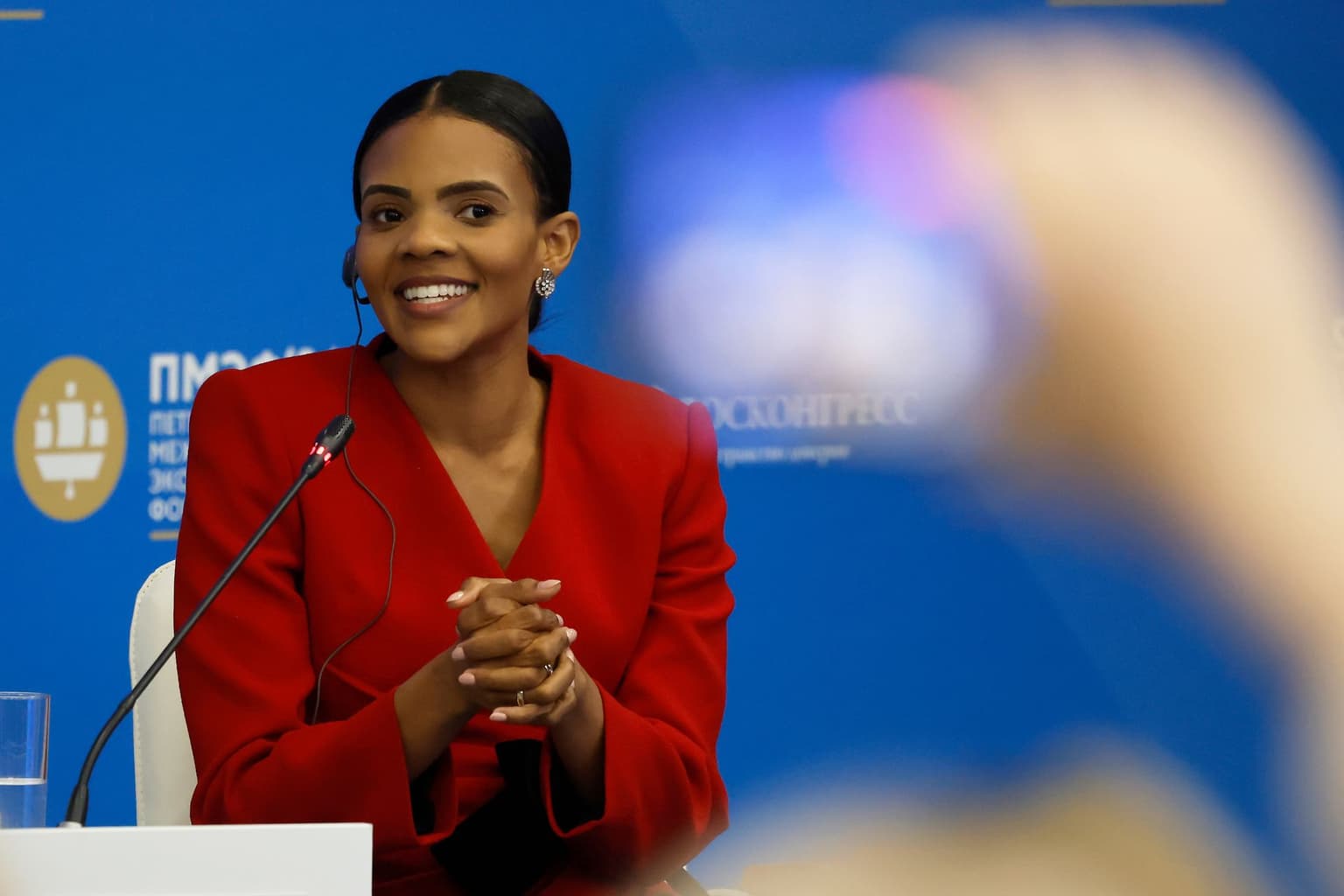
U.S. far-right conspiracy theorist Candace Owens attends the St. Petersburg International Economic Forum in St. Petersburg, Russia, on June 4, 2026. (Anatoly Maltsev / Pool Photo / AP)
 on Google
Candace Owens billed her trip to Russia last week as a family vacation. It turned into something far more useful for the Kremlin.
The U.S. far-right conspiracy theorist — boasting 35 million followers across all social media platforms — ended up appearing at Russia's flagship economic forum, talking to Russian propaganda outlets, and praising the country's "traditional values" while dismissing Western coverage of it as lies.
Her visit also exposed a fresh fault line within the MAGA movement, drawing sharp rebukes from prominent Trump allies, with some describing her trip as a "propaganda tour."


While known primarily for railing against Israel and spreading conspiracy theories about France's first lady, Owens now tried her hand at whitewashing Russia for U.S. audiences.
The Kyiv Independent explains why her arguments do not hold water.
The outdated Ukraine aid argument
According to Owens, Americans are not interested anymore in funding Ukraine's resistance against Russia — even though U.S. President Donald Trump cut almost all of that funding more than a year ago.
Talking to reporters on the sidelines of the St. Petersburg Economic Forum, Owens alleged that the U.S. public is "getting tired of funding" the war in Ukraine, "not knowing where the money is going, learning that oligarchs are buying yachts."
The remarks echo a familiar Biden-era refrain among American Ukraine skeptics, who have long questioned whether taxpayer dollars are being spent effectively.
But the argument does not make much sense since Trump took office in January 2025.
The Trump administration has ended nearly all new aid allocations to Ukraine, mostly agreeing to only sell arms via NATO and leaving Europe to shoulder the financial burden.

The Pentagon has even slowwalked the disbursement of the $400 million in Congress-approved funds for Ukraine's arms contracts in 2026 — a sum that is only a drop in the $1-trillion bucket of the U.S. defense budget.
European partners, in turn, allocated about $30 billion to Kyiv last year, according to the Kiel Institute's Ukraine aid tracker.
Western officials have been closely monitoring the provided aid. And while Ukraine has grappled with major corruption scandals during the war — including one that allegedly involved former presidential chief of staff, Andriy Yermak — there has been no confirmed case of Western aid being siphoned off to buy yachts for Ukrainian officials or oligarchs, despite such disinformation surfacing at times.
The grocery store illusion
Since her arrival in Russia, Owens has been gushing about how "unbelievably beautiful" Moscow is and how much more affordable life seems there than in the U.S.
This largely mirrors a visit by fellow conservative pundit Tucker Carlson, who marveled at how cheap Russian grocery stores are during his own trip in February 2024.
"Gas is cheaper, food is cheaper, and they have less debt," Owens said on X. "Our media lies day in and day out and pretends Russia is on the brink of collapse to justify our own citizens struggling to afford basic necessities."
Numbeo, an online service that collects data on costs of living around the world, estimates that groceries are about 82% more expensive in the U.S. than in Russia.
However, the local purchasing power — that is, what an average person can afford to actually buy, adjusted for local prices — is 140% higher in the U.S., according to the same portal.
And while the average wage in the U.S. is about $65,000 per year, in Russia, it is only around $12,000.
Owens also omitted that the two cities she visited — Moscow and St. Petersburg — are among the wealthiest in Russia, far above much of the country, particularly regions in the North Caucasus, Siberia, and the Far East.

She also did not mention that inflation, taxes, and other impacts of the war have driven prices higher in recent months, leading to complaints about rising living costs since early 2026.
An analysis by the independent news outlet Important Stories says that items like wine, milk, bananas, bottled water, tomatoes, cheese, apples, and oranges are now mostly cheaper in European capitals, despite a much higher median wage.
While an average Russian spends 32% of their total expenses on food, in Poland it is only 18.5%, 15.7% in Czechia, and 11.6% in Germany, according to the analysis.
Regions across Russia and the Ukrainian territories occupied by Moscow have also grappled with fuel shortages due to Ukrainian strikes against oil refineries, with some gas stations even capping the amount of fuel per driver.
Russia, the 'Christian bastion?'
Another motif in Owens' tour has been the image of Russia as a family-friendly Christian bastion, an image that Russian propaganda — and its Western allies — often contrast with the "decadent West."
"The Christian expression and heritage here is unmatched," Owens said on X in a post accompanied by interior footage of the Main Cathedral of the Russian Armed Forces, an Orthodox temple dedicated to the Russian military.
During her panel debate at the St. Petersburg forum, Owens lauded the Russian government's pro-family policies.
Around 14,000 women died in Russia every year as a result of domestic violence — over nine times more than U.S.numbers.
"It really has been a blessing to hear about what's going on in Russia in terms of the policies that are being put into place to encourage big families," Owens said.
"I truly believe that any nation that supports that sort of dynamic, whether it's West, East, or hopefully both… will have a much more fruitful and productive society."
Yet again, data paints a different picture.
Russian society has long been plagued by widespread domestic violence, with its parliament even decriminalizing some forms in 2017.
Even before the full-scale war, around 14,000 women died in Russia every year as a result of domestic violence — over nine times more than U.S.numbers despite Russia's comparatively smaller population.
The situation is getting even more dire with traumatized soldiers and pardoned convicts returning from the front lines, while authorities are increasingly turning a blind eye to such cases, research shows.
Russia also has one of the highest divorce rates in the world, with more than 70 divorces recorded for every 100 marriages.
Church attendance, in turn, is in decline, with only 16% of Russians saying they go to church at least once a month, according to the Levada Center's survey.
The MAGA split
But Owens' trip was not simply about persuading U.S. audiences about a "blissful life" in Russia. Experts see multiple goals behind her visit.
Owens "telling her followers that Moscow is clean and beautiful, and that '(Russia) collusion' is just media panic, ran on RT and Pravda within hours," notes Jade McGlynn, a Russia expert at the Center for Statecraft and National Security at King's College London.
"A lot of the value there is domestic: 'see, even Americans say the West lies,'" McGlynn adds.
But that does not mean Owens is not useful for Russia as a "bridge" — to cite a word she herself used — to sympathetic Western audiences.
Unlike Carlson, whose audience largely shares his convictions, Owens may even reach a broader, less politically defined demographic, political historian Brian Rosenwald of the University of Pennsylvania told the Kyiv Independent.
The visit also underscored a new emerging rift within the MAGA movement, with stances on Russia appearing as a new — albeit tenuous — fault line.
Owens' trip was criticized by prominent Trump allies, including her former Daily Wire boss, Ben Shapiro, and conservative influencer Laura Loomer.
Shapiro, who described Owen's visit as a "propaganda tour," interviewed President Volodymyr Zelensky in Ukraine last year. Loomer, in turn, dispatched a reporter to cover Russian strikes against Ukraine earlier this month.
"conspiratorial wing of MAGA… has long been anti-Ukraine and pro-Russia, but now they're also anti-Trump because they oppose Israel."
In a statement to the Kyiv Independent, Owens declined to comment on Loomer's accusations that she amplifies Russian propaganda, dismissing them as "delusions."
But the Russia-Ukraine divide appears to be only secondary to a more significant cause of the MAGA split — views on Israel and Trump's war on Iran, heavily criticized by both Owens and Carlson.

The "conspiratorial wing of MAGA… has long been anti-Ukraine and pro-Russia, but now they're also anti-Trump because they oppose Israel," says Michael Weiss, English language editor of the Russian independent outlet Insider.
At the same time, Russia is now less reluctant to court Trump's critics, as it realizes rapprochement with Washington has failed, he adds.
"So now you have the war party in Russia unencumbered by any pretense of making nice with Washington. That makes Trump fair game for attack," Weiss says.
Disclaimer: This article was produced as part of the F.A.C.T. (Fighting Against Conspiracy and Trolls) project, funded by the European Union through HaDEA. The views expressed are those of the authors and do not necessarily reflect the views of HaDEA or the European Union. Neither HaDEA nor the EU is responsible for any use of the information contained herein.
Correction: The article incorrectly said that the average U.S. salary is $65,000 per month and Russia's is $12,000 per month, rather than per year. The mistake has been corrected.
Note from the author:
Hi, this is Martin Fornusek, one of the authors of the article.
At the Kyiv Independent, our team strives to bring you insights into Russian disinformation, propaganda, and its ongoing aggression in Ukraine. This work is only possible thanks to the support of readers like you. If you value independent journalism, please consider joining the Kyiv Independent's community.