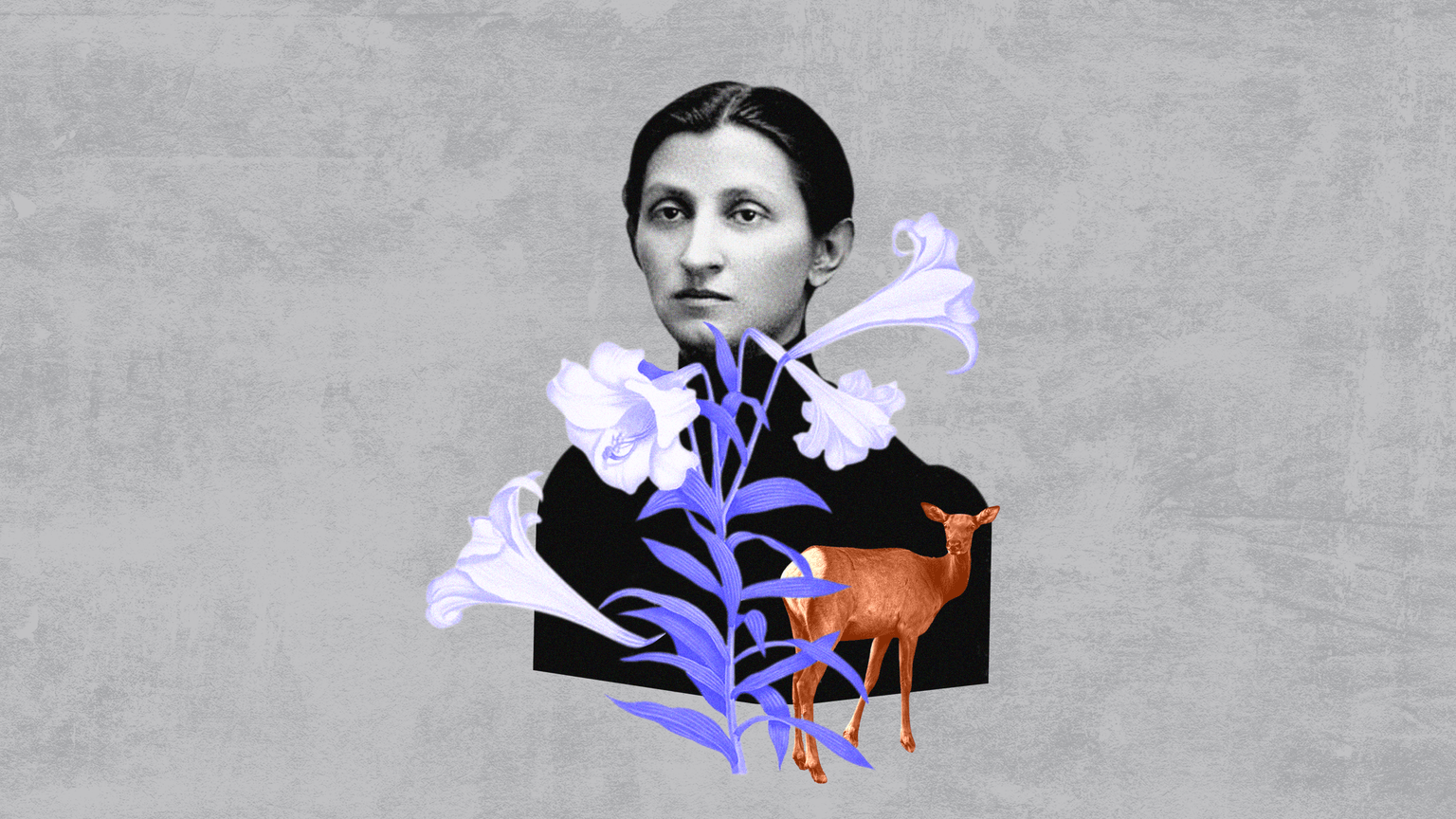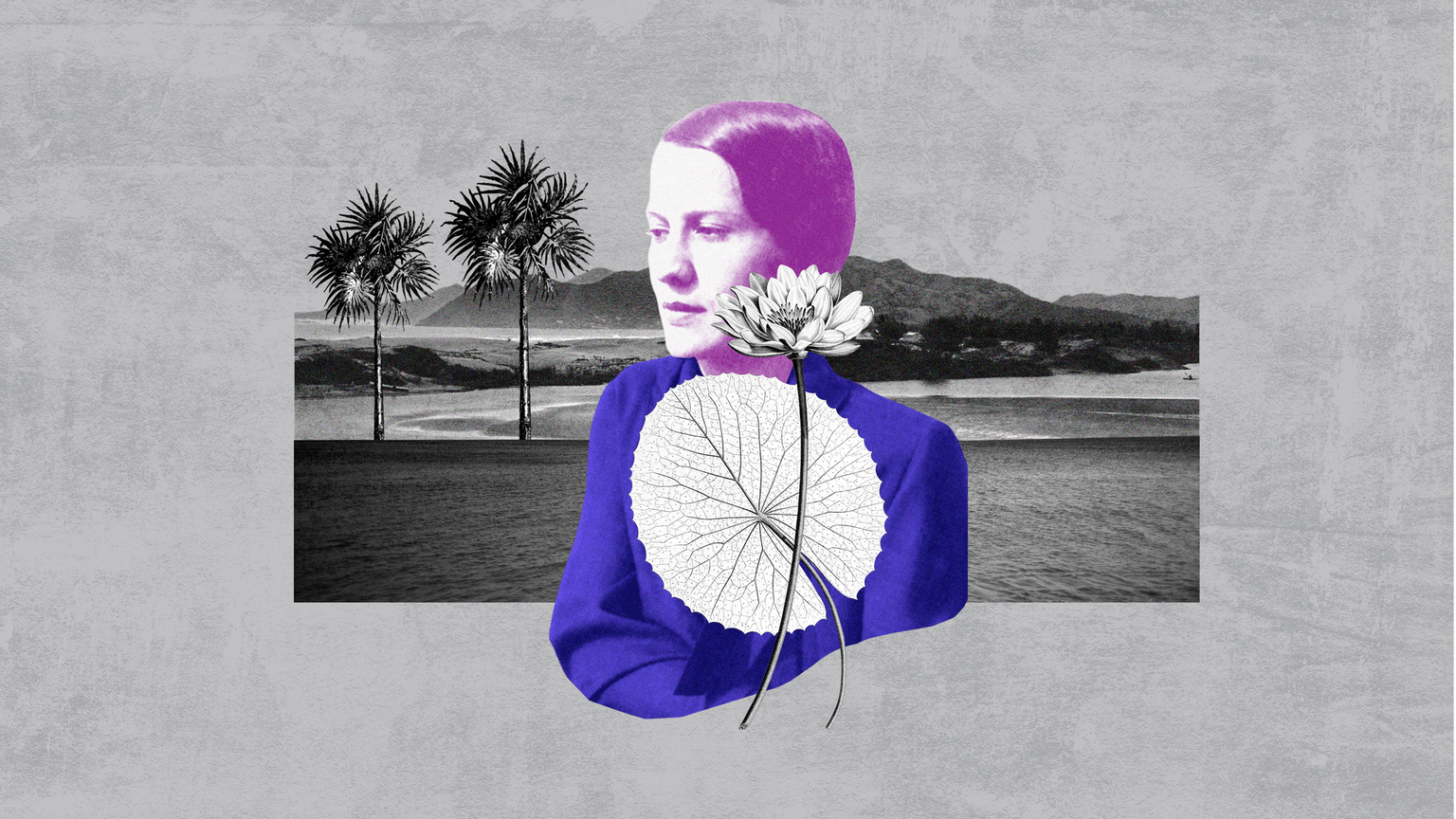
Sofia Yablonska was a Ukrainian author who wrote travelogues of her journeys through China, Morocco, and a number of other countries in the 1930s. (Anastasiia Starko / The Kyiv Independent)

Editor's Note: This story is part of the "Hidden Canon" – a special series celebrating Ukrainian classic literature and aiming to bring it to a wider international audience. The series is supported by the Ukrainian Institute.
The photographs featured in this article are shared with the permission of the Sofia Yablonska Foundation, which is tasked with preserving her legacy. All photographs are subject to copyright.
As the opium smoke curled around her in a dim-lit room in China, the writer Sofia Yablonska found herself hallucinating vivid memories of her childhood village in western Ukraine’s Lviv Oblast.
“Reclining on my back, I took pleasure in watching the apparitions drift by — some returning, lingering briefly, before fading once more. On the dim ceiling of that smoky room, I often glimpsed images close to my heart,” Yablonska writes in her 1936 travelogue “From the Land of Rice and Opium.”
“Here’s my home village, brimming with apple orchards. From a distance, I hear a cart’s wooden creak and the sound of someone retting hemp. Folk songs drift in the air. I can almost smell it all — especially the scent of warm, freshly baked bread. Suddenly, I know it’s Saturday: the kitchen’s yellow floor has just been scrubbed, and embroidered tablecloths are spread out in welcome.”
Born in 1907 to a priest’s family, the beautiful, perceptive, and fearless didn’t allow herself to be defined by the societal expectations of her era. While most women could only dream of a life filled with adventure, she chased hers all the way to Paris, wanting to become a movie star. Ultimately, it was behind the camera that she found her true calling. Yablonska worked as a journalist, cinematographer, and photographer, journeying to China, Morocco, and other far-flung places. Her world travels inspired travelogues that captivated Ukrainian audiences.
Yablonska’s work is currently experiencing a renaissance in Ukraine, and her contributions to Ukrainian literature are unmistakable. Her travelogues introduced Ukrainian modernism to a voice that was both distinctly female and unapologetically cosmopolitan, setting her apart from many of her contemporaries. Through her writing, she offered Ukraine a window to the wider world at a time when hopes for statehood were fading after the loss of the war of independence (1917-1921) and when Ukrainian culture was being repressed during the Stalinist purges of the 1930s.

“The main impetus for writing for Yablonska was impressions from the outside world, and this brings her works closer to reportage. This reportage can be called not even ethnographic, but anthropological, because it aims to understand human existence in its various cultural manifestations,” Ukrainian literary scholar Olena Haleta told the Kyiv Independent.
“The main story she tells is the story of the formation of a person who responds and experiences. Her works are far from the classic novel, but they have a hero who goes through a deep change, and they have emotional and intellectual tension and a plot. And this makes them part of literature as a work of imagination.”
The travelogue "From the Land of Rice and Opium" recounts Yablonska’s experiences in China in the 1930s, when she worked for a French film company to shoot documentary footage. What started as a short-term job turned into a 15-year stay, during which she even met her future husband.
Although Yablonska never achieved her earlier dream of becoming a movie star, the book opens with the captivating intrigue of an adventure film: “Getting to Yunnan isn’t always possible, because if it’s not pirates attacking the trains, then it’s mountain landslides blocking the tracks or bridges being washed out by floods, shutting down the route for long periods of time.”
Yablonska chose Yunnan, a province in southwestern China, based on recommendations that it resembled the “old” China, with greater isolation and limited external influence. From the very beginning, she faced challenges in work because locals held the superstition that cameras could steal a person’s soul, which often led them to flee when they saw her with her camera.
“At first, I tried to outsmart the locals by setting up my camera on a narrow street where loaded caravans would pass on their way into the city after long journeys. I figured they’d have no choice but to walk past me. But that didn’t work either — the whole street would grind to a halt right in front of me,” Yablonska writes.
“Anyone who could would squeeze by along the wall or slip into a side street, while the caravans just stopped and waited until the police, alerted by the jam, showed up. They’d soon arrive and politely ask me to move off the sidewalk. There was nothing I could do.”
As a result of this prevalent superstition, Yablonska had to get creative. She rented an office and disguised it as an import-export business dealing in cars and airplanes. Her assistant handled any curious visitors at the front desk, while Yablonska worked in the dimness of a back room, filming through a mostly covered-up window to get the shots she needed. Still, Yablonska tried in a number of circumstances to set boundaries out of respect for locals.


Yablonska was determined to experience life in China as authentically as possible, deliberately trying to avoid other foreigners and their usual haunts. This sometimes led to darkly comic situations — for example, she describes nearly losing her mind after being eaten alive by fleas and mosquitoes at an inn for poor Chinese travelers. Eventually, she gave in and spent the rest of her journey staying in various Buddhist temples that welcomed devout — paying — visitors. Even though she longed to capture these beautiful places on film, she initially chose not to, out of respect for their hospitality.
“These pagodas have become true havens of rest and peace for me during my exhausting travels. Out of respect for this, I haven’t yet dared to disrupt their tranquility with my curiosity as a filmmaker. Honestly, my desire to capture great photographs is so strong that it would probably win out over my gratitude, if not for my fear of losing the monks’ trust forever,” Yablonska writes.
“Knowing how wary they are of devices ‘that reproduce the human face — and thus the divine, for every human is part of God,’ I don’t even try to film or take pictures of the monks or their sanctuaries.”
The more Yablonska traveled, the more she had to confront the limitations of her knowledge, and with it, her views on people different from her. For instance, Yablonska, in “From the Land of Rice and Opium,” describes learning that China is not ethnically homogeneous. In Yunnan, the Yi people — who once resisted Chinese rule — had come to accept living under it. Being from Ukraine, which has long fought against Russia for its right to exist, she found the idea difficult to grasp.
“It’s only natural that Ukraine wants to be free, that for centuries it has fought, and will continue to fight, for its independence. If we were passive, it would only prove that we have no real basis for independence, no justification for our separate existence,” Yablonska writes.
According to Haleta, Yablonska, “like anyone else, was a child of her time and used its language, often asymmetrical in the descriptions of different cultures.” While this sometimes comes through in her writing, Yablonska nonetheless “sought her own communication with representatives of different traditions, which, by her own admission, challenged both established stereotypes and wandering romanticism.”
As a Ukrainian woman traveling the world at a time when Ukraine had just been denied statehood, Yablonska had a unique understanding of and inclination toward "otherness," according to Veronika Homeniuk, the director of the Sofia Yablonska Foundation.
"Through herself, she gave voice to the Other, whom she sought to understand despite everything — despite the everyday discomforts of traveling life in the early 20th century, despite the danger to her life, and despite borders. Despite it all, she managed to bear witness to the Other in her writing, and in a sincere portrait, in a gaze directed straight into the lens of her film camera," Homeniuk told the Kyiv Independent.
Even in the most remote corners of the world, Yablonska couldn’t escape the long shadow of Russian imperialism. In her 1932 travelogue “The Charm of Morocco,” she describes having to explain to Kaid, the head of a harem, that Ukrainians and Russians are not the same people, after he refers to a Russian woman serving him as Yablonska’s fellow countrywoman.
“I began to explain to him the differences between the Russians and us, drew a map of Ukraine and its neighboring countries so that he could better understand its location, and finally, I said that there were about forty million of us and that Ukraine was one and a half times larger than France,” Yablonska writes.
“I know all these explanations better than a prayer, because I often find myself repeating them to the French and other foreigners who know nothing about our existence.”
Despite the misunderstanding, the exchange becomes a bonding moment for two people shaped by cultures that have endured oppression. After praising Yablonska for representing “Ukraine’s strong conscience,” Kaid tells her about the Zaian War, which began in 1914 during the French conquest of Morocco. He describes how the French paid off some local tribes to fight against their fellow Arabs, sharing this story with a mix of regret and bitter disgust.

Yablonska herself becomes a target of Western condescension, notably when a French acquaintance, Mr. Manrieut, dismisses her open-mindedness about the country. After she challenges his derogatory remarks about the local customs of Morocco, he dismisses her not only as “young and naive,” but most notably as a “wild Ukrainian woman.”
The “wild Ukrainian woman” lays bare the deeply-rooted imperial attitudes that shaped interactions between Western Europeans and those they considered “other.” When addressing her in front of Moroccans, Yablonska is his “European friend” — but for Manrieux, her “Europeanness” has its limits. The comment also conveys how Western prejudices have extended well beyond the most apparent markers of difference, like skin color. Instead, they frequently encompass a broader array of perceived social hierarchies.
Yablonska writes in “The Charm of Morocco” how she “came to detest” Mr. Manrieux’s behavior, that he “considered himself the full owner of Morocco and treated Arabs as if they were his slaves.” He declares that “there is nothing interesting” about Moroccan culture and that it is just “the outer facade” which appeals to her, and looking beyond it will reveal “the great banality and aimlessness of their uncivilized life.”
Yablonska counters that this notion of a superficial outer facade is “deliberately placed before overly curious, or perhaps even insolent, European eyes.” Taking her pushback even further, she later leaves a biting, playfully irreverent note for Mr. Manrieux after accepting Kaid’s invitation to join him for tea and get a glimpse into his home and daily life: “When after your return from Casablanca you do not find me anywhere, forgive an unruly ‘wild Ukrainian woman’ and go to Kaid and demand that he reduce his harem by one woman: me.”
Almost a century after her journeys, in a more self-conscious and critical world, it’s tempting to read Yablonska’s work through a strictly national, anti-colonial, or feminist lens. But as Haleta points out, none of these fully capture the depth of her work — it’s far more universal than that.
“Good literature is not limited to one methodology. Sofia Yablonska shows the formation of a complex personality that discovers different levels of belonging, crosses external boundaries, and establishes internal limits,” Haleta said.
“And this is not an abstract person, this is a concrete person with her character, thoughts, emotions, biography, and external circumstances. She shares this experience, and in this way encourages readers to move, to be actively present in the world, to find themselves, and to care for others.”
Sofia Yablonska’s “From the Land of Rice and Opium” will be released in late 2026 by Academic Studies Press in a co-translation by Yulia Lyubka and Kate Tsurkan.
Yablonska's other works have yet to be fully translated into English.