A subtle drop in Putin's ratings carries an unusual signal
Experts suggest Kremlin-linked polls are hinting at elite disagreements over wartime censorship and online control.
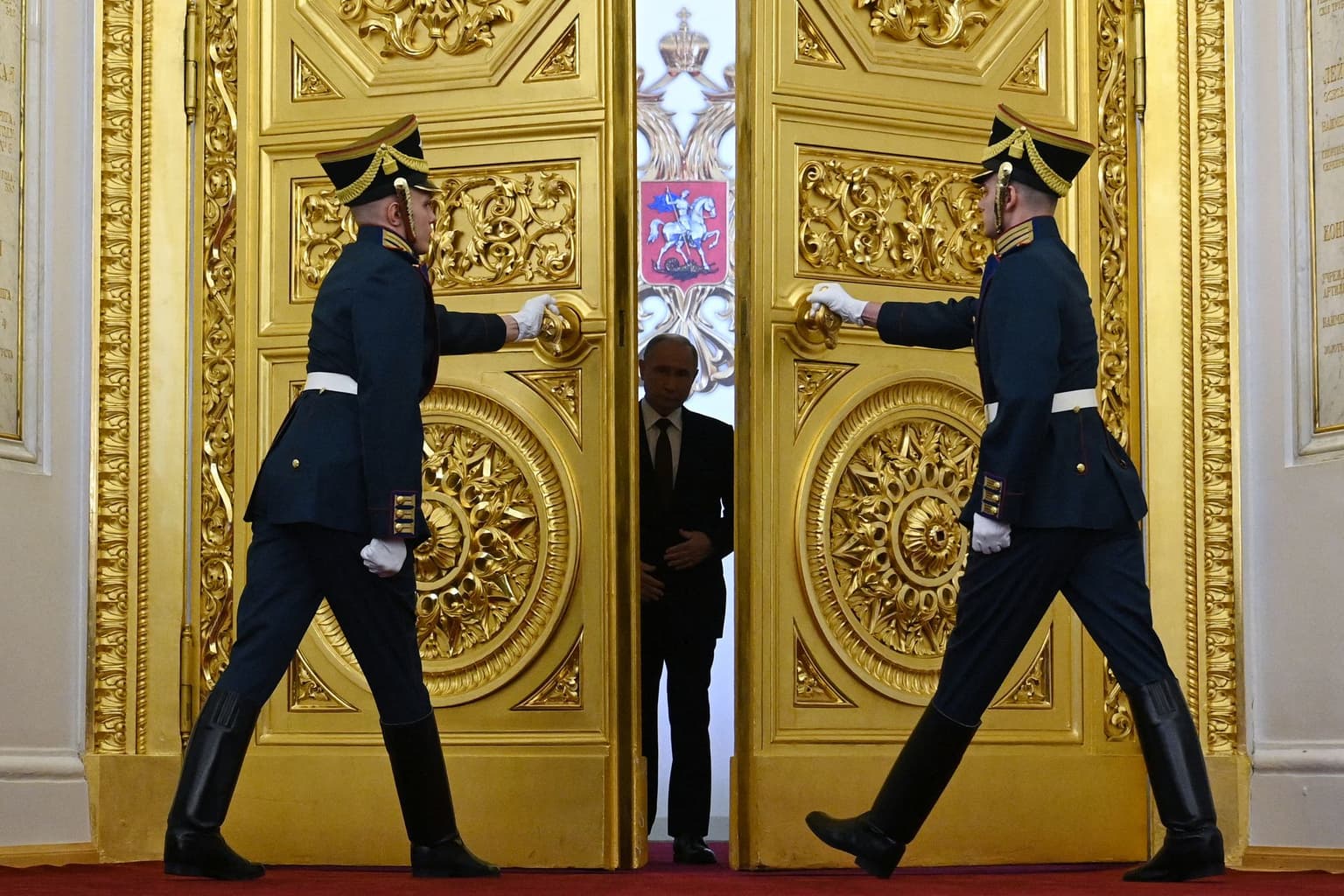
Vladimir Putin in Moscow, Russia, on May 7, 2024. (Sergei Bobylyov/Pool/AFP/Getty Images)
 on Google
The steady decline in Vladimir Putin's ratings is sending a message — just not the kind polls in democracies are designed to capture.
As the Kremlin's grip over the internet tightens, pro-war military bloggers, figures from state-approved "opposition" parties, and even influencers have railed against the online crackdown.
State-linked pollsters, meanwhile, report that the Russian president's approval rating has steadily declined, reaching its lowest point during the all-out invasion of Ukraine.
About 73% approve of Putin's performance, the lowest figure since 71% in February 2022, according to the Public Opinion Foundation's (FOM) survey published on May 1.
The Russian Public Opinion Research Center (VCIOM), another state-controlled pollster, reported that almost a quarter of Russians do not trust the president, marking another post-2022 record.
These margins — which would be the envy of most democratic leaders — cannot be taken at face value amid the omnipresent censorship and Russian wartime propaganda, experts say.
Some argue that they point at something else: a growing rift between the "civilian" and the "security" (siloviki) factions of the regime over the internet crackdown.
"It's not about people liking Putin less. We don't know how much they like him, actually, because that's not what is being asked," says Anton Barbashin, co-founder and editorial director at Riddle Russia.
"What is being asked is what you are ready to say publicly."
Barbashin, as well as Konstantin Sonin, a political economist at the University of Chicago Harris School of Public Policy, say the Kremlin-approved polls may be seen as a message sent by the "civilian" camp of the regime — such as presidential aide Sergei Kiriyenko — to the "security" one.

"The current message is 'blocking internet wholesale really hurts," Sonin told the Kyiv Independent.
The Kremlin elite rift
In authoritarian regimes, any surveys on sensitive issues "should be treated with extreme caution," says Mikhail Komin, a political scientist at the Center for European Policy Analysis (CEPA).
While state pollsters like VCIOM and FOM "do not fabricate results out of the blue," they skew the sample toward more loyal parts of the population, the expert told the Kyiv Independent.
Pro-regime pollsters are likely to alter the wording to prompt preferred answers, while avoiding certain questions altogether.
Respondents, in turn, may be inclined to self-censor in the heavily repressive regime.
FOM and VCIOM show a steady decline in Putin's ratings since at least February, just as the bite of the online crackdown and economic downturn began to set in.
Frequent online outages forced Russians onto "whitelisted" websites, while authorities throttled popular messaging apps like WhatsApp and Telegram and cracked down on virtual private networks (VPNs).
The Kremlin justified online blackouts as a security necessity in the face of Ukrainian drone attacks, while observers see them as a push for full control over the online space.

But the crackdown has hurt businesses and irritated Russians who are politically ambivalent — or even loyal — but rely on internet services in their daily lives.
This has become a concern ahead of the September elections for the Duma, the lower chamber of the Russian parliament.
While widely regarded as a sham rather than an actual electoral exercise, Russia's legislative elections nevertheless help legitimize the regime.
"The political department of the presidential administration needs people to vote," Barbashin says.
Although the results can be easily falsified, the administration wants a high turnout — and not too many protest votes for parties other than Putin's United Russia, he adds.
"And the FSB, the hardliners, are killing all those efforts with the mass attack on the internet, VPNs."
Top politicians from the "systemic opposition" — Kremlin-aligned parties set up to mimic parliamentary democracy — have joined the dissenting voices.
Gennady Zyuganov, head of the Communist Party, Sergey Mironov from the Just Russia party, and Alexey Nechayev, head of the New People party, have all lambasted internet restrictions.
But according to Sonin, criticism from the systemic opposition sends the same message as state-approved pollsters: "It's messaging directed upwards."
The trend is there
Not all observers agree with this interpretation, arguing that even state pollsters show clear trends among the population.
"Specific figures on support or disapproval should certainly not be trusted, but trends are more reliable," Komin notes.
Levada Center, the last pollster in Russia not outright controlled by the government, has also recorded a modest drop in Putin's ratings — from 87% in September 2025 to 79% in April 2026.
While even independent polling in Russia faces pitfalls — such as self-censoring by respondents — rumblings can be seen in less politically charged topics as well.

Only 41% Russians said in February 2026 that their income is above the minimum subsistence level, a 7-percentage-point decrease since March 2025.
Levada Center polls reveal growing concerns among Russians about the economy, primarily due to inflation driven by wartime spending.
"The economy has started to bite; I think Russian people are seeing the increase in prices, the inflation," Stephen Hall, an assistant professor of Russian and post-Soviet politics at the University of Bath, told the Kyiv Independent.
The internet outages may have been the "straw that broke the camel's back," he adds.
Not the end
Outside Russia, the growing discontent — whether among the elites or the population — has fanned speculation about the Putin regime teetering.
Victoria Bonya, a Russian fashion influencer based near Monaco, publicly addressed Putin last month, outlining the problems facing ordinary Russians that, she argued, his aides are afraid to raise — including widespread internet outages.
The video gathered millions of views and was quickly picked up by international media as a sign of growing dissent.
But Bonya, a former TV presenter, swiftly made clear she wants nothing to do with anti-Kremlin dissidents. After the Kremlin responded to her address, she posted a tearful video thanking the authorities.
Earlier this week, several outlets reported an alleged European intelligence leak, outlining mounting anxieties over Putin's personal security due to fears of a coup and assassination.

The report polarized Russia experts. Skeptics, like Mark Galeotti, described it as "a psyop meant to generate paranoia in the Russian elite."
The leak named Sergei Shoigu, a former Russian defense minister ousted in 2024, as a "potential destabilizing actor" for the regime.
Rumors about a coup linked to the ex-minister emerged as early as March. Experts who spoke to the Kyiv Independent at the time dismissed them as "wishful thinking."
"The downward trend in the government's ratings, at least to the extent we are seeing now, does not pose a real threat to the stability of Vladimir Putin's regime," Komin says.
Since the outbreak of the full-scale war, the Russian regime has shown remarkable resilience, weathering Western sanctions, massive wartime casualties, and emigration.
Save for the fleeting Wagner rebellion in 2023, the Kremlin has not faced a serious internal challenge, despite a brief dip in popularity during the 2022 mobilization.
The current crisis is "not the beginning of the end," Barbashin says.
read also
Note from the author:
Hi, this is Martin Fornusek.
I hope you enjoyed this article. In our team, we believe that fact-based, truthful reporting should be available to all — that's why we don't use a paywall.
If you want to see more in-depth coverage of what is happening inside Russia as it wages its all-out war against Ukraine, please consider joining the Kyiv Independent community.