We asked Ukrainian soldiers about Russian losses passing 1.5 million
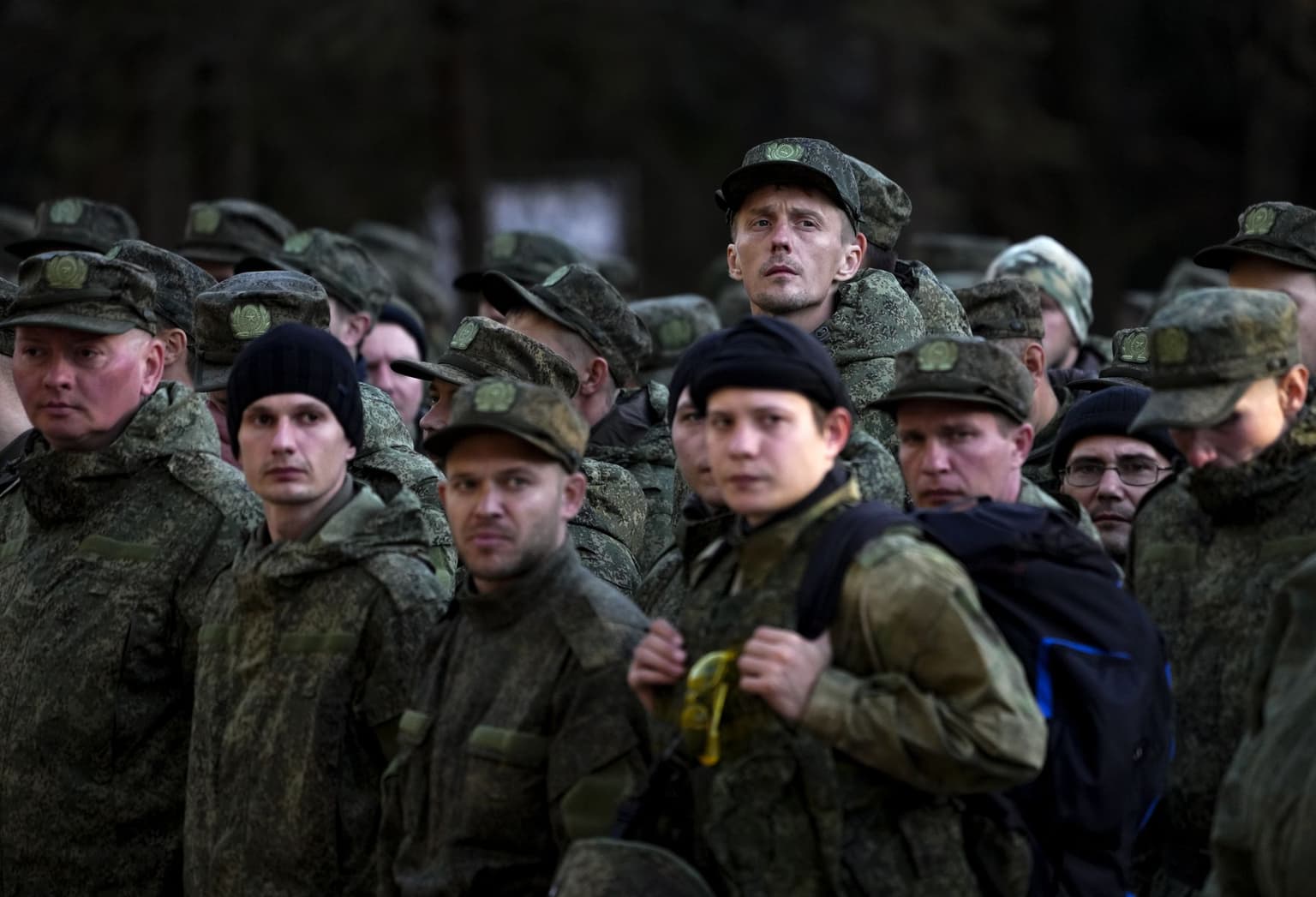
Russian citizens drafted during the partial mobilization are dispatched to combat coordination areas in Moscow, Russia, on Oct. 10, 2022. (Stringer / Anadolu Agency via Getty Images)
 on Google
Russia's total military losses in Ukraine have reached 1,500,870, Ukraine's General Staff said on Sept. 9, marking another grim milestone in the war for the Kremlin.
It took roughly two years and three months for the Russian Armed Forces to incur their first 500,000 casualties. Moscow has now suffered roughly the same number in just the past 15 months, as technology increasingly shapes the battlefield and drones expand the kill zone almost daily.
The Kremlin's total personnel losses in Ukraine now exceed the combined toll suffered by Russian and Soviet forces in all wars and armed conflicts during the second half of the 20th century and the early 21st century, the General Staff said.
Moscow's toll in Ukraine is also more than 100 times higher than the number of personnel lost during the decade-long Soviet war in Afghanistan, and more than 125 times higher than the combined casualties from the First and Second Chechen wars, according to the General Staff.
Since the beginning of 2026, Russian forces have suffered around 30,000 casualties per month in Ukraine. In July alone, the figure surged to a record 42,860 — the highest monthly toll since the start of the full-scale war. In August, the monthly figure again topped 40,000, according to Ukraine's Defense Ministry.
Yet even as Russian casualties continue to mount, Ukrainian soldiers do not expect the losses to force the Russian military to abandon its objectives in Ukraine, particularly as, according to Ukraine, the Russian government is considering a new mobilization wave that could bring another 600,000 people into the military in 2026-2027.
read also
Artem Kariakin
soldier in the Ukrainian Armed Forces, former partisan
"The level of Russian personnel losses we are seeing now is still not high enough to cause serious damage to the Russian army. It is becoming more difficult for them to persuade people to sign military contracts — that is a fact — but their pool of available manpower remains enormous, even without officially declaring another mobilization.
They continue to assault our positions head-on with infantry, essentially hoping that out of 10 soldiers, at least two will make it to the position. And even if those two infantrymen arrive wounded, their presence at the position means it has effectively been taken. This is how they keep moving forward, link by link.

The main reason we are still forced to give up territory is manpower — the basic mathematics of the situation. People remain the single most important military resource. Eventually, Russia will also face a manpower shortage, but so far, we are not seeing that.
Although the pace of their advance is gradually slowing, this is primarily due to our growing technological capabilities, which allow us to eliminate significantly larger numbers of enemy troops. But technology can never fully replace people."
Pavlo Yurynets
service member of Ukraine's Unmanned Systems Forces
"In Kyiv, people still raise their children in Russian, as if they are asleep when it comes to national consciousness. Our so-called elites and those in power live in their own world. They have created a subculture where the values are immorality, lies, and theft, showing total disrespect for the Ukrainian people.
This is our internal enemy, and it is more dangerous than the external one. So 1.5 million Russian casualties may sound like a good thing, but when I think about how many great, genuine Ukrainian men and women have been killed, I don't really care about that number. I think Russia can afford to lose just as many again, or even twice as many."

'Strada'
an electronic warfare operator who asked to be identified only by her callsign due to security concerns
"Such high Russian casualties are primarily linked to their tactics of warfare. They continue to actively deploy infantry — very often in waves — in an attempt to overwhelm our positions with sheer numbers. At the same time, manpower remains one of their primary tools for achieving results.
Summer is a period when activity on the front lines intensifies. Consequently, more assaults mean more casualties. But the figure of 42,000 per month reflects not only the intensity of the fighting, but also the extent to which Russia is willing to sacrifice its own people to advance even short distances.
Russia can maintain this pace for some time yet. They have significant mobilization resources, financial incentives for contract soldiers, and, unfortunately, the willingness of their surreal society to accept heavy losses.
But this does not mean their resources are limitless. The constant accumulation of losses is gradually affecting the quality of personnel, the level of training, and the ability to form combat-ready units."

Dmytro 'Collector'
a Mavic drone pilot with the 21st Separate Unmanned Systems Regiment Kraken
"They are pressuring us with 'meat,' that's why they face such big losses.
A thought formed in their head that if (Russian troops) are strong and want to defeat Ukraine, they throw all forces and resources to achieve some sort of a result. Since they can't rely on quality, they go for quantity. Against one or two drone pilots, there are 10 soldiers who just go forward. That's their tactic.
I view this result (of the Russian losses) positively, but not enough. There needs to be more. It is necessary to extinguish them in such a quantity that the ratio of mobilized and combat losses is not so significant. This is so that they lose more people than mobilized. Then this will give a better, tangible result.
I think that now that it's fall and the greenery will disappear, we will begin to see the count reach 30,000 per month and be much higher."

Liubomyr Dmytryshyn
a 24-year-old veteran and civil society activist
"The rise in casualties among Russian troops is linked to the fact that we have started to focus on the technological aspect of warfare. (Mykhailo) Fedorov's plan played a significant role; it was designed to ensure victory in every technological cycle.
Another factor is that we are tracking all these casualties. They are effectively confirmed by evidence in the system via E-Points or DELTA. In other words, every single one (of the dead Russians) can be verified.
So, it's effectively a conveyor belt. We've put the killing of Russians who have entered our territory onto a conveyor belt, and it's very much a straightforward 'industrial process.' That is, there are certain investments we're making in specific solutions and resources that yield results.
There are plenty of such cases, but, unfortunately, not enough yet to make Russia decide on its own to stop the war."