As Armenians head to polls, Russia and West vie for influence in the South Caucasus
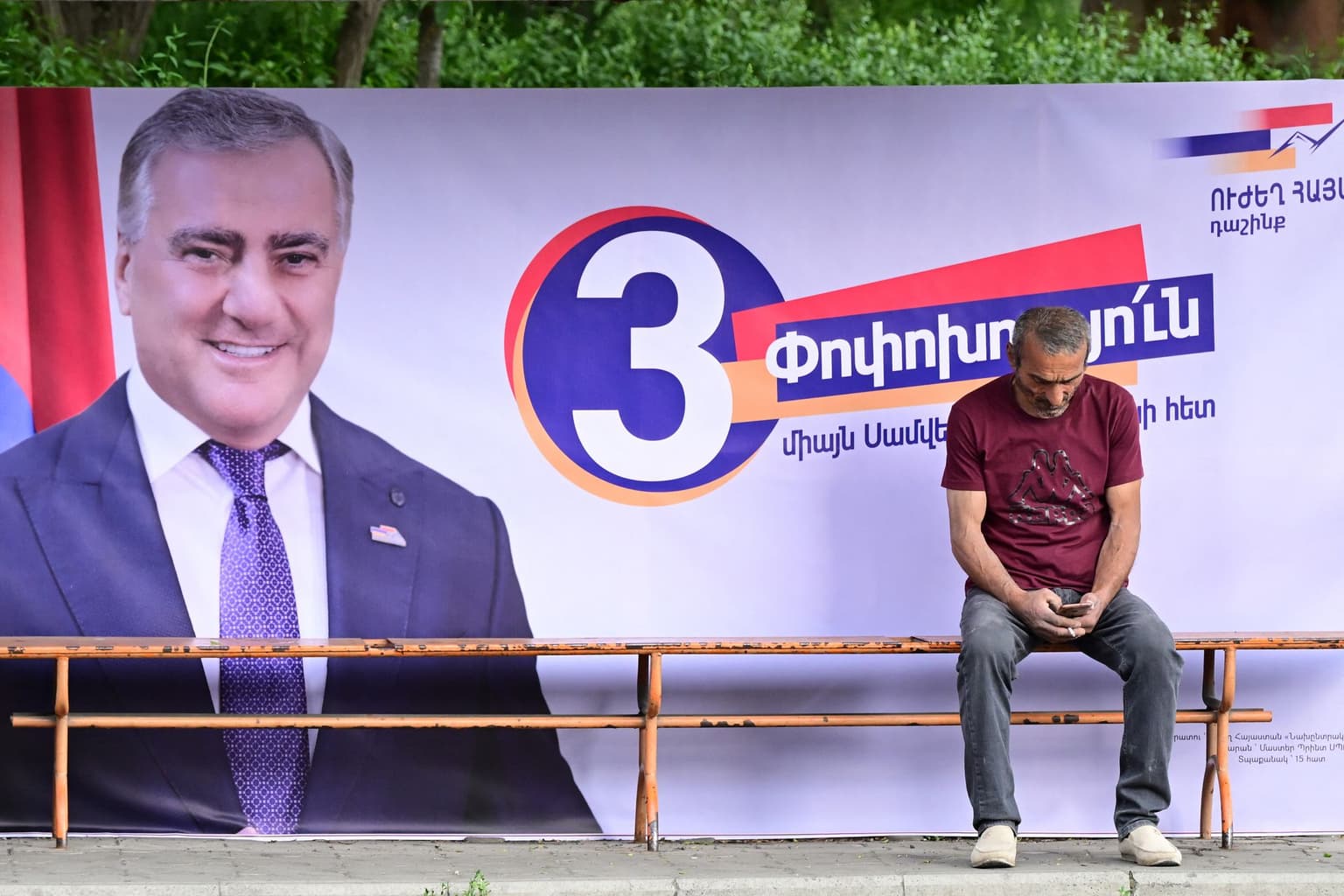
A man sits of a bench next to a campaign poster and a banner of Strong Armenia, the party of billionaire Russian-Armenian businessman Samvel Karapetyan on June 4, 2026, days ahead of the parliamentary elections. (Karen Minasyan / AFP via Getty Images)
 on Google
From a gated hilltop mansion on the outskirts of Yerevan, Russian-Armenian billionaire-turned-opposition figure Samvel Karapetyan is carefully coordinating his path to power.
An energy sector magnate who made his fortune in Russia, Karapetyan has been under house arrest since January. From behind his high iron gates, he and his pro-Russian Strong Armenia party have emerged as the most prominent force among Armenia's bloc of scattered opposition parties.
In Sunday's election, that opposition is hoping to stop Prime Minister Nikol Pashinyan's Civil Contract party from winning a third consecutive term in office. The election, which some analysts are billing as the country's most important since regaining independence in 1991, will determine whether Armenia continues to draw closer ties with the West, or instead opts for reconciliation with Moscow.
The election is being watched closely by both Moscow and Western capitals. In the run up to the vote, the West has thrown its weight behind Pashinyan's Civil Contract party, while Russia has warned of "amicable divorce" should Armenia decide to turn its back on its old ally.
Both camps are fighting for influence in a region of increasing strategic importance, analysts said.
"The South Caucasus has emerged as a key bottleneck of transit and trade flows in an otherwise very turbulent continent," said Laurence Broers, an associate fellow in the Russia and Eurasia Programme at Chatham House.
Since coming to power in 2018, Pashinyan has pivoted Armenia to the West. Last year he passed a law to launch the official process of joining the EU. Since Azerbaijan regained control of the disputed ethnic-Armenian region of Nagorno-Karabakh in 2023, Pashinyan has pursued a lasting peace deal with Baku and has repeatedly credited U.S. President Donald Trump for his role in brokering the deal.
The West has responded in kind. In May, European dignitaries arrived in Yerevan for the first of its kind EU-Armenia summit. Weeks later, Trump offered his “complete and total endorsement” of Pashinyan. On June 4, in response to a number of trade restrictions introduced on Armenia by Moscow, European Commission President Ursula von der Leyen pledged an economic support package to Yerevan worth €50 million ($58.1 million).
In addition to trade restrictions, Moscow has continued to ramp up pressure over Armenia's growing engagement with the West.
In 2025, Armenia bought 82% of its gas from Moscow at roughly a quarter of the price of what it would cost in Europe.
"The disparity is vast. The difference is substantial," Russian President Vladimir Putin told Pashinyan at a meeting in the Kremlin in April.
A month later, Putin called on Pashinyan to call a referendum to decide between the European Union and the Eurasian Economic Union (EAEU), a Russia-led trade bloc of post-Soviet states. Moscow insists Armenia cannot sit on "two chairs" at once.
But the Civil Contract party insists that for now, it can.
"We will continue to combine the deepening of relations with the European Union and our membership in the EAEU for as long as this remains possible. When the time comes and it becomes clear that this is no longer feasible, the people and citizens of Armenia will decide which direction the country should take," Arsen Torosyan, Armenia's minister of labor and social affairs, told the Kyiv Independent.
But despite winning supporters in the West, Pashinyan's domestic approval has continued to wane in his second term, falling from 54% in 2021 to around 30% today.
One reason for that is his handling of the Nagorno-Karabakh crisis. His critics say in pursuing peace with Baku, he has made the country weaker.

Another is that Pashinyan also faces allegations of democratic backsliding and increasing authoritarian tactics from both his opponents and international rights groups.
Dozens of opponents have been detained in the lead-up to the election, while Karapetyan says the allegations he faces of money laundering, tax evasion, and attempts to usurp power are politically motivated.
On the campaign trail, Pashinyan has struck a scathing tone, gesticulating at his critics and in one case even manhandling a heckler. In one example, Pashinyan had to later explain his actions after asking a displaced man from Nagorno-Karabakh, "why didn't you die?"
"He is becoming like a new Lukashenko," Edmon Marukyan, a former ally of Pashinyan and now the leader of the Bright Armenia opposition party, told the Kyiv Independent.
Torosyan rejects those allegations.
"Such claims are completely unfounded and do not correspond to reality. Armenia is freer, more sovereign and more democratic than ever before," the minister said.

Polls show the Civil Contract leading with around 30% support, while Karapetyan's Strong Armenia trails at between 6 and 11%.
Moscow, however, is not going down without a fight.
In the past months, groups reported to be linked to the Kremlin stepped up their disinformation efforts. Fake narratives targeting Pashinyan have spread via social media and a series of fake news websites, accusing him of crime, corruption and even possessing an incurable disease.
Another report by Reuters also said Moscow plans to bus thousands of Russian-Armenians back to the country to vote in the election.
Moscow's playbook in Armenia is almost identical to its efforts to influence the results in the Moldovan election last fall, Andrei Curararu, an expert in hybrid warfare at the Chisinau-based Watchdog.MD, told the Kyiv Independent.
"In Armenia, we are seeing several Russian interference patterns that were already used in Moldova. Trade embargoes, pressure campaigns, political financing, vote buying, NGO cover, scare tactics and disinformation," Curararu said.
"Moldova showed that this pressure can be resisted, and I hope Armenia succeeds as well," he added.