Putin issues public 'warning' to Armenia over closer EU alignment
 on Google
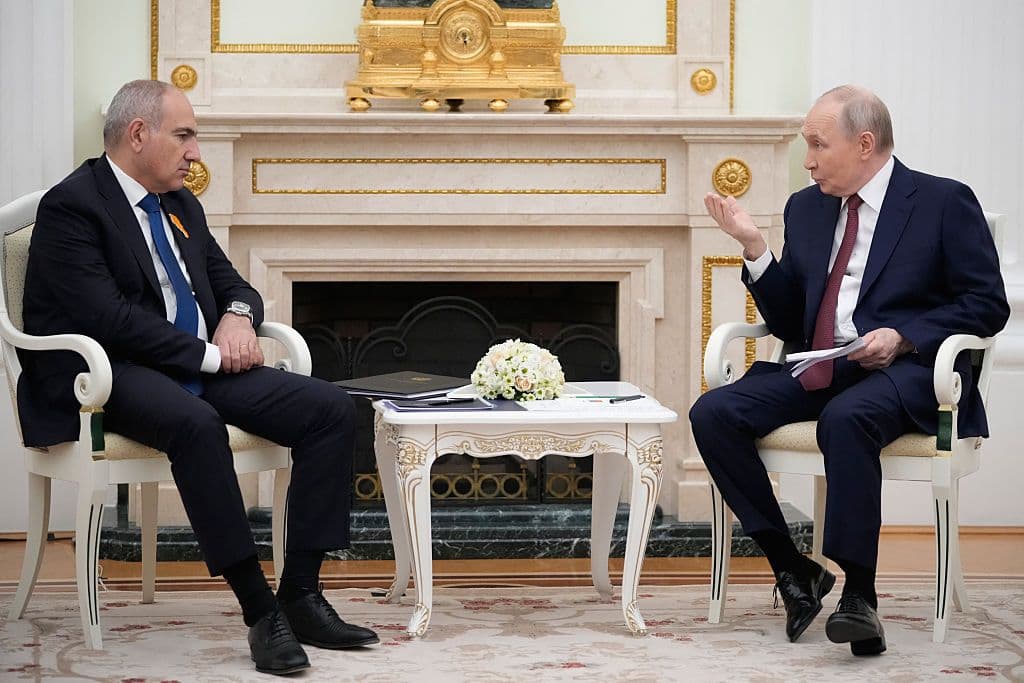
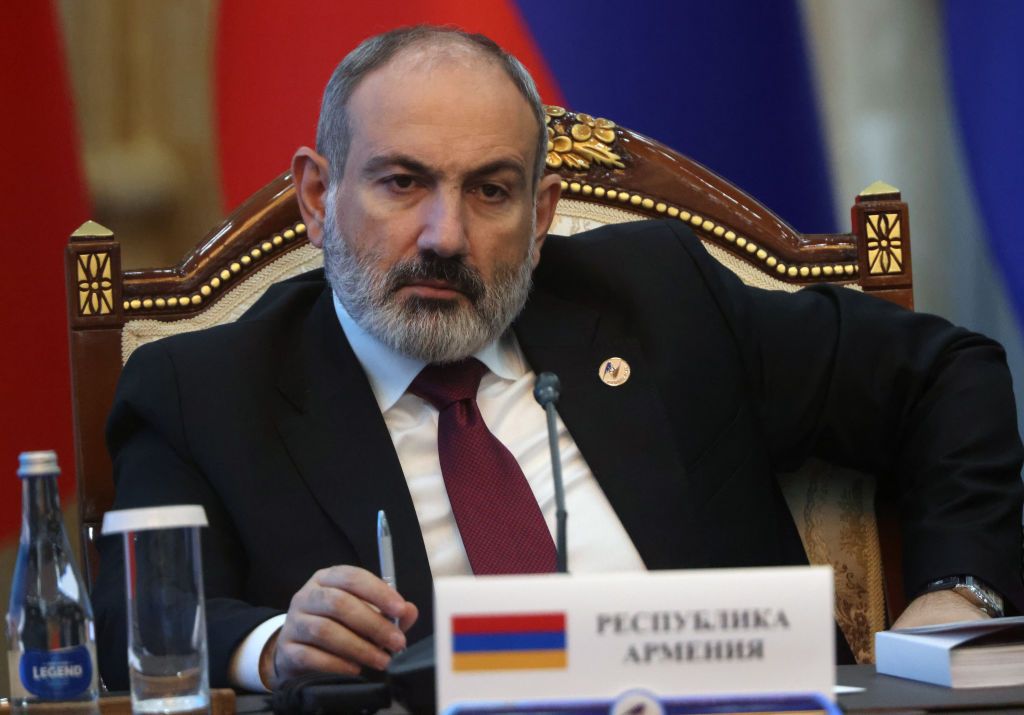
Russian President Vladimir Putin issued a public "warning" to Armenia against forging closer ties with the EU during Armenian Prime Minister Nikol Pashinyan's visit to Moscow on April 1.
“We see that there is a discussion in Armenia about developing relations with the European Union. We treat this absolutely calmly… But it should be obvious and honestly stated upfront that membership in a customs union with both the EU and the Eurasian Economic Union (EAEU) is impossible," Putin said on camera, the latter referring to the organization that has been fostering greater economic ties between Russia, Armenia, Belarus, Kazakhstan, and Kyrgyzstan since 2015.
Putin then emphasized that Russia sells gas to Armenia at a "substantially" lower price than the EU does, adding that it's "Armenia's choice" whether to work with the EU or Russia.
During their public conversation, Putin also addressed the topic of the political opposition within Armenia, saying that Russia "would very much like all these political parties and politicians to be able to take part in domestic political life during elections," adding that "some are in detention despite having Russian passports."
Putin appeared to be alluding to Samvel Karapetyan, a Russian-Armenian oligarch who has cycled in and out of detention while seeking to position himself as a political challenger to Pashinyan.
Pashinyan, also without naming Karapetyan, noted that Armenian law requires political candidates to hold exclusively Armenian citizenship, adding that “no restrictions” are being imposed on political opposition under such circumstances.
Armenia and Russia have long maintained close ties, but the relationship has come under increasing strain in recent years. A central source of tension has been what Yerevan views as the failure of the Collective Security Treaty Organization (CSTO), a Russia-led alliance, to come to Armenia’s defense during renewed fighting with Azerbaijan over Nagorno-Karabakh in 2022.
In 2024, Armenia suspended its membership in the CSTO, but it has not yet formally left the organization.
"(Its) mechanisms should have worked, but they did not. This led to the current state of our relations with the CSTO. We are not participating in its work now because we still cannot explain to our people why the CSTO did not respond," Pashinyan said.