Killing Ukrainian artists is Russia's century-old tradition
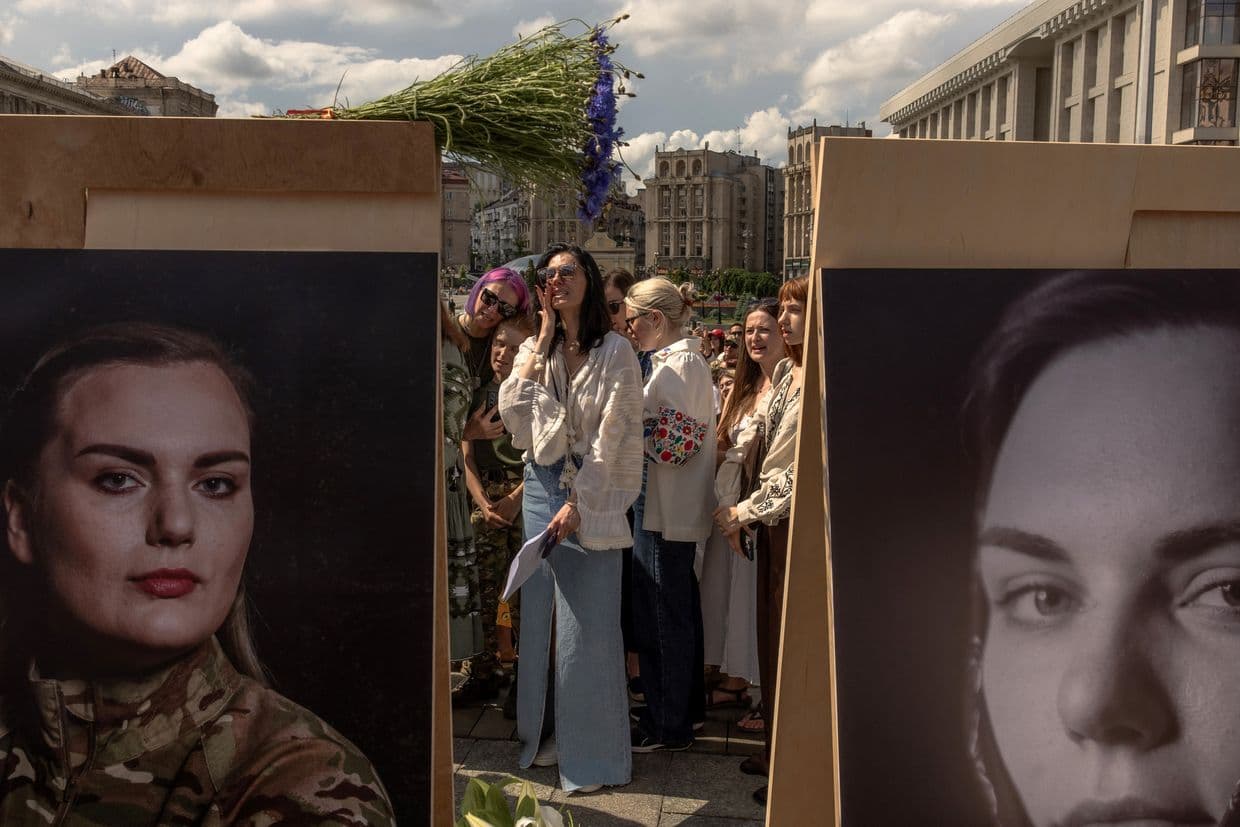
People in Ukrainian traditional clothes ("vyshyvanka") attend the funeral ceremony of the paramedic Iryna 'Cheka' Tsybukh from the Hospitaliers volunteer battalion at the Independence Square in Kyiv, Ukraine on June 2, 2024. Tsybukh left funeral instructions that included wearing vyshyvanka, lighting a bonfire, and singing Ukrainian songs. (Roman Pilipey /AFP via Getty Images)
 on Google
Daria Kolomiec
Ukrainian cultural activist
On May 22, 1979, thousands gathered in Lviv to bid farewell to Volodymyr Ivasyuk, one of the most influential figures in modern Ukrainian music.
Weeks earlier, the composer had disappeared under mysterious circumstances before being found dead in a forest near the city of Lviv, in what Soviet authorities declared a suicide. Yet for Ukrainians, Ivasyuk's death became inseparable from the broader machinery of Soviet repression aimed at silencing Ukrainian culture and identity.
His funeral transformed into a rare and powerful public act of defiance against the Soviet regime, which is, as many believe, responsible for the murder of Ivasyuk.
I was born in 1988 in the city of Cherkasy, nine years after Ivasyuk was killed by the KGB. Yes, I know this fact was never proven in court, but under Soviet occupation, proving such crimes was impossible.
In 2022, I gave an interview to The New York Times about the life, genius, and mysterious "disappearance" of the composer. I showed them his vinyl records and said openly that, at that time, the KGB eliminated artists who became inconvenient to the regime. The New York Times published it exactly that way. For the first time, an international publication wrote about Ivasyuk's death in those terms.
The songs of Volodymyr Ivasyuk held together my faith in humanity during the first days of February 2022, when I was hiding in a basement in the nearest cafe with more than forty Kyiv residents. Russian missiles were falling on the city, and the absurdity of it all going around just made us sing. We began singing Ukrainian songs together.
"Pisnya Bude Pomizh Nas" — The Song Will Be Among Us — became my personal anthem.
Since then, I have played this song at international events, at festivals, on the radio station KEXP, and in countless spaces far from Ukraine. I wanted the world to know the story of this composer. But alongside that desire, I felt another emotion I had never known before: rage. A physical rage.
I saw how the global order failed us. How international institutions failed us. I understood with terrifying clarity that nobody would save us except ourselves. And that nobody would tell our stories except us.
And then another question began haunting me: What if Ivasyuk had been on my childhood cassette tapes? Who would I be if I had grown up knowing his story from the very beginning?
Despite his enormous popularity, so much of Ivasyuk's work never truly reached me in the fullness of what he created. Of course, I knew his most famous song, Chervona Ruta (or "Red rue," a mythological flower), which, for decades, has spontaneously united Ukrainian crowds in song during protests, football matches, celebrations, and public gatherings alike. But his story was not told widely, and so much of his music remained inaccessible to me growing up.
How much music would Ukraine have today if Russia had not silenced him forever and then tried to erase and rewrite his story?
In Russia's modern war against Ukraine, the methods remain exactly the same: destroy artists who carry Ukrainian identity through words, music, memory, and action. That is why, when we talk about Ukrainian culture, we need to understand that this is something we literally protect with our bodies — with specific names and with lives.

One of those names was Iryna "Cheka" Tsybukh — a contributor to Diary of War, a public activist, a Hospitaller combat medic, and my friend. She was killed on May 29, 2024, near Kharkiv Oblast, three days before her 26th birthday. Iryna changed the culture of remembrance in Ukraine. In her will, she asked people to sing Ukrainian songs at her funeral. She worked constantly on the idea of memory — on how we honor the fallen.
Now, every morning at 9 a.m., people across Ukraine stop for a minute of silence to honor those killed by Russia.
"When they ask me what war is, I'll answer without hesitation: it's names," wrote Maksym "Dali" Kryvtsov, a Ukrainian poet and soldier killed on Jan. 7, 2024, at the age of 33.
Or Volodymyr Vakulenko, a Ukrainian poet and children's writer abducted during the Russian occupation of the Izium region in 2022. His diary was later found buried beneath a cherry tree in his garden by the writer Viktoriia Amelina. Viktoriia Amelina was also killed by Russia in July 2023.
There are thousands of these stories. Each one deserves its own article. Each one deserves its own minute of silence at 9 a.m.
Before the age of 30, Ivasyuk wrote more than one hundred extraordinary Ukrainian songs. What would Ukraine be today if he had been allowed to keep creating freely? Listening to his music now as an adult, I hear how deeply his songs are about remembrance itself.
On June 2, 2024, "Pisnya Bude Pomizh Nas" ("The Song Will Be Among Us") was sung on Kyiv's Independence Square during the farewell ceremony for Iryna Tsybukh. The song was part of the list of ten songs Iryna asked to be sung after her death.
On May 30 this year, her family and friends will organize Cheka Fest 2.0 in Lviv — a festival of remembrance dedicated to her life. And Volodymyr Ivasyuk's music will be there too. I am sure.
Who are we without memory? Who would we be today if Volodymyr Ivasyuk had been allowed to live and create freely?
I propose that we think of Volodymyr Ivasyuk, too, in this endless list of Ukrainians killed by Russia. If only we were given enough lifetime to remember them all.9 a.m. Every day. Until the very end.
"Yellow leaves will fall and green ones will grow again,
and in song you will always remain beside me."
Editor's note: The opinions expressed in the op-ed section are those of the authors and do not purport to reflect the views of the Kyiv Independent.