How Ukraine's annual radio dictation brings a nation together, one word at a time
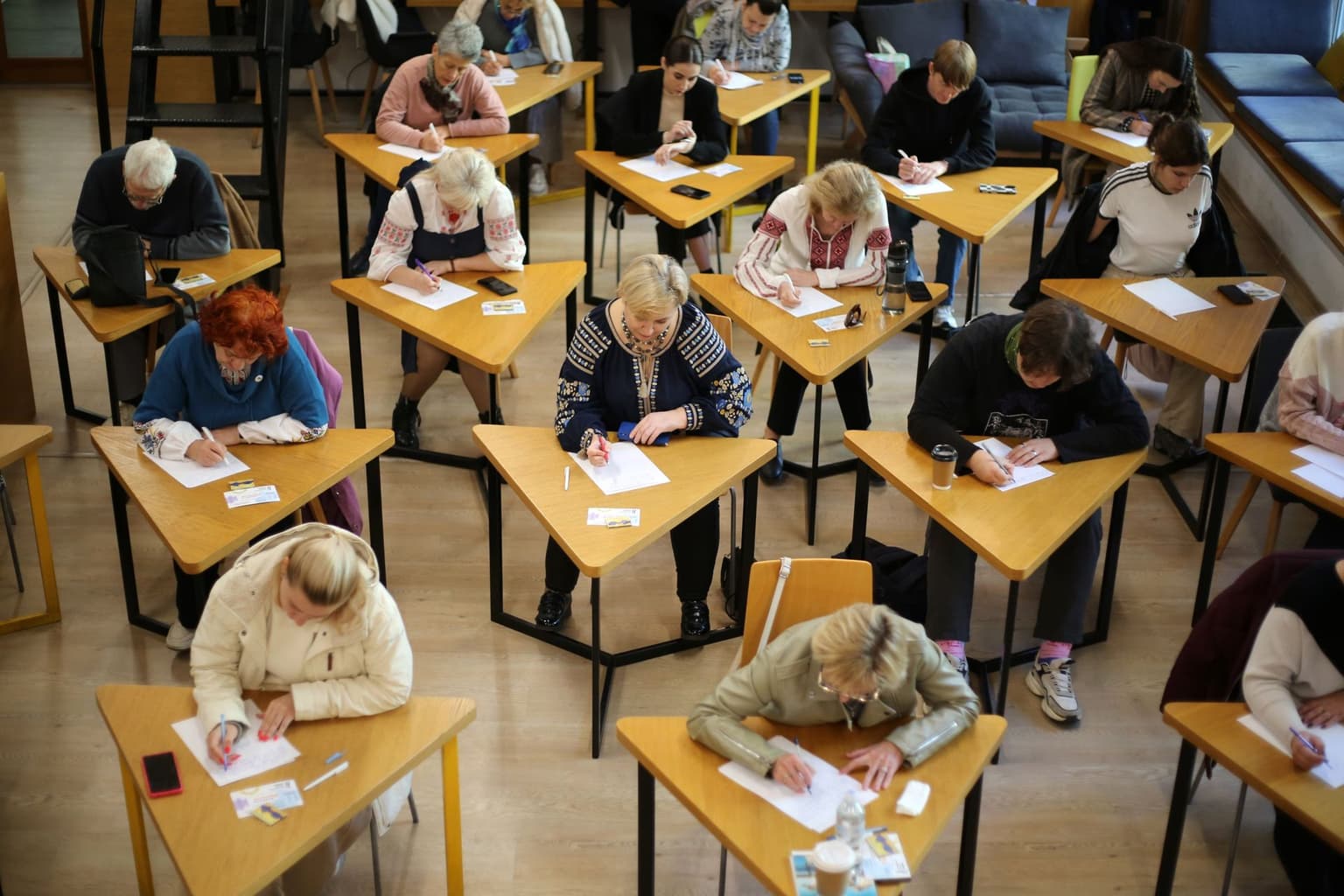
People take part in the Radio Dictation of National Unity at the Odesa Regional Universal Scientific Library named after M.S. Hrushevsky in Odesa, Ukraine, on Oct. 25, 2024. (Viacheslav Onyshchenko / Global Images Ukraine via Getty Images)
 on Google
As it turns out, dictation exercises are not just for schoolchildren. On Oct. 27, hundreds of thousands of Ukrainians — from diaspora communities abroad to service members on the front lines — will take part in an annual tradition: listening, writing, and testing their mastery of the Ukrainian language.
Organized by Ukrainian Radio since 2000, the annual Radio Dictation celebrates the Day of Ukrainian Writing and Language, bringing participants together to transcribe a text broadcast live across multiple platforms. Those who wish to have their work assessed can submit it to a professional review panel.
For Ukrainian author and war veteran Artur Dron, who wrote this year's dictation, the invitation to craft a text that so many people would follow word by word was "daunting." Still, he didn't hesitate to accept.
"I've taken part in (the dictation) myself several times, and I see something truly special in it," Dron said.

"The fact that, even during the full-scale war, we're holding this initiative for the fifth time — that we continue to do so even under these circumstances, and that language still brings us together — means a great deal."
Yuliia Sheludko, an executive producer at Ukrainian Radio, told the Kyiv Independent that she believes the dictation serves as "a kind of anchor" for Ukrainians during wartime.
Bringing Ukrainians together around a shared love of the Ukrainian language also carries particular weight as Russia intensifies its attacks against the country.
"We know from history that the Ukrainian language was suppressed for many years, so we must value and protect it," Sheludko said.
Under Russian imperial rule, successive restrictions curtailed Ukrainian use in publishing and education, while Soviet authorities continued to subordinate Ukrainian to Russian, despite periods of official support for Ukrainian-language culture. Ukrainian intellectuals, writers, and cultural figures were also persecuted, imprisoned, and even killed for their pro-Ukrainian stances.

The 2014 EuroMaidan Revolution helped accelerate a broader societal shift back to Ukrainian, which has gained further traction since Russia launched its full-scale invasion in 2022. For many, speaking Ukrainian has become one of the most powerful expressions of their national identity.
Despite its power to unite Ukrainians through a shared love of the language, however, the Radio Dictation also tends to stir up strong opinions.
Ahead of this year's event, volunteer and civic activist Dasha Astafieva received what she described as "an avalanche of hate" for being chosen to read the dictation alongside teacher Artur Proidakov, with people criticizing everything from her past as a Playboy model to her former use of Russian in public life.
Since 2022, Astafieva has worked to promote Ukrainian culture. She launched the audiobook app UnderBooks in 2023, and wrote on Facebook that "the hysteria over the fact that the dictation will be read by someone who narrates audiobooks marks a whole new level of absurdity."
Public debate isn't limited to this year's dictation. Actress Nataliia Sumska drew criticism in 2025 for delivering the dictation at what many felt was too fast a pace, with many participants saying that it left them scrambling to piece their sentences together.
The uproar grew when a longtime participant with a track record of top marks reportedly had her microphone switched off after she criticized the pace of Sumska's dictation and called author Eugenia Kuznetsova's text "silly."

In 2024, author Oksana Zabuzhko's text was so challenging that only one person in the country wrote it without any errors.
The disputes point to a tension at the heart of the dictation's mission: how to celebrate Ukrainian as a shared national language while navigating disagreements over who represents it and what mastery of it should look like.
The organizers, however, seem to take the controversy that comes with the Radio Dictation in stride, pointing out that when an event draws this much public attention, some people will always be dissatisfied.

As for the controversy surrounding Astafieva, Sheludko encouraged those who haven't heard her narrate audiobooks to do so, describing it as "something she does with real mastery."
Ukrainian Radio can't provide the exact number of people who take part in the Radio Dictation every year, but it can estimate participation in the hundreds of thousands based on how many people post about it on social media and submit their written work to the professional committee for review.
According to Sheludko, Ukrainian Radio received more submissions in 2022 than in any previous year — and encouraged people to keep doing so not only for the commemorative prizes given to those with top marks.
For all the arguments over who reads the dictation and how difficult the text should be, its enduring appeal lies in something simpler: the chance for Ukrainians, wherever they are, to take part in a shared cultural tradition.
"I believe that this year thousands of people will enjoy the text, the act of writing, and, above all, the sense of unity around the Ukrainian language," Sheludko said.