From Ukraine's war zone to loving homes
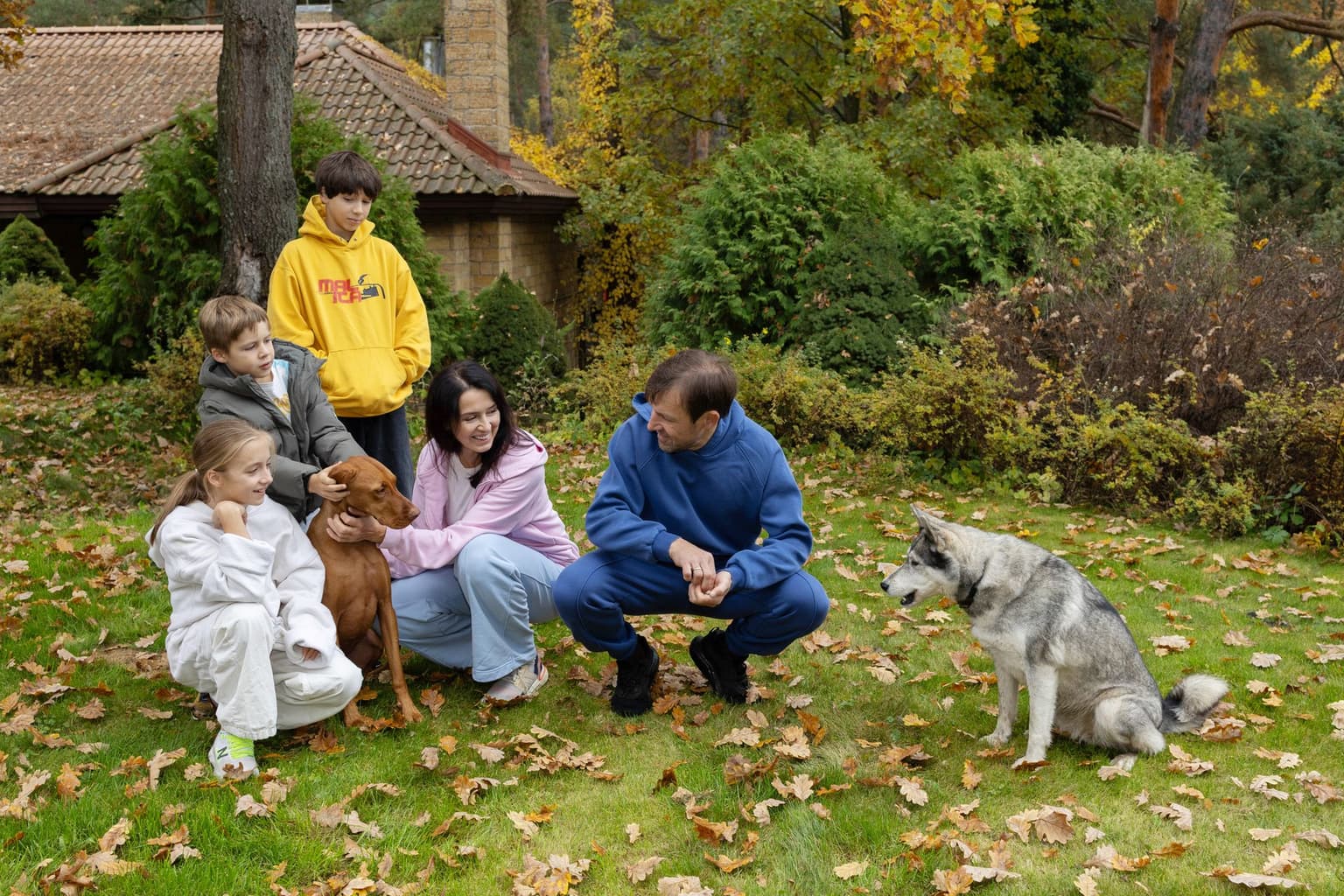
Andrii Onistrat, Valentyna Khamaiko, and their kids - Andriiko, Myroslava, Mykhailo, and their rescued dogs Divchulia (black and white) and Hugo (ginger) in Bobrytsia, Kyiv Oblast, Ukraine, on Oct. 22, 2025. (Anna Donets / The Kyiv Independent)
 on Google
When war approaches, people may be able to pack their lives into a suitcase and flee within hours. Animals, however, cannot.
In areas where humans can no longer enter, animals are often the last living beings left behind amid relentless drone attacks and artillery fire, with little chance of survival.
As the front line shifts across Ukraine, more and more animals are abandoned to face the realities of war alone — stranded on the streets, constantly at risk of being killed by strikes or trapped in anti-drone nets and left to starve.
UAnimals, a Ukrainian animal rights and welfare organization, said it is difficult to determine the exact number of homeless animals in Ukraine, but added that the figure has risen sharply since 2022. Many animals are abandoned after their owners are unable to evacuate with them or are killed in Russian attacks.
While there is no government-organized evacuation of animals in Ukraine's war-torn regions, a small group of volunteers continues to rescue those left to fend for themselves in some of the country's most dangerous areas. They evacuate not only dogs and cats, but also large farm animals trapped in combat zones — all in the hope of giving them a safer, better life far from the constant threat of explosions and destruction.
As part of the "Finding Home" project, the Kyiv Independent spoke with five families who opened their homes to animals rescued from the war zone.
Fasolia
Fasolia ("Bean") was evacuated to Kyiv from Pokrovsk, Donetsk Oblast, in late 2024, along with her sister, who later also found a home in the capital.
The dogs' former home has been heavily damaged by Russian strikes and now bears little resemblance to what it once was. Pokrovsk has reportedly been under full Russian occupation since May 18, 2026, according to the Ukrainian monitoring project DeepState, though Ukrainian authorities have not officially confirmed this.
Kateryna Hodunova, 28, a reporter who had dreamed of having a dog since childhood, came across photos of Fasolia on a friend's Instagram and suggested to her partner, Andrii Boiko, 28, who works in IT, that they meet her.

"Andrii was naive because he thought we were really going to see Fasolia just to meet her," Hodunova said.
Within days, the five-month-old puppy had moved into her new home, quickly upending her owners' routines and even the layout of their apartment. With no prior experience of living with a dog, Kateryna and Andrii gradually began working with a trainer to build trust and establish a routine with Fasolia — though not without incident.
"It was a complete disaster, but actually not as bad as I imagined," Boiko said, recalling how Fasolia's first actions in the new home included chewing up a mattress, tearing wallpaper, and damaging a headphone case.


The most difficult stage of Fasolia's puppyhood is now behind them, and she has grown into a devoted companion.
"When I take her for a walk, I know I'll feel better — we'll play and spend time together. I'll focus on her first and foremost, rather than on what's been upsetting me, and there are plenty of such things during wartime," Hodunova said.
Hugo and Divchulia
Andrii Onistrat, 52, a soldier, and Valentyna Khamaiko, 44, a TV presenter and entrepreneur, had a family that included three children and a dog named Mimi. After the start of Russia's full-scale invasion, their household grew even larger.
In 2022, the couple took in Hugo and Grace, then still puppies, after their home in the town of Irpin in Kyiv Oblast — occupied by Russian forces for 23 days — was destroyed.
At the time, the puppies were about a month old and required round-the-clock care. Grace was later adopted by another family, while Hugo remained with Andrii and Valentyna.


"There was so much sadness (in 2022)," Khamaiko said. "But when these little ginger ones appeared, I felt a huge emotional relief."
Another dog joined the family in 2023, when Onistrat, an officer in the Ukrainian Armed Forces, was serving in Kharkiv Oblast. He found Divchulia (a sweet nickname for "Girl" in Ukrainian) in the village of Borova, where she had been living near a local grocery store since the beginning of the fullscale war.
"She's always by my side and never leaves."
"I brought her with me to Izium, got her all her shots," Onistrat said. "I didn't let her out of my sight for the first few days."
"She couldn't eat, she was coughing constantly — she couldn't keep any food down," Khamaiko said. "The soldiers said Andrii ran after her like she was a little girl, feeding her by hand."

After arriving at her new home in Kyiv Oblast, Divchulia initially accepted only Onistrat, but gradually began trusting the rest of the family.
"For two weeks, we tried to find common ground with her," Khamaiko said. "And one day she came into the house, lay down, then lifted a paw and asked to be petted."
Although Divchulia has settled into her new family, Onistrat remains the person she is most attached to.
"When I'm at home, she helps me emotionally. She's always by my side and never leaves," he said.

Multik
Viktor Kvas, 41, a member of the Ukrainian Armed Forces, found a cat named Multic, short for "MultiCam," in Kostiantynivka, Donetsk Oblast, and the cat soon began living alongside the soldiers, occasionally bringing them mice as "gifts." When the unit relocated, Viktor's wife, Iryna, 46, insisted that he take the cat with him in 2024.
"Cats never just show up out of the blue," Iryna Kvas said.
The family was ultimately unable to keep the cat because their older pet would not accept him, so Multic — described by the family as "a proper Donetsk lad" — moved in with Iryna's parents.

Nataliia Ostrovska, 67, Iryna's mother, is a retiree who has cared for cats throughout her life, including stray cats living in neighboring yards. After being brought from the front line, Multic struggled with stress and remains frightened by explosions during Russian attacks, though he has gradually begun to adapt.
"My husband complains that I buy the cat the most expensive things," Ostrovska said.
"But just looking at how beautifully he lies there makes my heart feel warm and joyful," she added.

Misa
Misa was born in 2025 at a front-line position where Viacheslav Pylypenko, 21, was serving near Novopavlivka in Dnipropetrovsk Oblast, a village now located in a contested area that is under pressure from advancing Russian forces.
"Misa survived both FPV (first-person-view) drones and glide bombs," Viacheslav Pylypenko said.
As fighting intensified and the area became too dangerous, the kitten was evacuated from the front line to Kyiv, where Viacheslav's wife, Darusia, 19, was waiting for her.

"I thought the kitten was calm and shy. But when I arrived at the train station, I saw she was a wild one," Darusia Pylypenko said.
"She came into our house and immediately made herself at home. And right away she started sharpening her claws and jumping on the couch."
Misa also developed a habit of bringing random objects into bed — a trait the family said dates back to her early days near the front line.


"She's a little hunter — catching sparrows, lizards, frogs, and proudly dragging them into the house for us," Viacheslav Pylypenko said.
Over time, the cat became a source of comfort for the family during difficult moments.
"Sometimes I come home all upset, tears streaming down my face, and she just lies down on my chest," Darusia Pylypenko said. "It helps."
Lypka
Lypka lived with soldiers in dugouts in the village of Vysoke in Kherson Oblast, about 15 kilometers (9 miles) from the east bank of the Dnipro River, an area under Russian occupation. The cat was brought off the front line in 2023 by Ukrainian soldier Andrii Kuzmenko, who was killed in action two years later.
Maksym Volynets, 28, an engineer, and his wife, Olha Volynets, 23, who is currently on maternity leave, had not planned to get a cat. But a friend of the couple, who had wanted a pet, was unable to keep her, leaving Lypka — already in Kyiv — in need of a new home.

"It all happened so fast," Olha said.
"She's super affectionate — staying close to people is how she survives," she added.
One of the couple's concerns was how the cat would behave around their newborn daughter, Melania, who is now nearly a year and a half old.
"We were preparing for the baby's arrival. We bought a crib and a changing table. And Lypka was always sleeping there," Maksym said.

After Melania was born, Lypka quickly accepted the new family member and showed particular affection, often lying next to the baby while she slept.
"When we come back home, Lypka nudges Melania with her nose — and she smiles so brightly," Olha said.

Note from an author:
Hi, this is Anna, the photographer behind this series. Thank you for taking the time to view it to the end. I hope these photos brought you a sense of warmth and reminded you that even amid the horrors of war, hope and light remain.
The Kyiv Independent is running a campaign to welcome 4,000 new members to its community, to support the work of its journalists and sustain on-the-ground reporting on Russia's war against Ukraine as it unfolds. If this reporting matters to you, please consider joining the community and helping reach that goal.