Corruption, flawed democracy, unjust courts — and other myths about Ukraine the data don't support
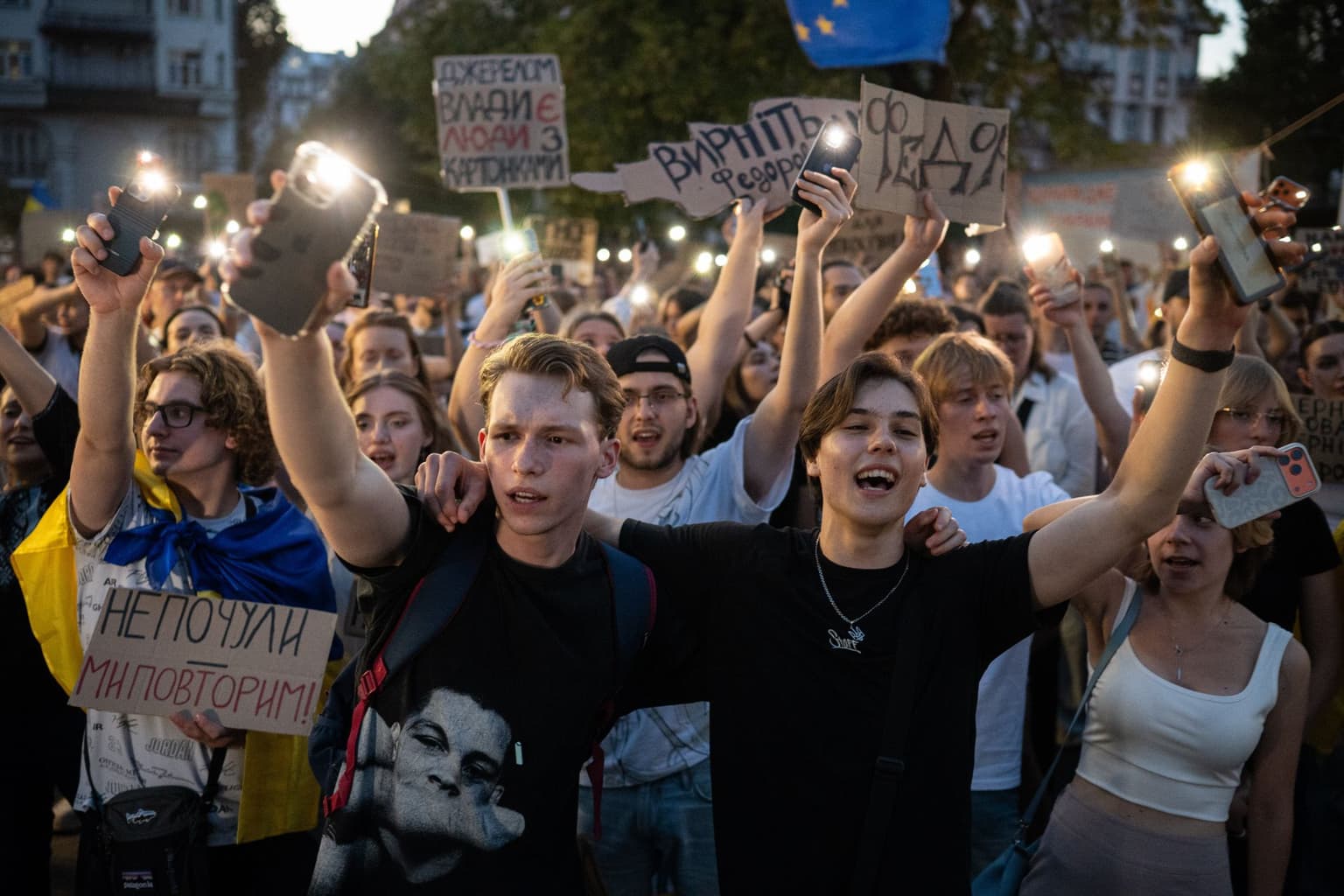
Thousands attend a rally protesting the dismissal of Defense Minister Mykhailo Fedorov in Kyiv, Ukraine, on Aug. 16, 2026. (Danylo Antoniuk / Anadolu / Getty Images)
 on Google
Maryna Starodubska
Kyiv-Mohyla Business School Adjunct Professor
Ukraine marked 35 years of independence this August, in the 12th year of Russia’s war on Ukraine – the fourth since the full-scale invasion.
Anniversaries invite stock-taking, and this one prompts an observation that's long overdue.
We Ukrainians have grown so used to self-inflicted inferiority that we recycle stereotypes about our own society, which data don't support. No wonder the West has done the same: for all that time, and through this war, it has kept reading Ukraine through a handful of tired categories: post-Soviet, corrupt, Russia's junior "brother."
Three decades of comparative data say it is time to change the lens.
The misreading is the most obvious in the EU accession debate. With the EU talks grinding forward against a Hungarian veto and a steady chorus of doubts about Ukrainian readiness, Europe treats the country's membership as an open question.
After 15 years spent reading Ukrainian society through cross-cultural data, I've concluded it has the question backwards: Ukraine is not becoming European. By the numbers, it already is — and it already meets, or even sometimes exceeds — the standards of members admitted decades ago.
Europeanness, beyond a passport, is a set of values: how a society treats democracy, authority, the individual, and the stranger. Measured against them, Ukraine is veritably a "candidate" in the European sense.
Start with democratic expectations. The European Social Survey shows Ukrainians rate the principle that courts should treat everyone equally at 9.62 out of 10 (the highest in Europe), while rating their courts' actual performance at 2.03/10 — the lowest in the ESS sample.
Skeptics view that gap as a dysfunction, but I'd argue the opposite. You cannot judge your institutions this harshly unless you hold them to an exacting democratic standard to begin with. This is hardly a resigned post-Soviet public. It's an impatient European one, angry because it expects better.
In longitudinal sociology, one paradox keeps surfacing: the Ukrainians most distrustful of the courts are those who've never dealt with them, while the highest trust (however low in absolute terms) comes from citizens who've actually stood in a courtroom.
Openness to outsiders points the same way. Asked whether people of a different race or ethnic group from most of the population should be allowed to settle in the country, 72% of Ukrainians said "many" or "some" in 2022 – up from 49% a decade earlier, and still climbing in the first year of a full-scale invasion.
That is higher than in Czechia (27%), Slovakia (35%), and Hungary (16%) — EU members that share Ukraine's communist past, yet are rarely asked to prove their "Europeanness" the way Ukraine is.
Then there is the myth that dies hardest — that Ukrainians and Russians are "one people," two branches of the same tree. The data retired it long ago, but the stereotype is still there.
The two societies have not been converging; they have been pulling apart for three decades, and the split is sharpest among the young.
Forced to choose between freedom and equality, 64% of Ukrainians pick freedom, against 50% of Russians. One society increasingly equates order with an obeyed ruler; the other, with defending its own voice.
The gap is not between Ukraine and European values. It is between Ukrainian reality and Western perception.

This "brotherly nations" claim never came from sociology, but from false entitlement to ownership.
A third stereotype casts Ukraine as a passive, collectivist relic.
For decades, textbooks assigned it an individualism score near those of Indonesia and Pakistan — a figure never actually measured in Ukraine.
When researchers finally measured it directly, it doubled (to about 48), landing Ukraine squarely mid-table worldwide, a society that combines individualist and collectivist norms. And the character of social relations is unmistakably civic: horizontal, self-organizing, "allergic" to imposed authority.
It chose the otamans of the Zaporizhzhian Sich, the commanders of the self-defense sotni ("hundreds") on the 2014 Maidan, and, in February 2022, the leaders of territorial-defense units that formed overnight, before any order came from above.
The country did not fold that winter, and continues to stand, because the society organizes bottom-up when the top falters. We still send money to the Hospitallers, a volunteer medical battalion, because we can see them doing work the state has not always done, however imperfect their paperwork.
Even corruption (the West's favorite reason to keep Ukraine at arm's length) is more complicated than its reputation.
Around 91% of Ukrainians believe corruption is widespread, yet fewer than 19% have personally encountered it, a perception-versus-experience gap familiar across the EU.
Moreover, that norm is hardening: the share who call bribery flat-out unacceptable rose from 37% to 54% in under a decade.
That is far from a society resigned to graft; it is one pushing back, which is why the fight over its anti-corruption institutions runs so hot.
It cuts the other way, too: when an official makes a mistake or gives poor service, many Ukrainians' first instinct is to call it corruption and self-dealing rather than plain incompetence.
Ukraine is no finished European ideal, of course, but then, no country is, least of all the ones lecturing it.
Reform is uneven, institutions are still weak, and the war strains everything. But the deeper "horizontal" culture (democratic demand, civic self-organization, openness, a decisive turn away from the Russian model) is already European — sometimes more visibly so than in parts of the EU itself.
So Europe is still making wrong assumptions. The gap is not between Ukraine and European values. It is between Ukrainian reality and Western perception, and in wartime, that gap is anything but harmless.
It slows accession, conditions aid, and lends quiet plausibility to the idea that Ukraine is a borderland to be bargained over, not a European society defending itself.
Ukraine's allies would do better to set the caricature aside and look at the evidence, which describes a country that is not waiting to become European. It already is, and, 35 years on, it is fighting to stay that way.
Editor's note: The opinions expressed in the op-ed section are those of the authors and do not purport to reflect the views of the Kyiv Independent.