As war drags on, Russia's pro-war camp turns its anger on the Kremlin
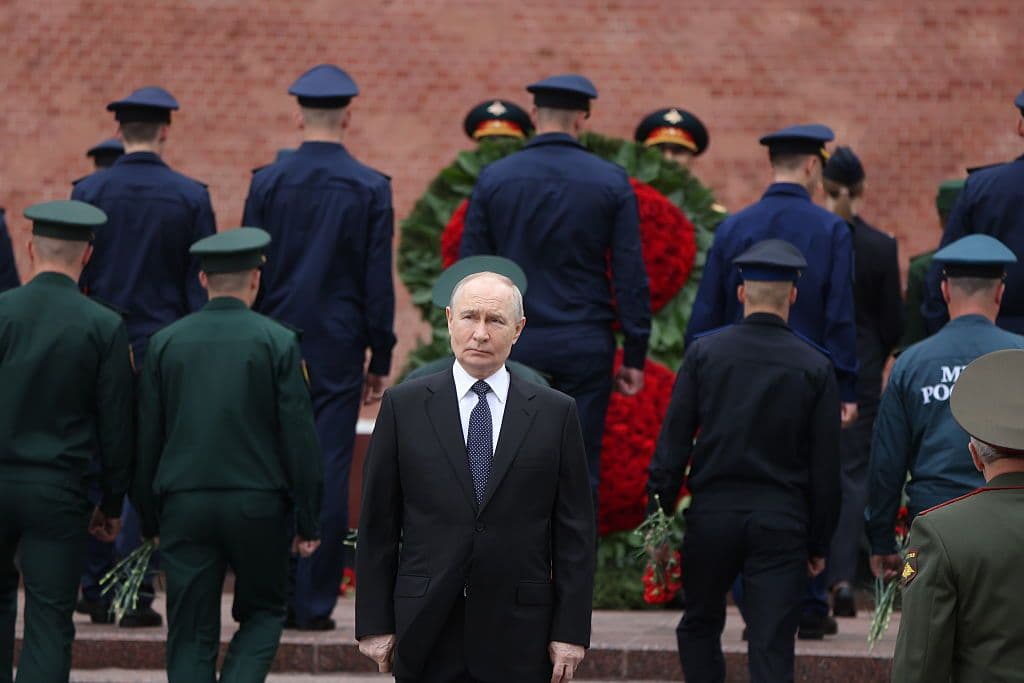
Russian President Vladimir Putin arrives to lay a wreath during a ceremony at the Unknown Tomb on June 22, 2026 in Moscow, Russia. (Contributor/Getty Images)
 on Google
In late June, Russian soldier Alexander Lunin took to Instagram an emotional appeal addressed to Russian President Vladimir Putin in which he threatened to organize a military coup.
"The army will turn its weapons against the Kremlin," he said.
In the video, which was watched 10 million times, the soldier turned blogger demanded a meeting with the Russian president to discuss what he claimed was systemic mistreatment of soldiers in the Russian army.
Unsurprisingly, Lunin was detained soon after publishing the appeal, eventually spending 11 days behind bars on charges of "demonstrating extremist symbols."
On July 10, Russian media reported that the rebel soldier was once again a free man. Soon after his release, he recorded another video in which he apologized to Putin.
While the incident could sound alarming for the Kremlin, echoing Yevgeny Prigozhin's failed mutiny in 2023, observers of the Russian military told the Kyiv Independent that the Russian army is far from revolt.
The incident, however, shows a clear trend — dissatisfied Russian soldiers and members of the pro-war community, which for a period were seen as the backbone of Putin's regime, are emerging as one of the most vocal sources of criticism of the Kremlin.
Russian nationalists and their doubts about war
While Lunin is a soldier himself, he was never much of a star in his community, said Ivan Filippov, an exiled Russian journalist at VotTak, who follows the online activities of Russian pro-war groups.
"The reaction was really moderate, maybe a few texts here or there," Filippov said. "In general, Lunin was pretty much a no-name (in this sphere)."
"He really does not represent anyone," agreed Dmitry Kuznets, who reports on the Russian military for Russian exiled outlet Meduza.
At the same time, the fact that he called for armed mutiny against the Kremlin and the support he got can be seen as a significant development, the journalist argued.

This is even more relevant as morale in Russia's nationalist pro-war community is extremely low, according to Filippov.
Lunin is not the first pro-Kremlin figure to go against Putin.
A prominent blogger known for his aggressive attacks on Russia's opposition abruptly published a series of scathing critiques back in March. A day later, he was allegedly admitted into a psychiatric hospital in St. Petersburg. The blogger, Ilya Remeslo, declared that Putin was "not a legitimate president" and should resign and face trial as a "war criminal and thief."
Several developments would be causing this, Filippov argued.
First and foremost is the situation on the front line, where Russian forces have struggled for months to achieve meaningful territorial gains. Over the past few months, Ukraine's successful middle-strike drone campaign, which has significantly disrupted Russian supply lines, together with its deep-strike campaign targeting oil refineries far inside Russia, has additionally hit morale.
Equally important are self-inflicted domestic problems in Russia that have spilled over into a prolonged crisis of trust in the country's leadership and Putin personally: this crisis began with the widely unpopular blocking of Telegram across Russia in March.
The Russian Public Opinion Research Center (VCIOM), a state-controlled pollster, has reportedly stopped publishing Putin's "open" trust rating after it fell to its lowest level since the start of the full-scale war, the Moscow Times reported on June 8. Unlike VCIOM's regularly published "closed" polls, which ask respondents directly whether they trust Putin, the "open" survey asked people to name politicians they trust without prompting.
"Overall, Russian pro-war bloggers are experiencing a deep, prolonged state of depression linked to the situation behind the front lines," Filippov said.
Hard data confirms
Russia's active pro-war public is often portrayed as a driving force behind the country's war effort, mobilizing volunteers and raising donations to support Russia's war of aggression.
Growing criticism of Russia's leadership suggests increasing frustration that the war has failed to unfold as many supporters had expected.
One possible indicator of this shift is military recruitment.
"The pace of recruitment into the Russian army, for instance, has slowed down considerably," said Katya Bonch-Osmolovskaya, head of the data team at iStories, a Russian investigative outlet in exile.

"Figures were already lower at the end of 2025, and they remained much the same at the beginning of 2026: for now, we are seeing a 20% drop in comparison with the same period last year, which is pretty significant."
Kuznets, however, cautioned against interpreting these figures as definitive evidence of a sustained decline.
"This drop could have also just been a statistical artifact, and the drop was rather just on paper," he said. "Initial estimates for the second quarter of 2026 are less reliable for now, but they seem to show that recruitment is coming back to previous rates."
Even if recruitment has remained relatively stable, Kuznets argued that this has come at a growing financial cost. One-time signing bonuses for new contract soldiers continue to increase, placing mounting pressure on regional budgets. Poorer regions, in particular, struggle to match rising compensation levels and, in some cases, have instead resorted to coercive recruitment practices.
Penza Oblast, for example, has recently faced reports of local authorities pressuring residents to sign military contracts.
At the same time, Russia continues to record high numbers of desertions and soldiers going absent without leave (AWOL). Estimates from 2025 put the total number of desertions and AWOL cases at around 50,000, while subsequent reporting indicated that approximately 28,000 soldiers had been convicted for going AWOL.
According to Bonch-Osmolovskaya, these figures should also be viewed alongside increasing reports of mistreatment within the Russian military, which point to broader problems with morale.
Although morale is inherently difficult to measure, Kuznets argued that declining motivation among Russian soldiers is already affecting Russia's conduct of the war.
"Lack of motivation weakens so-called creative approaches to the war," he said. "As far as we can understand, most (Russian soldiers) continue to fight by inertia, either just for the money or because they are not allowed to terminate their contracts until the end of the war."
"Nowadays, most of their creative energy is simply used to lower their own risk of dying," he concluded.