As Russia targets Ukraine’s economy, keeping businesses alive takes priority
Companies are calling for more support as equipment is destroyed, stocks are turned to ash, and lives are lost.
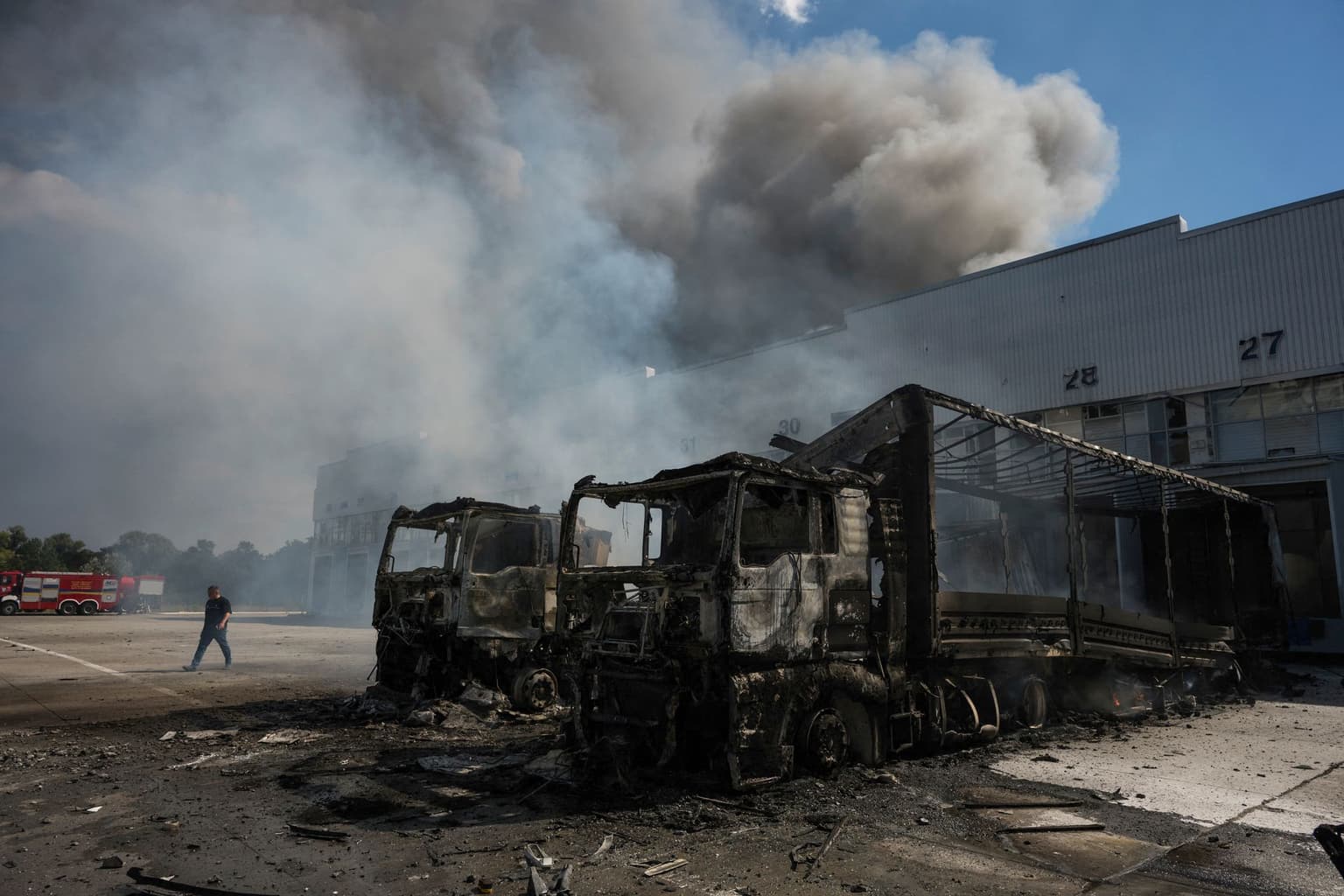
A man walks past burnt-out trucks near a burning warehouse following an air attack in Kyiv, Ukraine, on Sept. 2, 2026. (Vladyslav Musiienko / AFP via Getty Images)
 on Google
As Russian attacks on Ukraine's businesses escalate, the government's push to attract investment to Ukraine's wartime economy is coming up against a more immediate challenge: keeping businesses alive at all.
"When the attacks started, we realized that the challenge was about more than raising investment. It's also about keeping supply chains and businesses going, like pharmacies, food and retail goods that are needed to survive," Deputy Economy Minister Yegor Perelygin told the Kyiv Independent.
The last month has been grueling for Ukraine’s businesses, particularly in and around the capital, as Russia launches waves of daytime drone attacks to throttle Ukraine’s economy. This year alone, businesses are expected to lose a staggering $10 billion, according to the Economy Ministry.
Recent roundtables this month between government and business leaders have discussed how to expand financing programs and state-backed insurance to more businesses and assets outside front-line regions.
But amid an air defense shortage, companies operating in Ukraine are feeling increasingly vulnerable to Russian attacks, and most cannot afford expensive war-risk insurance. At the same time, many say there is little support from the government, leaving them to rebuild on their own with limited resources.
"We're talking about the survival of the country. There needs to be a lot of support because otherwise there's going to be no money in the economy. And then there are going to be defaults and inflation risks, to say the least," Yuriy Kryvosheya, board member of the Canada Ukraine Chamber of Commerce and co-owner of Ukraine’s CEO Club, told the Kyiv Independent.

The cost of staying alive
One of the major issues for companies has been access to war-risk insurance. While big international players, like Coca-Cola, are able to afford coverage, the premiums are simply too high and insufficient for 94% of companies in Ukraine, according to a survey by the European Business Association.
In response, the government is working on a new compensation fund to cover up to $10 million in "first losses," while the remainder will be covered by insurers.
The idea is to make it easier and cheaper for insurers to cover businesses and to help a destroyed asset get back to work quickly, with compensation expected to be paid out within 30 days after documents are submitted, Oleksandr Sokolovsky, a member of the Council of the Federation of Employers of Ukraine, wrote on Facebook after attending a meeting with the Economy Ministry on Sept. 11.
"Before raising VAT, the government should demonstrate that it has exhausted other viable options."
Starting in January, businesses from critical sectors, like agriculture and energy, will be able to pay 2% of the chosen compensation limit to join the program and protect fixed assets, like critical equipment and property — although inventory and goods won’t be covered for now.
In addition to businesses paying the 2% fee, the state plans to finance the fund by hiking the VAT rate from 20% to 21%, which Perelygin said will help the government raise $1 billion a year. While that is expected to push up consumer prices by 0.6% to 0.8%, Perelygin said the level is "manageable" and not "catastrophic."
Unsurprisingly, some businesses are unhappy with the plan to increase VAT, as higher consumer prices will cost them too. Tax hikes should be a "last resort," German Chamber of Commerce in Ukraine CEO Reiner Perau told the Kyiv Independent in a written statement.

"Before raising VAT, the government should demonstrate that it has exhausted other viable options, particularly improving tax collection from the shadow economy and identifying scope for budget savings," he added.
Kyiv also plans to attract foreign donors to the fund and has already presented it to international financial institutions and governments. While nothing has been confirmed yet, the response has been positive, Perelygin said.
Support for some, not for all
So far, the government has mostly discussed solutions for big or critical businesses like supermarkets and retailers. Many smaller and noncritical companies feel there are few opportunities for them, despite attacks on major logistics hubs impacting them too.
Osnovy, a Kyiv-based independent publishing house, lost nearly 40% of its current print inventory in one attack on Aug. 28 that destroyed a fulfillment center housing book stockpiles for multiple publishers.
"In terms of the financial impact, our general losses are shattering. It’s comparable to our total annual revenue in 2025," Osnovy CEO Andriy Vyshnevsky told the Kyiv Independent.
While customers rushed to support Osnovy after the attack, boosting purchases tenfold, and the owner of the fulfillment center, courier company Nova Post, compensated for the loss of the burned books, Vyshnevsky said there was little help from the state because publishing isn’t listed as a critical sector.

Like many businesses, Vyshnevsky says Osnovy and other small publishers need access to favorable lending backed by state guarantees, government-supported risk insurance programs, and direct subsidies.
While there are programs like the state-run 5-7-9% favorable loan program for small and medium-sized companies (SME), it requires businesses to pledge property or land to secure a loan from a bank — something that many publishers and other SMEs don’t have.
Instead, there needs to be more willingness from banks to help the private sector, Kryvosheya said. Ukrainian banks, which have seen record profits during the war, should give businesses grace periods, restructure debts and, more importantly, take risks by lending to companies on favorable terms to boost liquidity in the private sector and help businesses stabilize as the situation deteriorates, he said.
"None of the nations in the world won a war without economics," he said.
"The economy is driven by the private sector, by entrepreneurship. That's what Russia is hitting very hard. There have to be measures taken urgently."