Russia's test of 'Satan 2' missile 'to compensate for international embarrassment,' expert says
 on Google

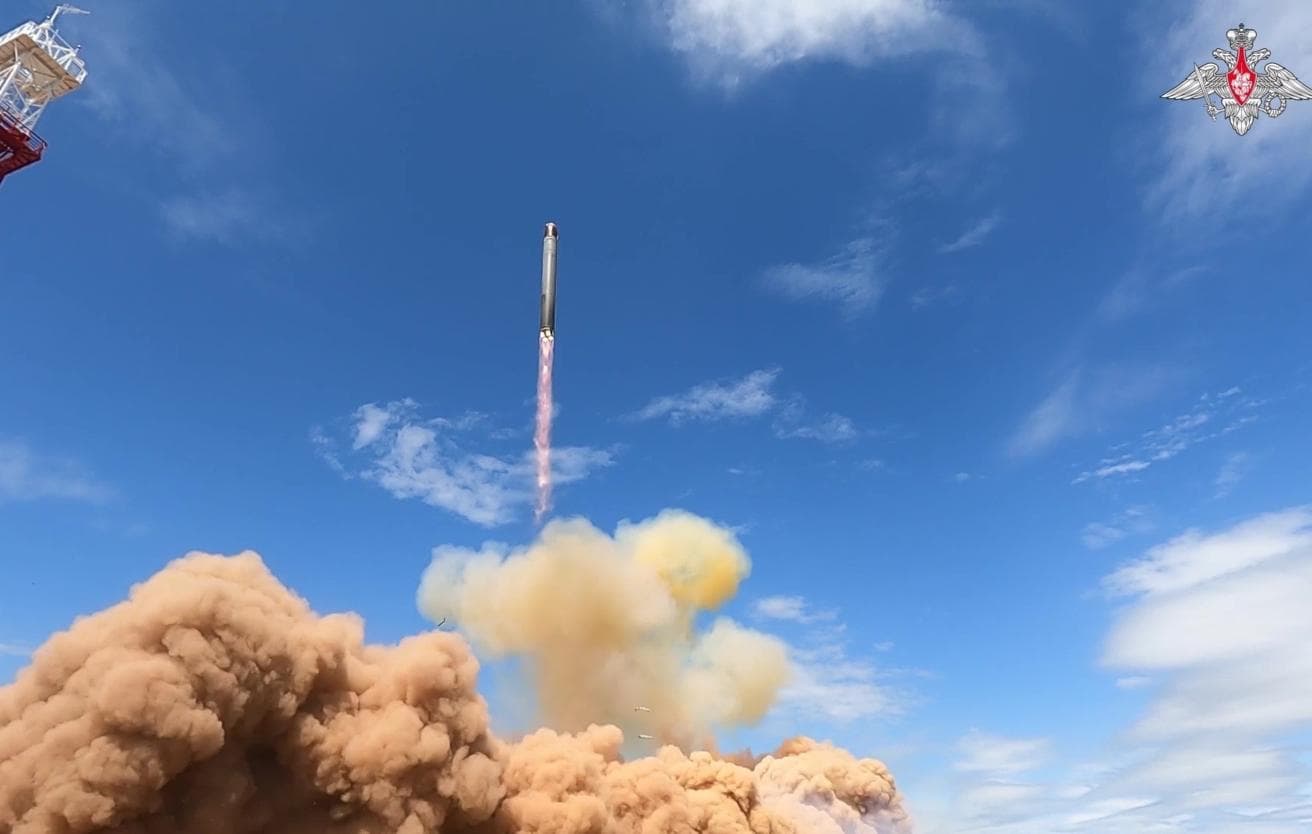
Russia has allegedly conducted a successful test of its nuclear-capable RS-28 Sarmat intercontinental ballistic missile (ICBM), following a series of failed launches that exposed weaknesses behind Moscow's repeated nuclear threats.
News of the claimed launch was delivered to Russian President Vladimir Putin by Strategic Missile Forces Commander Sergey Karakayev, Russian state news agency TASS reported on May 12.
According to Kremlin spokesperson Dmitry Peskov, Moscow warned the U.S. and "other capitals" about the test.
The missile, one of six "superweapons" first unveiled by Putin in 2018 to project the cutting edge of Russian strategic weaponry, has been a frequent feature in Moscow's nuclear saber-rattling.
But with several reported failed launches during the full-scale war against Ukraine, the missile has instead highlighted the weaknesses in Russia's strategic nuclear weapons program.
In September 2024, the open-source intelligence group MeNMyRC reported a catastrophic failure of a Sarmat upon launch at the Plesetsk Cosmodrome in Russia’s northern Arkhangelsk Oblast, based on analysis of satellite imagery.
Later satellite imagery from Planet Labs and Maxar, supported by NASA FIRMS fire data, showed evidence of a large explosion, including a crater with a radius of about 70 meters near the launch silo.
Another failed test launch was reported by the U.S. in February 2023, days before President Joe Biden's visit to Kyiv. Russia did not comment on the incident.
Later, in November 2025, a video showing a missile veering off course shortly after launch and crashing into the ground was attributed to another failed Sarmat test in Russia's Orenburg Oblast, in the southern Ural region.
According to Putin, the Sarmat will be deployed for active duty by the end of 2026, despite Roscosmos chief Yuri Borisov previously saying this would happen in 2023.
The missile, sometimes referred to as "Satan II" after its Soviet-era predecessor, the R-36M "Satan," can reportedly carry up to 16 warheads and has an operational range of up to 18,000 kilometers, allowing it to strike targets anywhere in the world from silos in Russia.
Despite Russian authorities' claims about the missile's uniqueness and destructive power, its effectiveness remains uncertain.
George Barros, an analyst at the Institute for the Study of War, said that the Sarmat is "not interesting, given the big picture and the underlying principles of nuclear deterrence and mutually assured destruction."
"The Sarmat missile does not pose a unique elevated threat to any actor, though the Kremlin designs these tests and press releases in order to instill fear in its target audience in order to persuade them to surrender to Russia," Barros told the Kyiv Independent.
In 2022, after launching its full-scale invasion of Ukraine, Putin said the Sarmat would "reliably ensure the security of Russia from external threats and make those who, in the heat of aggressive rhetoric, try to threaten our country think twice."
Of Russia's other "superweapons," two have been used in the war against Ukraine — the Kinzhal, an air-launched ballistic missile, and the Zircon, a hypersonic cruise missile.
A new intermediate-range missile, the Oreshnik, was first announced when it was used in Ukraine with dummy warheads in November 2024, while Putin has also said that the Burevestnik nuclear-powered cruise missile and the Poseidon nuclear-armed underwater drone are in the "final stages" of development.
At the same time, such statements from Moscow may be largely for show, aimed at reinforcing the perception of a credible threat among countries the Kremlin considers hostile.
Barros added that the announcement of the Sarmat missile's successful launch came just days after a scaled-down Victory Day parade on Red Square on May 9, which lasted only 45 minutes and, for the first time in nearly 20 years, did not feature heavy Russian weaponry.
The Kremlin attributed the shortened format to a "terrorist threat" from Ukraine, which has significantly increased the number of drone attacks against Russia in recent months, including strikes on Moscow.
"Putin is likely touting this announcement to compensate for the international embarrassment Russia suffered on May 9, when Putin had to plead with Zelensky to allow Russia to hold a parade on Red Square," Barros said.
"Putin seeks to posture Russia as a global power, and such announcements help him in that PR effort."