What I realized about life under Russian occupation as a war crimes researcher
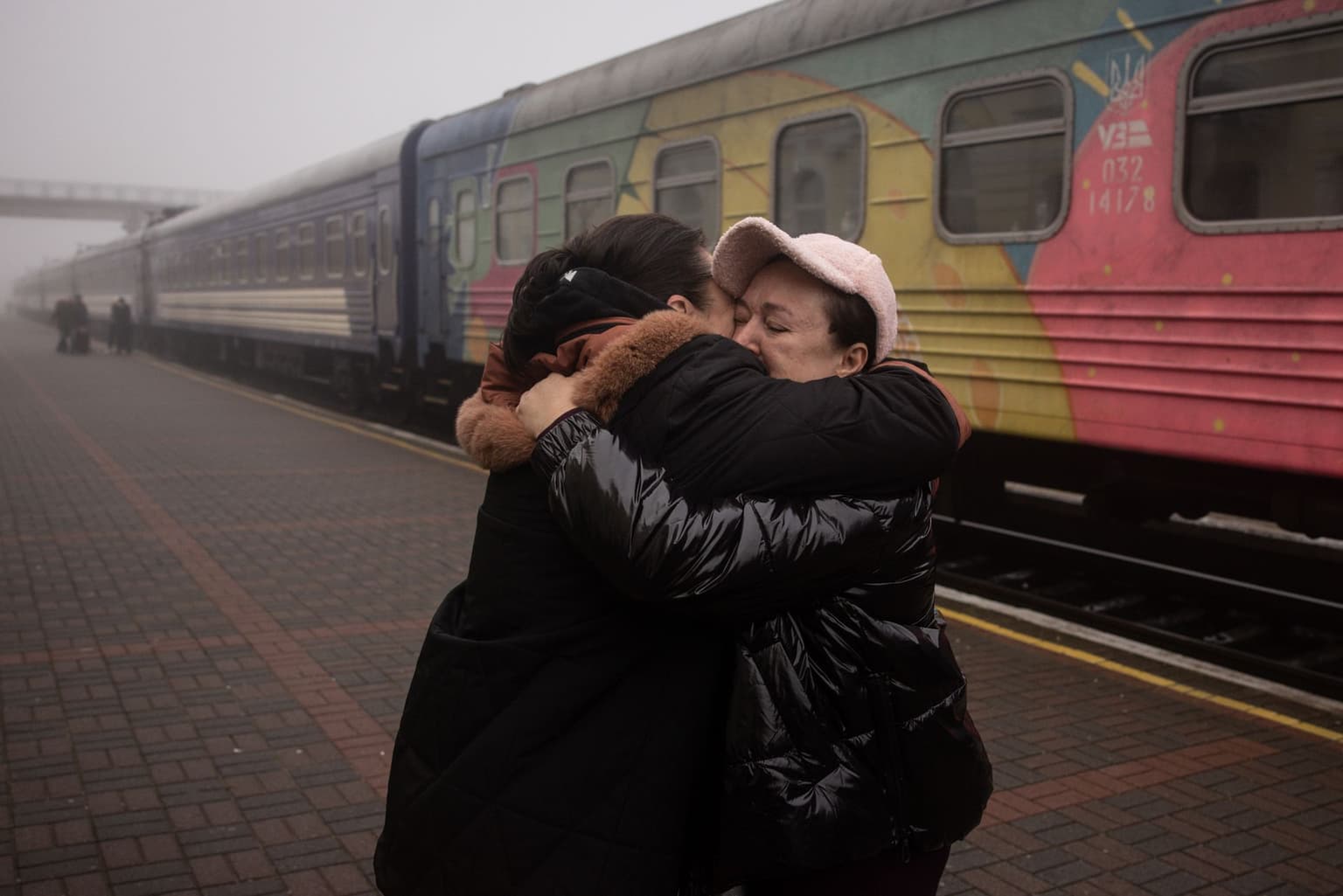
Friends hug after a train arrives in Kherson, Ukraine, on Nov. 21, 2022. (Chris McGrath / Getty Images)
 on Google
Dinara Khalilova
Journalist
Some names have been changed to protect the identities of those featured in the story.
After over two years of full-time reporting on the war in my country, I spent several months with the Reckoning Project, recording testimonies of alleged war crimes.
I focused on forced displacement, deportation, and daily life under occupation, speaking with people who lived under Russian rule — from Crimea's annexation in 2014 to the occupation of parts of Kherson and Kharkiv oblasts in 2022.
Many lost loved ones, homes, and everything they owned. They endured detention, forced transfers, violence, and immense psychological pressure.
But after these conversations, I keep returning to one of the most overlooked and, in my view, cruelest effects of occupation: it deprives people of the right to choose who they are and how they live their lives.
Outsiders often find it hard to understand the Russian occupation in Ukraine.
From afar, occupation may seem like a temporary military event — checkpoints, soldiers, flags replaced with other flags. In practice, occupation is the systematic destruction of human agency.
Everyday decisions are no longer your own: what language your child studies in school, what passport you carry, what news you can read, whether you can access healthcare, keep your property, or even remain with your family.
Under occupation, life stops belonging to you.
"It feels like you're just trapped — like you can't breathe, like you're deprived of communication, of everything, really," says Viktoriia from Kherson Oblast. "They take everything from you, literally everything you have."
Her town was captured on the first day of the full-scale invasion.

She stood in hours-long lines for bread, watched Russian soldiers search her home, take over the company she worked for, and the homes of her neighbors. Friends told her about relatives who had been imprisoned and beaten for unknown reasons, or simply disappeared.
Under occupation, reality becomes dominated by fear. And fear erodes trust. Some people collaborate with Russian authorities and report neighbors they suspect of supporting Ukraine or having ties to Ukrainian forces. Since danger can come from anywhere, people isolate and start to suspect everyone around them. It feels like nowhere, and no one is safe.
Fear, distrust, and confusion make it easier to force a new version of reality on people. The education system is often used to do this, starting with young children.
"They take everything from you."
In occupied areas, schools become tools for political control. Ukrainian language and history are removed or minimized. Children are forced to sing the Russian anthem, learn a rewritten version of history, and take part in militarized "patriotic education."
Since the goal is to erase the very existence of the occupied nation, the deportation and forced transfer of Ukrainian children to Russia exposes this logic in its most extreme form.
Maksym is one of 20,000 Ukrainian children forcibly transferred by Russian forces since the 2022 invasion. Orphaned and with a learning disability, he was 17 when Russian troops occupied his home. Soon after, his college switched to online learning, and he moved out of the student dormitory.
One day, Russian soldiers approached him in a local shop and told him there was an "evacuation" due to ongoing hostilities. He and his older brother were put on a bus heading to a so-called "recreational camp" in Russia, and separated upon arrival.
His legal guardian, Ihor Serdiuk — also the college director — only learned of the transfer when Maksym called him from the camp.
Maksym begged to be brought home, terrified by threats from the camp employees that he would be mobilized into the Russian army once he turned 18. Because he could not travel to Russia to bring the child back himself, Serdiuk turned to the UN and the Ukrainian police for help, but their efforts were unsuccessful.

Maksym remained in Russia. Within a year, he dropped out of school and took Russian citizenship.
Stories like his illustrate how occupation leaves people with choices that are not really choices at all. Take a Russian passport or lose your livelihood. Send your child to a Russian school or lose custody. Cooperate or disappear into detention. Leave your home forever, or stay and survive under rules designed to erase your identity.
Perhaps the most psychologically devastating part is that occupation forces people to constant moral compromise. Not always because they lack principles, but because even survival becomes a political issue.
Some of Viktoriia's former colleagues in Kherson Oblast initially refused to work under the occupation authorities. But as occupation became entrenched and salaries from Kyiv stopped, they accepted jobs under the Russian-installed administration.
Viktoriia was also struggling financially, but her family survived on pensions from her husband's seriously ill parents. The need to care for them was the main reason they stayed. As soon as the relatives died, Viktoriia and her husband left. Now, they live with their daughter's family near Kyiv.
"It builds up. The desire to leave is always there in your mind, but you push it away, because how can you just leave everything behind, how? People have lived their lives, for generations, in one place — how do they just abandon that?" says Viktoriia.
"But life was passing by, and we wanted to live."
Editor's note: The text was created in collaboration with The Reckoning Project, a global team of journalists and lawyers documenting, publicizing, and building cases of atrocity crimes. The opinions expressed in the op-ed section are those of the authors and do not purport to reflect the views of the Kyiv Independent.