Ukraine's Ambassador to US: Why Ukraine celebrates America's 250th too
As the United States marks 250 years of independence, Ukraine reflects on the enduring power of self-government, civic responsibility, and the democratic ideals that unite our nations
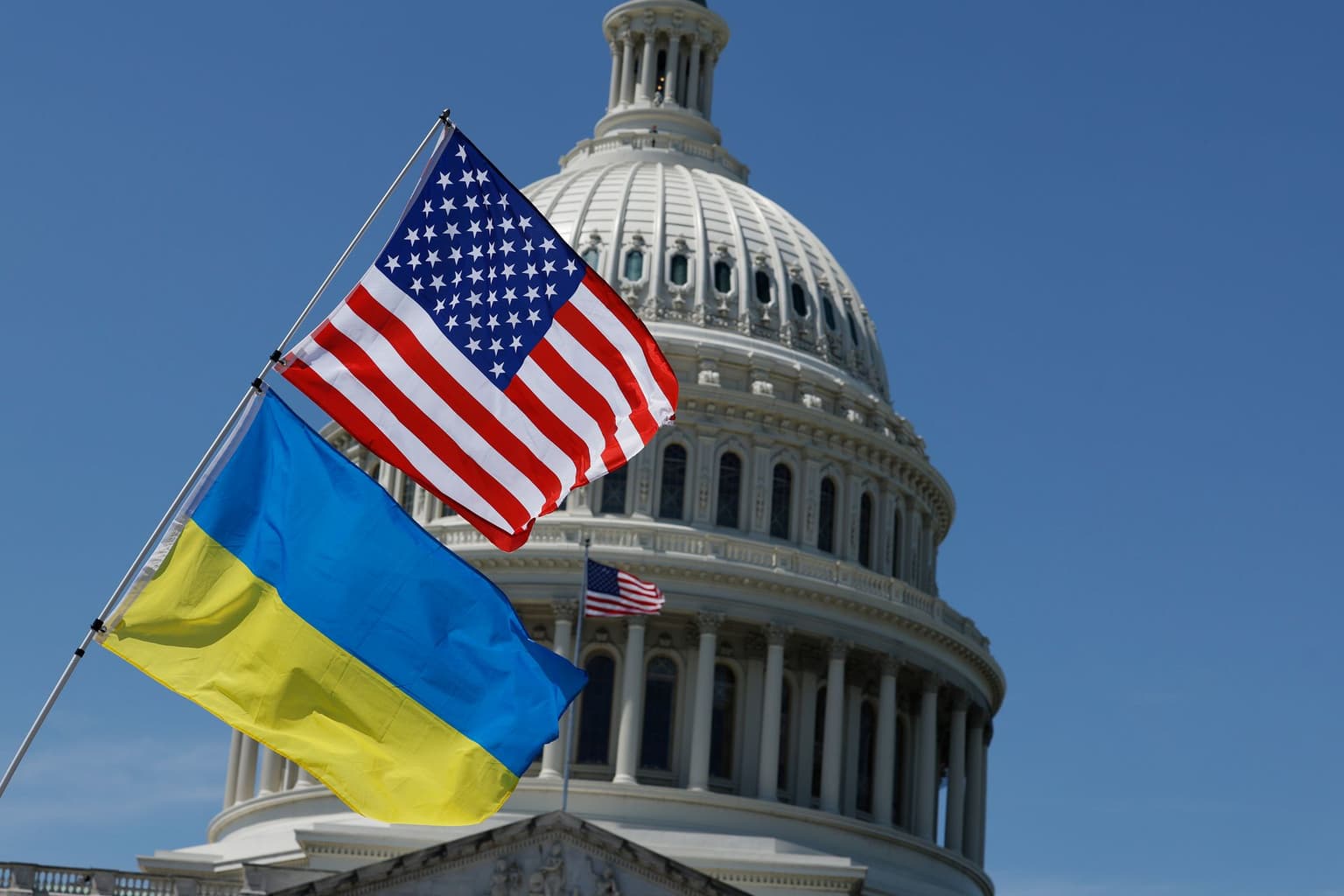
U.S. and Ukrainian flags billow in the wind on the East Front Plaza of the U.S. Capitol in Washington, D.C., U.S., on April 23, 2024. (Anna Moneymaker / Getty Images)
 on Google
Olga Stefanishyna
Ambassador of Ukraine to the United States
There are anniversaries that belong to one nation, and there are anniversaries that remind the world why certain ideas never stop mattering.
America's 250th birthday is both.
For Ukrainians, this celebration is more than an occasion to congratulate a friend, as we honor a country whose founding principles have inspired generations far beyond its shores, including our own. This day is also a chance to express something deeply personal: our gratitude to the American people.
Over the past several years, Americans have opened their homes to Ukrainian families, raised funds for hospitals and schools, organized community drives, sponsored students, welcomed children displaced by war, and reminded millions of Ukrainians that solidarity is not an abstract virtue but a daily choice.
As Ukraine continues its fight for freedom, Americans often ask what keeps our nation going after so many years of war. The answer begins with an idea that Americans know well, for it is one they, too, once fought to defend
"Liberty is not a privilege granted by rulers but an inherent right belonging to every human being."
In 1776, a group of American visionaries made an extraordinary declaration. They asserted that government exists not to rule over people but to derive its legitimacy from them. They affirmed that liberty is not a privilege granted by rulers but an inherent right belonging to every human being. With the Declaration of Independence, Americans forever transformed humanity's understanding of freedom itself.
Ukraine's own history has followed a different path with different experiences and challenges. Yet the aspiration has always been familiar: the determination that a nation should govern itself, choose its own future, and entrust authority to institutions that serve citizens rather than power.

For generations, even when statehood seemed impossibly distant, Ukrainian writers, intellectuals, and community leaders continued to look toward democratic ideas as a source of hope. Among them was Taras Shevchenko, Ukraine's national poet.
Writing under imperial oppression, Shevchenko saw in George Washington more than the founder of another country. "When shall we have our own Washington, with his new and righteous law? We shall have one someday," he wrote, seeing in the American leader the possibility that a nation could be built not on domination but on civic virtue and shared responsibility.
Another remarkable Ukrainian voice, Mariia Hrynchenko, helped introduce Abraham Lincoln to Ukrainian readers, presenting his life as an example of moral leadership grounded in equality, dignity, and perseverance. Long before Ukraine regained its independence, American democratic thought had already become part of our own intellectual conversation.
Every nation writes its own history. But ideas travel beyond borders, and the conviction that people have both the right and the responsibility to build their own futures has always resonated deeply in Ukraine.
Today, we see those ideas becoming reality in the everyday choices of ordinary citizens. Millions of Ukrainians have become volunteers. Teachers organize shelters. Doctors remain with patients under bombardment. Engineers restore electricity within hours after missile attacks. Neighbors collect supplies for soldiers they have never met. None of these people acts because someone orders them to. They act because they believe the country belongs to them.
That instinct may be the strongest foundation any democracy can possess.
This is another reason why Americans have understood Ukraine so profoundly, even before it found expression in their leadership's statements and decisions. Many Americans recognize that freedom survives because ordinary people accept the responsibility of preserving it, and that ordinary people are capable of extraordinary things.
Got an opinion on anything you've read in the Kyiv Independent so far?
and it may appear in our Letters section.

Perhaps that is why the support Ukraine has received has extended so far beyond the reach of official policy — into church basements where congregations gathered winter clothing for Ukrainains, into university halls opened to determined students, into hospitals where doctors shared what they knew, into workshops where businesses donated equipment, into the experience of veterans who offered the guidance, and into the small, careful handwriting of American children, half a world away, who wrote to other children sleeping on the cold floor of bombshelters.
History books have little room to catalog such small, human gestures, and it is true that no single one of them turned the tide of history. And yet, taken together, they were and are the history.
As the United States marks two and a half centuries of independence, its example continues to remind the world that democratic institutions require constant care, that liberty depends upon civic responsibility, and that the most enduring strength of any republic ultimately resides in its people.
History never repeats itself exactly. The challenges facing America today are not the challenges of 1776. Ukraine's path is uniquely our own.
Yet the belief that free people can govern themselves, renew their institutions, and choose hope over fear remains as powerful today as it was 250 years ago.
That belief continues to unite our nations across the ocean, and that is why Ukrainians celebrate this anniversary too. Not because our stories are identical, but because they are connected by a shared conviction that the future belongs to those willing to defend freedom, strengthen it, and pass it forward.
From one nation still fighting for its future to another celebrating the remarkable endurance of its founding ideals, we offer our heartfelt gratitude.
Happy 250th Birthday, America.
Editor's note: The opinions expressed in the op-ed section are those of the authors and do not purport to reflect the views of the Kyiv Independent.