Russia's 160-year war on Ukrainian books
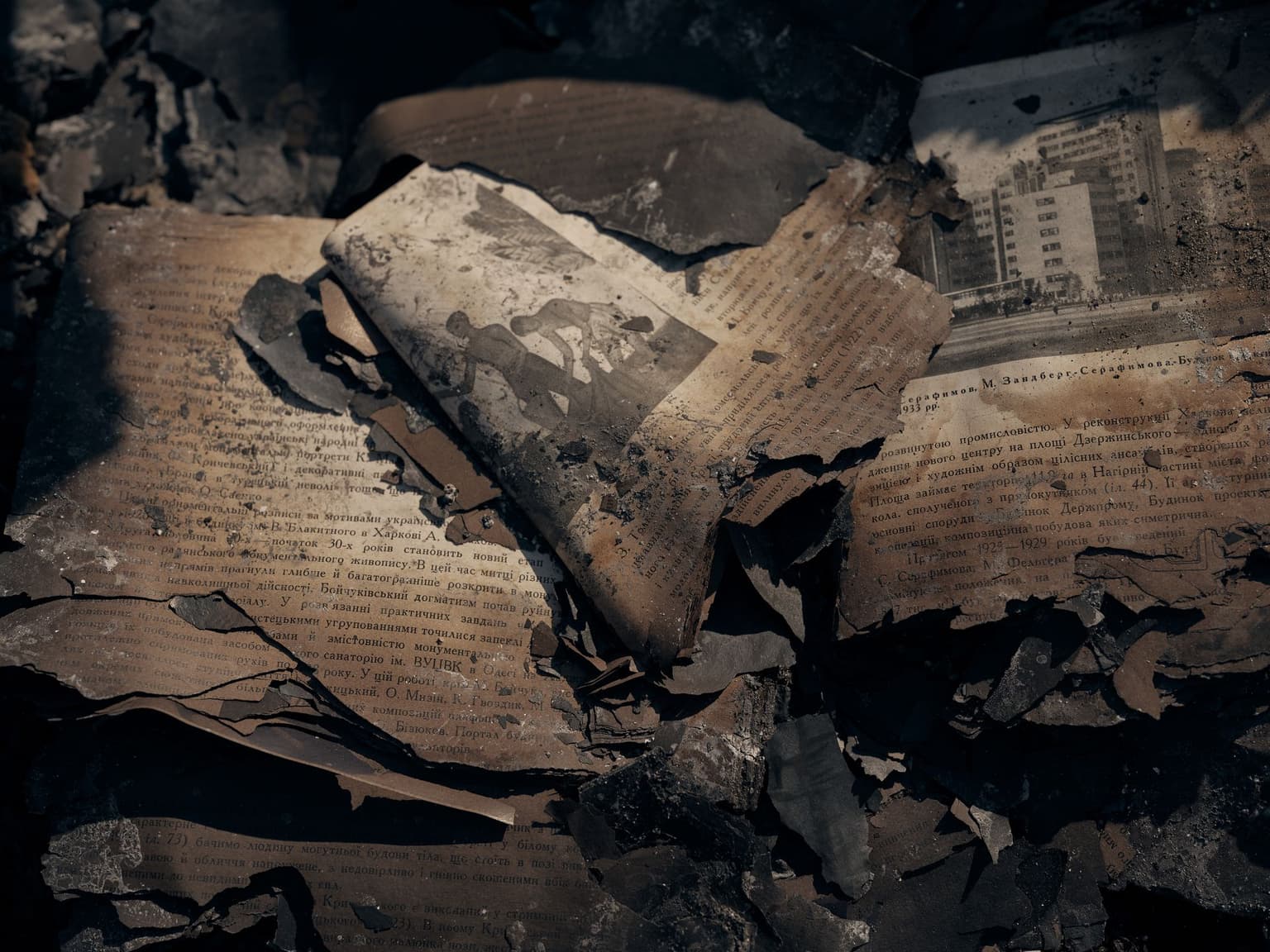
Burned books at the Petrivka book market, following a Russian missile and drone attack in Kyiv, Ukraine, on Aug. 16, 2026. (Kostiantyn Liberov / Libkos / Getty Images)
 on Google
Pauline Foret
Lecturer at the Kyiv School of Economics
"The first step in liquidating a people is to erase its memory. Destroy its books, its culture, its history", said the historian Milan Hubl in Milan Kundera's The Book of Laughter and Forgetting.
To destroy a man, first destroy his culture: this idea is neither new nor particularly singular.
It was this very idea that prompted the creation of the Hague Convention in 1954, to protect cultural heritage during armed conflicts, after the Nazi regime burned and destroyed innumerable works of art in an attempt to "free" Europe from what they considered “degenerate art”.
Cultural destruction has, however, taken on a new scale with Russia's war against Ukraine. In August alone, according to the BBC, Russian strikes on printing presses and publishing companies destroyed more than 12 million books, as well as 10% of the country's school textbooks.
According to Ukrainian media, more than a third of all books printed this year were reduced to dust.
Ukrainian printers refuse to give in, though. Their calls to buy books from targeted publishers multiply on social media, and, as is often the case when their culture is in danger, many Ukrainians rallied to their cries.
It is, after all, far from their first attempt to protect their art, culture, and language from Muscovite oppression.
As early as the nineteenth century, as the territory of what is now Ukraine was mostly divided between the Habsburg and Russian empires, the authorities had already understood that the only way to sap Ukrainian independence movements was to muzzle their cultural production.
In 1863, the Russian imperial Interior minister, Pyotr Valuyev, forbade the use of the Ukrainian language in educational and religious publications.
About 13 years later, after a "special conference for the prevention of ukrainophile propaganda," the czar Alexander II imposed a total ban on any Ukrainian-language publication. The "Ems Ukaz," though it was a near-fatal blow to local culture, did not, however, completely prevent the smuggling of Ukrainian books across the empire.
Later, after the Russian revolutions and the creation of the Soviet state, an entire generation of Ukrainian writers and intellectuals was executed or deported, and their works destroyed.
Les Kurbas, Valerian Pidmohylnyi, and Mykola Zerov, known today as the "Executed Renaissance," were all executed on the same day in a forest in Russian Karelia, alongside hundreds of other prisoners from the Solovki camp.

After this operation, of the 259 Ukrainian authors who had been published in 1930, only about 30 were able to continue writing.
Under Brezhnev's rule, repression took a less spectacular shape than these summary executions, but one just as systematic.
A russification campaign was launched, especially in the East and the South of the country, forcing schools to only provide classes in Russian and forbidding history books focusing on Ukrainian independence.
Soviet libraries had special archives for "nationalist" works, keeping them away from the public eye and replacing them with Kremlin-approved books.
Authors who opposed this repression, such as Vasyl Stus or Ivan Dziuba, were arrested and deported at the beginning of the 1970s. The poet Stus died on the night of September 3 to 4, 1985, merely six years before the independence of the country he loved so dearly, in the Siberian camp of Perm-36.
Neither Brezhnev, nor Stalin, nor Alexander II can claim to have destroyed several million books in a few weeks.
If the scale and violence of this destruction are unprecedented, however, Moscow's willingness to destroy Ukrainian culture at any cost is clearly not.
Nearly 2,000 schools in Ukraine's occupied territories, teaching more than 580,000 children, now operate entirely under Russian curricula; since December 2025, the Ukrainian language has been removed as a subject altogether under Russia's own federal education standards, while a new "History of the Region" module tells these children that the land they live on was always Russian.

It is Valuyev's ban and Brezhnev's russified classrooms all over again.
In the face of the technological advancements that allow Russia to attain such levels of destruction, cultural resistance seems to be the only sensible, if emotionally straining, answer.
Both the Russian Empire and the Soviet Union thought they could destroy Ukrainian identity by promulgating laws or deporting people to the Gulag; their failure was crystallized by the raising of the blue-and-yellow flag on the Kyiv municipal council in July 1990.
Today, Russia seeks to accomplish with ballistic missiles what its predecessors failed to obtain with legal oppression and deportations. We must ensure that, by burning Ukrainian books, Moscow only reminds the world how valuable they are.
Preserving Ukrainian history means talking about these relentless attacks, buying Ukrainian books, and reading about the fates of Vasyl Stus or Valerian Pidmohylnyi. Though they may seem like small actions, they will ensure neither the memory nor the people of Ukraine will, as Hubl feared in Kunder's telling, be "liquidated."
Editor's note: The opinions expressed in the op-ed section are those of the authors and do not purport to reflect the views of the Kyiv Independent.