Explainer: Russia disrupts Ukraine peace talks with timed false accusations
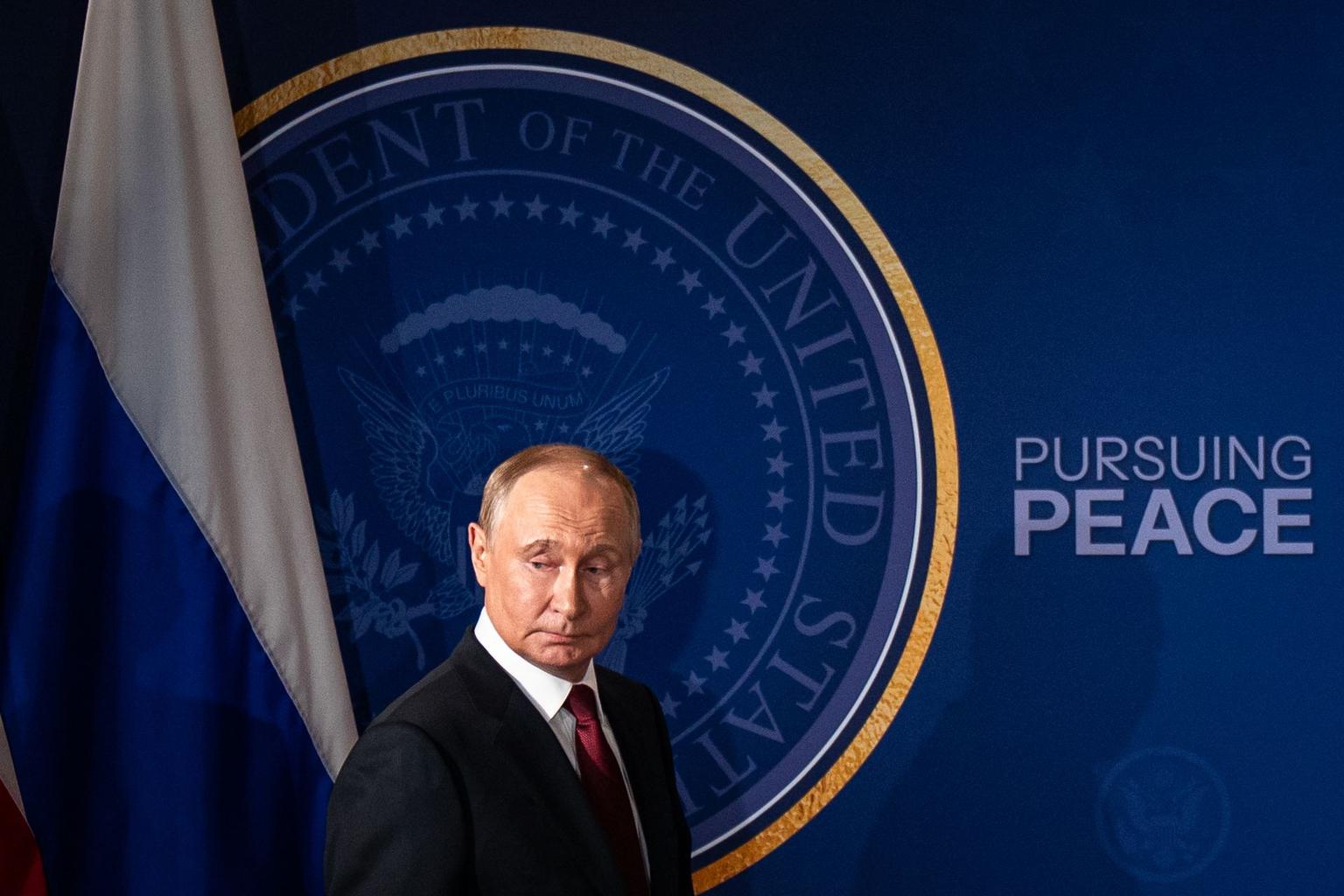
Russian President Vladimir Putin in Anchorage, Alaska, on Aug. 15, 2025. (Al Drago/Bloomberg via Getty Images)
 on Google
Every time negotiations between Russia, Ukraine, and the U.S. appear to gain momentum, Moscow introduces a new allegation — drone attacks, assassination attempts, nuclear plots, sabotage — that threatens to stall or derail the process.
Ukrainian officials and Western analysts say the pattern is no coincidence.
A high-level Ukrainian official familiar with the course of the negotiations told the Kyiv Independent that the "nonsense" Russia is spreading is intended to influence the talks and divert attention from Moscow’s unwillingness to seek compromise.
As Russian negotiators show little flexibility on concessions, the Kremlin appears to weaponize the diplomatic track — testing Washington's reactions, seeking leverage, and undermining Kyiv's credibility.
Drones over Valdai
The first major rupture came late last year.
After Washington pressed Kyiv in November to accept an unfavorable draft settlement, Ukrainian officials spent more than a month renegotiating key provisions.
By late December, President Volodymyr Zelensky and U.S. President Donald Trump had publicly suggested that roughly 95% of the revised peace framework was agreed, with the fate of Donbas remaining unresolved.
Then, Russian President Vladimir Putin called Trump.
Hours before the call on Dec. 29, Russian Foreign Minister Sergey Lavrov alleged that 91 Ukrainian drones had targeted Putin's state residence near Valdai, Novgorod Oblast. Lavrov warned that Moscow would "review" its position in negotiations in light of the alleged attack.
The timing was striking. The claim followed high-level Zelensky-Trump talks in Florida on Dec. 28 that appeared to move the process forward.

Residents of Valdai later told independent Russian media they had neither seen drones nor received air raid alerts. Zelensky dismissed the allegation as a "lie," suggesting Moscow sought to justify slowing or abandoning negotiations.
Trump initially appeared rattled.
"I don't like it. It's not good. You know who told me about it? President Putin told me about it … I was very angry about it," he said on Dec. 29.
When pressed on the source, Trump hesitated: "You're saying maybe the attack didn't take place? That's possible. But President Putin told me it did."
After U.S. intelligence briefings, Trump publicly walked back his reaction. Still, Moscow soon signaled dissatisfaction with the revised peace draft — and momentum faded.
Shooting in Moscow
Another disruption followed more than a month later.
Russian Lieutenant General Vladimir Alekseev was shot multiple times in Moscow on Feb. 6 by an unidentified assailant. Lavrov quickly blamed Kyiv, accusing Zelensky of "provocations aimed at destabilizing the negotiation process."
Kyiv denied involvement. A senior Ukrainian official told the Kyiv Independent on the day of the shooting that Ukraine had nothing to do with it.
The episode carried institutional weight.
Alekseev's superior, Admiral Igor Kostyukov — head of Russia's military intelligence (GRU) — had just participated in talks with U.S. and Ukrainian officials in Abu Dhabi. The next round, agreed upon on Feb. 5, was set to tackle the most sensitive issue: territory.
From Moscow's security hierarchy, Alekseev was not peripheral. He had helped lead 2022 negotiations surrounding the surrender of Ukrainian troops in Mariupol and was widely regarded as a trusted figure within the GRU, overseeing foreign operations.

He was under U.S. sanctions for Russia's interference in the 2016 U.S. election and sanctioned by the European Union over the 2018 Novichok poisoning of Sergei and Yulia Skripal in the United Kingdom.
The shooting occurred just a day after the Abu Dhabi talks concluded. The media outlet Ukrainska Pravda reported on Feb. 23, citing undisclosed sources, that negotiations nearly collapsed afterward.
After that, Moscow reshuffled its delegation.
Presidential aide Vladimir Medinsky replaced Kostyukov, Alekseev's boss, as chief negotiator, although Kostyukov remained involved in a reduced capacity.
Ukrainian officials had previously described Medinsky as a hard-liner who framed talks through ideological narratives rather than compromise.
Lavrov's escalation
Lavrov then took center stage.
From Feb. 9 to Feb. 11, he publicly undercut optimism surrounding the next round of talks scheduled for Feb. 17–18. His message was consistent: Russia's territorial and political demands remained intact amid all the accusations against Kyiv.
He repeatedly referenced what he called the "Anchorage agreements" allegedly reached between Putin and Trump during their 2025 summit in Alaska — understandings that, in Moscow's telling, envisioned Ukraine surrendering territory without further fighting.
Lavrov also dismissed a revised 20-point U.S.-Ukraine peace framework developed in December, after which allegations of drones over Putin's residence surfaced.
"All subsequent (peace plan) versions are the result of an attempt by Zelensky and (Europe) to override the American initiative," he said. "Now they are waving around some kind of document with 20 points, which no one has given us."
Lavrov's claim was dubious. Bloomberg reported that the 20-point plan was delivered to Putin in early January via Russian envoy Kirill Dmitriev, with U.S. Special Envoy Steve Witkoff later visiting Moscow to discuss it directly with him.
The Russian foreign minister also cautioned against what he described as "some kind of enthusiastic perception" of progress.
"Negotiations are continuing… there is still a long way to go," he said — contradicting Trump's claim just days before that the sides were "closer than ever before."

Nuclear accusations, pipeline threats
Just before another planned round of talks, Moscow escalated again.
Russia's Foreign Intelligence Service said on Feb. 24 that France and the United Kingdom were working to provide Ukraine with nuclear weapons to secure more favorable negotiating terms.
Ukraine relinquished its Soviet-era nuclear arsenal under the 1994 Budapest Memorandum and has repeatedly denied any intention to reacquire nuclear weapons.
Senior Kremlin aide Yuri Ushakov said the alleged plans would influence Moscow's position in negotiations and that Washington would be briefed.
Two senior U.K. officials told the Kyiv Independent the claim was false, while Zelensky dismissed it as "political pressure."
"Usually, when Russia fails to win on the battlefield, it starts looking for nuclear weapons on Ukrainian territory," the Ukrainian president said.

The same day, Putin claimed intelligence about possible sabotage of the TurkStream and Blue Stream gas pipelines, warning such actions could derail peace efforts.
He accused Ukraine of "individual and mass terror" despite Russia's own sustained strikes on Ukraine's civilian infrastructure, including energy systems.
The allegations surfaced just before a tentative Feb. 26–27 new round of peace talks, later postponed to early March, according to Zelensky.
A pattern, not a coincidence
Analysts see a strategy behind the sequence.
Daniel Fried, former U.S. ambassador to Poland, said the moves appear designed to create Western divisions and justification for further Russian escalation.
At the same time, Fried noted the weakness of the claims may signal "Kremlin haste and even nervousness" about stronger security coordination between Ukraine, the U.K., and France.
Iuliia Osmolovska, head of the Slovak think-tank GLOBSEC's Kyiv office, said Moscow seeks to manipulate the negotiation narrative and shift American perceptions.
"Russia needs to create something that would turn Americans leaning more to the Russian position in negotiations, and to cause disappointment in Ukraine."
She also sees an effort to drive wedges between Washington and Europe, reinforcing Europe's exclusion from core peace negotiations.
Orysia Lutsevych, deputy director of the Russia and Eurasia Program at Chatham House, argued the messaging serves domestic purposes as well.
"(Russia's aim is) to vilify Europe, mainly the United Kingdom and France, and to demonstrate that Russia is not fighting Ukraine, but the West," she added.
The broader objective, analysts suggest, may not be to abandon negotiations outright — but to control their tempo, reshape their framing, and ensure that any breakdown can be blamed on someone else.
Each allegation serves multiple purposes: testing Trump's reactions, undermining Kyiv's credibility, creating justification for Russian intransigence, and maintaining the narrative that Moscow is the reasonable party seeking peace while Ukraine and its European backers sabotage progress.
The pattern is clear — and it's working.