Historic election ousts Hungary's Orban after 16 years in power
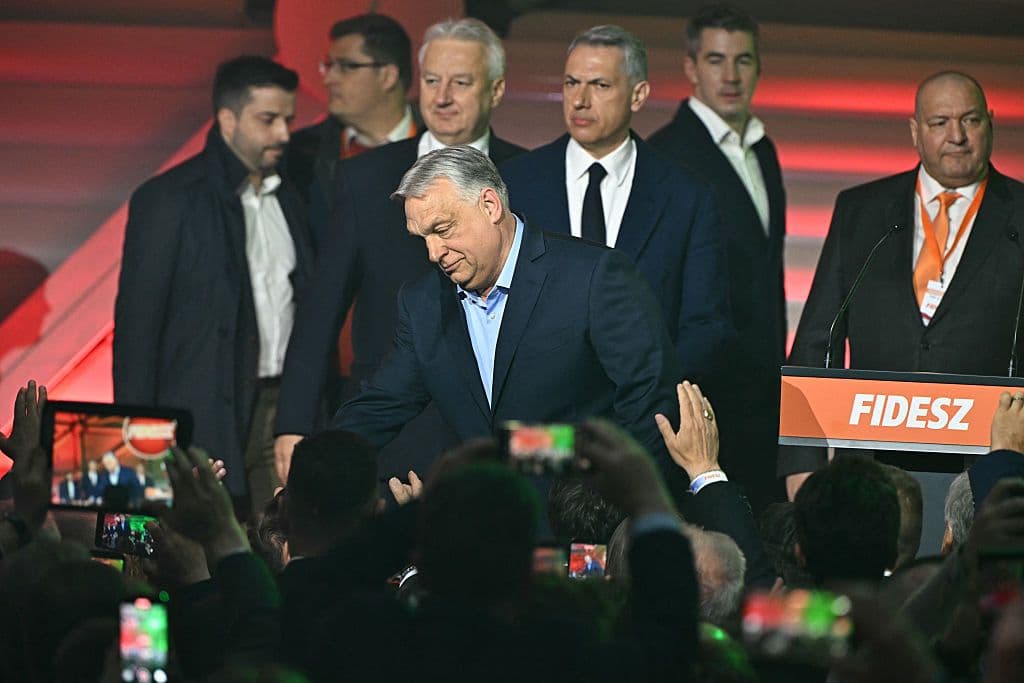
Hungary's Prime Minister Viktor Orban greets supporters at the Balna centre in Budapest during a general election in Hungary, on April 12, 2026. (Attila Kisbenedek /AFP via Getty Images)
 on Google
Editor's note: This story is being updated with the latest turnout figures and election developments.
Hungarian Prime Minister Viktor Orban's 16-year rule over Hungary came to an end on April 12 in a historic election marked by record-breaking turnout.
The election results are "painful for us, but clear," Orban said in a brief concession speech Sunday night.
"The responsibility for and the opportunity to govern were not given to us," he said.
Opposition leader Peter Magyar reported shortly before Orban's speech that the prime minister had phoned to congratulate him on the victory.
While the final tally is still being determined, results show Magyar's Tisza party winning a landslide victory over Orban. With 95% of the votes processed, Tisza is on track to win 137 seats in the country's 199-seat parliament — a 2/3 supermajority.
Record turnout marked Hungary's parliamentary election, with nearly 80% participation nationwide — topping voter turnout levels of all previous parliamentary elections. Magyar hailed the unprecedented turnout as a "celebration of democracy."
"All Hungarians feel in their hearts that this is a wonderful common victory," Magyar said in his victory speech.
"A victory because our country has decided and wants to live again. It wants to be a European country again. It wants to be a country that is not dependent on anyone," Magyar said, alluding to perceived Russian influence over Orban's government.
Meanwhile, election watchdogs reported allegations of vote-buying and organized voter transportation in several cities.
The high-stakes vote, which has ended Orban's 16-year grip on power, could shape Hungary's future relationship with the European Union and Russia.


Record turnout
Voter turnout hit historic levels as Hungarians cast their ballots on April 12. The parliamentary election saw more voters take to the polls than in any previous national parliamentary vote, reaching over 77% participation by the time polls closed at 7 p.m. CEST.
The trend was evident by the morning. As of 11 a.m. CEST, voter turnout stood at 37.98%, the highest level ever recorded by that hour and about 12 percentage points higher than in 2022 (25.77%), according to the National Election Office of Hungary.
Turnout in earlier elections was lower, including 29.93% in 2018, 23.23% in 2014, and 24.78% in 2010. The record trend continued throughout the day, with turnout reaching 54.14% by noon, significantly higher than the 40.01% recorded at midday in the 2022 elections.
By 5 p.m., voter turnout nationwide had climbed to over 70% — already surpassing the final count of any previous parliamentary election in Hungary.
Polls opened at 6 a.m. and closed at 7 p.m. local time, with a recorded turnout of 77.8% — over 7.5 million voters.

Magyar praised the record-breaking turnout, hailing it as a democratic achievement.
"This has become, and will be, a celebration of democracy," he said.
The historic election was also characterized by reports of misconduct. At about noon CEST, Hungarian election watchdog Tiszta Szavazas said it had received allegations of organized voter transportation and vote-buying in Debrecen, Pecs, and Kemecse.
"In Dabas, money was reportedly distributed in front of a polling station in the morning, while in Debrecen, chairs bearing the Fidesz logo were placed in the courtyard of a polling station, which is clearly against the rules," the statement said.
The watchdog shared updates of reported suspicious conduct throughout the day, including allegations that Tisza sympathizers at a Hungarian prison were barred from voting and that Fidesz organizers distributed possible bribes at polling stations.
Fidesz officials, meanwhile, accused the Tisza party of aggressive behavior at the polls.

With over 90% of the votes processed, Tisza leads Fidesz by a sweeping margin, on track to win a 138-seat supermajority in Hungary's 199-seat parliament.
Polls conducted shortly before the election also predicted a clear victory for the opposition Tisza party. A 21 Kutatokozpont poll for Telex forecasted that Tisza would win 55% of the vote, with the Fidesz-KDNP coalition taking 38%, Mi Hazank at 5%, DK 1%, and MKKP 1%. These results would garner Tisza up to 132 seats in parliament.
Another poll, conducted by Median, showed Tisza winning 135 seats.

'Hungary has chosen Europe'
European leaders welcomed Magyar's win as a victory for Europe and for democracy.
"Hungary has chosen Europe," European Commission President Ursula von der Leyen wrote on X. "Europe has always chosen Hungary. Together, we are stronger."
French President Emmanuel Macron called the election "a victory of democratic participation, of the Hungarian people's attachment to the values of the European Union, and for Hungary in Europe."
German Chancellor Friedrich Merz also congratulated Magyar and the prospects of stronger European cooperation, saying: "I look forward to the cooperation for a strong, secure, and above all united Europe."
Congratulations flooded in from across the European Union, with officials from the European Parliament, Sweden, the Baltic states, and countries throughout the bloc expressing optimism about a new chapter in Hungary-EU relations.
"I look forward to working with you on advancing common European interests and values," Latvia's Prime Minister Evika Selina wrote.
President Volodymyr Zelensky also publicly congratulated Magyar.
"It is important when a constructive approach prevails," he said on social media.
"Ukraine has always sought good-neighborly relations with everyone in Europe, and we are ready to develop cooperation with Hungary."
Slovak Prime Minister Robert Fico, Orban's closest political ally within the EU, said in a post on X that he "acknowledge(d) the decision of the citizens of Hungary," adding that he was "ready for intensive cooperation with the new Hungarian Prime Minister," whom he congratulated.


End of the Orban era
Hungarian Prime Minister Viktor Orban, who has led Hungary for 16 years with his Fidesz party, knew he faced a strong challenge from the opposition Tisza party, led by Magyar. Both leaders arrived at separate polling stations in Budapest around the same time to cast their votes.
Fidesz, widely described by critics as far-right and illiberal, has been in power since 2010. Over the past 16 years, Orban and his party have overseen what many observers describe as democratic backsliding in Hungary.
The Hungarian leader has also wielded his country's veto in the EU to block a 90 billion-euro ($105.5 billion) loan for Ukraine and the opening of negotiations on Kyiv's accession to the bloc.
Meanwhile, Tisza has criticized the government's tilt toward Russia and pledged to repair relations with European partners. The opposition has united around Magyar, who has promised to fight corruption and restore ties with the EU and NATO.

The war in Ukraine has been front-and-center in Fidesz's campaign, with images of Ukrainian President Volodymyr Zelensky alongside Magyar plastered across the country in the lead up to the polls.
"The most important thing is for there to be peace in Ukraine, starting with a ceasefire," said Balazs Kovacs, Fidesz candidate for an inner-city electorate.
"The Ukrainian people deserve not to be killed, as do the Russian people. These two Slavic nations are killing each other completely senselessly. This isn't in anyone's interest except for globalist capital and Western arms manufacturers."
Speaking to reporters outside after casting his ballot, Orban was asked by the Kyiv Independent if, in the place of Zelensky, he would hand over territory into Russian occupation.
"I'm lucky enough not to be Zelensky," he said, looking away quickly.
As the prime minister left the polling place, young Hungarians from the AHang civil society group played Red Army Choir music on speakers in protest of Fidesz's close ties to Moscow.
"If today we don't have regime change, and we don't have a party that wants to stay in the European Union, then Hungary will be on the path of Russia," said protestor Jozsef Gajzago.
"We knew that the Hungarian Prime Minister and foreign minister are in good relations with the Russians, but the recordings show that this is more than diplomatic relations, Orban and Szijjarto are basically people of the Russian government and puppets of Putin."
Dmitry Peskov, the spokesperson for Russian President Vladimir Putin, said on April 13 that Moscow is counting on the continuation of "pragmatic contacts" with Budapest.
"The Hungarians made their choice. We respect this choice," he said.